Six Thousand Plastic Spikes! The Acupressure Mat, the Relaxation Response, and the Trial That Compared It to Just Lying Down
The spiked mat is wellness social media's favorite torture device. The underlying technique — acupressure — has real trial support for pain and sleep; the mat itself has one controlled trial, and the mat lost to simply lying down.
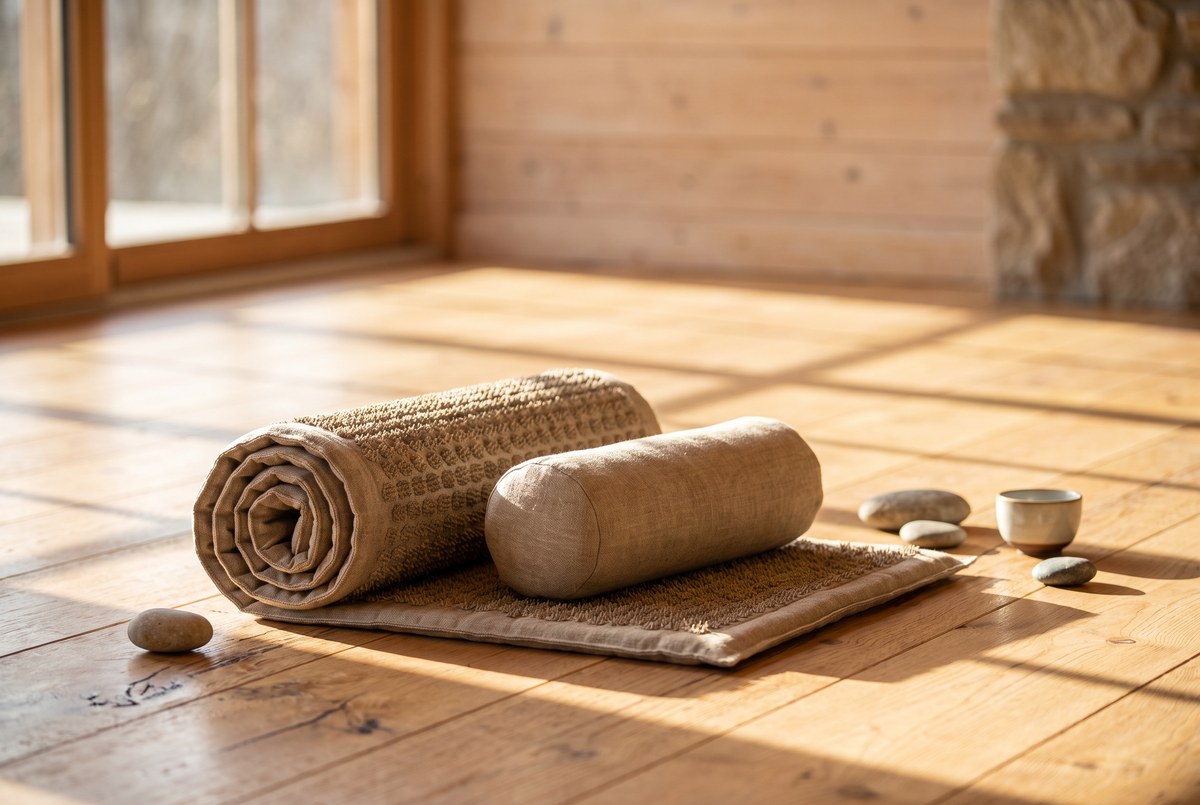
Thunk — that's the sound of a body lowering itself onto thousands of hard plastic points, shirt off, jaw clenched, phone propped to film the ordeal! The acupressure mat — spike mat, 'mechanical needle-stimulation pad,' bed-of-nails-for-wellness — is all over the recovery corners of the internet: back pain, sleep, stress, enlightenment, twenty minutes at a time. The promise is big. The plastic is hard. The evidence is a fork in the road, and which prong you land on depends entirely on one distinction.
Here it is, the whole ballgame: acupressure the technique has a real clinical literature; the mat the object has almost none. The precise question — does lying on spikes deliver what acupressure trials suggest? — gets its most defensible answer from a single controlled trial, and that answer was: no better than just lying down.
First prong: the technique has real trials
Acupressure — manual pressure on defined body points, no needles — has randomized evidence worth respecting. A 2019 randomized controlled pilot trial in Pain Medicine tested self-administered acupressure for chronic low back pain. A 2017 randomized controlled trial in Arthritis Care & Research tested self-acupressure in older adults with symptomatic knee osteoarthritis, and a 2024 randomized clinical trial in JAMA Network Open did the same for probable knee osteoarthritis in middle-aged and older adults. A 2016 systematic review and meta-analysis in Sleep Medicine Reviews examined acupressure's effect on sleep quality; a 2017 meta-analysis covered auricular acupressure for chronic low back pain. Across this literature, the technique is associated with modest improvements in chronic low back and knee-osteoarthritis pain, sleep quality, cancer-related fatigue, and anxiety — with better sleep and quality of life in meta-analyses of older adults, and a favorable safety profile throughout.
Second prong: the mat itself, tested once, null
Now the spike mat. Small studies suggest it can lower perceived stress and ease muscle tension — the proposed mechanisms being stimulation of cutaneous pressure and pain receptors, increased local blood flow, endorphin release. But the one controlled trial of regular mat use found it lowered subjective stress no more than simply lying down and relaxing, with no measurable change in blood pressure, heart rate, or pain thresholds. Sit with that. The relaxation is real; the attribution to the spikes is not. Reviewers repeatedly note high risk of bias, heterogeneity, and possible placebo effects across this whole space.
The honest synthesis
On balance, the mat appears low-risk and may offer short-term relief of tension, pain, or stress — partly because lying still and breathing for twenty minutes is genuinely good for those things. It is not a substitute for medical treatment, and it is generally not advised for people who are pregnant or who have thin skin, bleeding disorders, or poor circulation. If a mat session helps you unwind, the benefit is real even if the mechanism is mostly rest. And nothing in this literature speaks to longevity at all — the mat is a comfort device, not an aging intervention.
What a reader should take from this
Buy it, if you like, as a relaxation prop with a dramatic texture — not as an acupoint delivery system with proven physiology. The technique's trial record belongs to fingers and trained pressure, not to injection-molded plastic. Chronic pain deserves a clinician; a stiff evening deserves whatever gets you horizontal.
The mat goes back in the closet, spikes up, quietly unbothered by the verdict. The person who lay on it is calmer than before — and the trial says the floor alone might have managed that. Twenty minutes of stillness, it turns out, was the active ingredient all along.
Educational, not medical advice.
The takeaway
Randomized trials and meta-analyses support acupressure itself for modest improvements in back and knee pain, sleep, fatigue, and anxiety — but the one controlled trial of the physical spike mat found it lowered stress no more than lying down, with no change in blood pressure, heart rate, or pain thresholds.
References
5 peer-reviewed sources, published 2016–2024, across 5 journals. 1 of them has a full Magellan study write-up linked below.
- Pain Med · 2019 · PMID 31237610 · DOI 10.1093/pm/pnz138Self-administered acupressure shows promise for reducing pain and fatigue in people with chronic low back pain. Read our full write-up →
- JAMA Netw Open · 2024 · PMID 38639940 · DOI 10.1001/jamanetworkopen.2024.5830
- Arthritis Care Res (Hoboken) · 2017 · PMID 28437570 · DOI 10.1002/acr.23262
- Sleep Med Rev · 2016 · PMID 28089414 · DOI 10.1016/j.smrv.2016.12.004
- Evid Based Complement Alternat Med · 2017 · PMID 28804504 · DOI 10.1155/2017/6383649
Mechanisms and molecules in this article
Each links to its Magellan monograph — what it is, what it does, and the studies behind it.
Related reading
Breathing is the last thing most people think to train — until a climbing blood-pressure reading makes the…
The peptide is promoted online for tendon, ligament, muscle, bone, and gut healing. Nearly all of that…
A small one-hour immersion experiment measured dopamine in blood. It did not demonstrate a 250% rise in…
All Magellan articles → · More on Recovery, Sauna & Light Therapy →
Prefer the interactive version? Open this article inside the Magellan app →