Blood Pressure: What Actually Moves the Number
Home monitoring earns its effect only when the readings feed decisions; on its own it moved pressure a statistically meaningless 1 mm Hg. What does move the number, in randomized trials: DASH eating (−5.5 to −11.4), added potassium, weight loss at about 1 mm Hg per kilogram, and, at the top of a 270-trial ranking, the isometric wall squat.
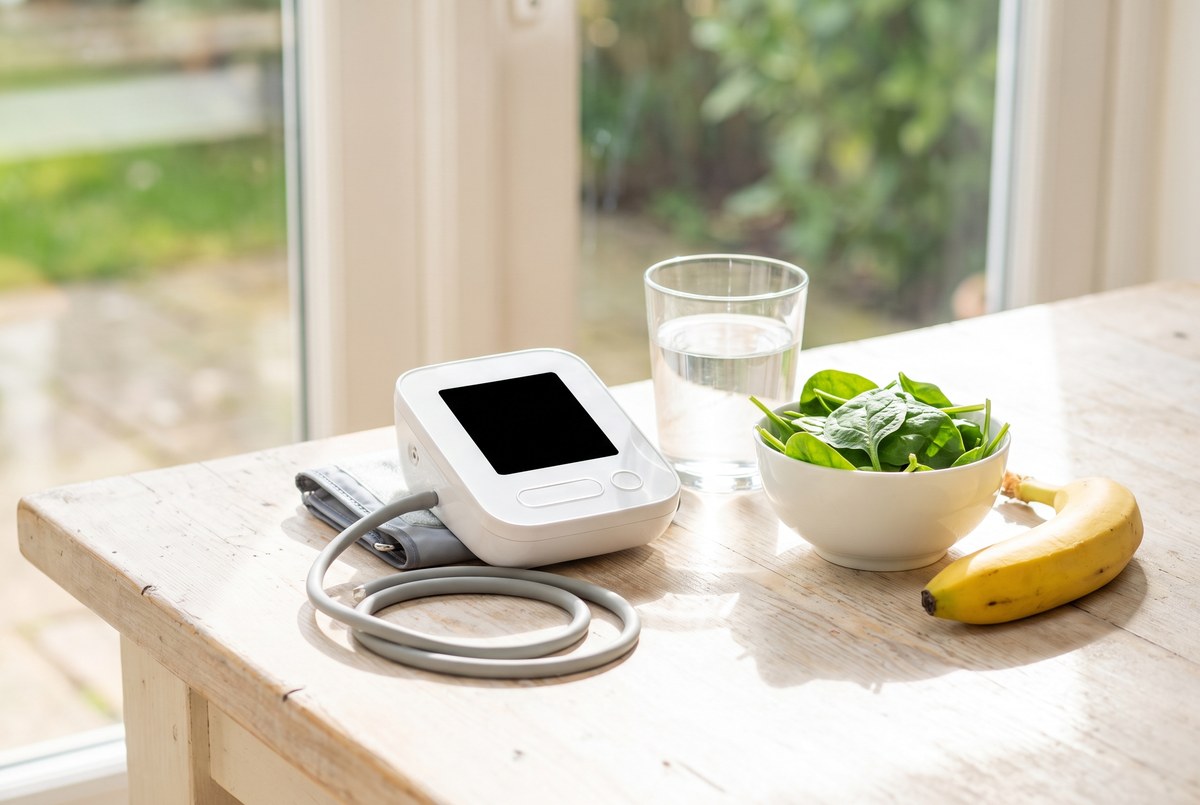
There is a particular kind of quiet madness in trying to learn one's own blood pressure. The pharmacy machine says one thing after a walk over with the groceries; the doctor's office says another, higher, always somehow higher, the cuff going on while the patient is still mid-sentence about parking; the drugstore cuff at home says a third on Tuesday morning and a fourth on Tuesday night. At some point a reasonable person begins to wonder whether the number is a fact about the body at all, or merely a fact about the last five minutes. The evidence suggests a steadier way of holding the question. Blood pressure is not a secret constant waiting to be discovered; it is a moving physiological signal, and the two questions that matter are how to measure it so the signal means something, and what has been shown, in randomized trials, with numbers attached, to move it.
Both questions turn out to have unusually good answers. Blood pressure may be the single most trial-tested number in preventive medicine, and the trials disagree with folk wisdom in specific, useful ways: the home cuff by itself turns out to do approximately nothing, the most effective exercise for the number is not cardio, potassium moved pressure roughly as much as a single sodium step down, and the eating pattern that beat everything was tested with salt deliberately held still.
One boundary belongs ahead of the numbers, because this page sits close to medicine. Everything below is a report of what randomized trials measured, in whom, with the caveats the investigators themselves attached. Treatment decisions, medication changes and target-setting are clinician territory; several of these trials produced their results precisely because a physician was in the loop acting on the data. The useful thing an article can do is put the trial arithmetic in one place.
Why the number is worth moving at all
The cleanest modern demonstration is SPRINT, which randomized 9,361 adults with systolic pressure of 130 mm Hg or higher and elevated cardiovascular risk, though no diabetes, to one of two treatment targets: below 120, or below 140. The groups separated to mean systolic pressures of 121.4 versus 136.2 within a year. The trial was stopped early, at a median of 3.26 years, because the lower-target group was doing measurably better. Major cardiovascular events (myocardial infarction, other acute coronary syndromes, stroke, heart failure, or cardiovascular death) ran 1.65 percent per year against 2.19 percent, a hazard ratio of 0.75, and all-cause mortality was 27 percent lower, at a hazard ratio of 0.73. In absolute terms, by simple arithmetic on those event rates, that is about five fewer major events per 1,000 people per year.
SPRINT also kept honest books on the cost side. Serious adverse events of hypotension, syncope, electrolyte abnormalities, and acute kidney injury or failure were all more frequent in the intensive group, though injurious falls, notably, were not. The trial concerns medication targets set by physicians, not self-management, and nothing here is a target recommendation. What SPRINT establishes for present purposes is simpler: a roughly 15-point difference in systolic pressure, sustained for about three years, was worth a quarter fewer cardiovascular events in this high-risk population. A number with that much riding on it deserves an accounting of what is known to move it, which is the work of the rest of this page.
The cuff is an instrument, not an intervention
The place to begin is a result that deserves to be printed on the box of every home monitor. An individual-patient-data meta-analysis — 2,846 articles screened, 36 eligible trials, and authors of 25 of them (including one unpublished study) contributing raw participant data, 7,138 analyzed for the primary outcome — found that overall, self-monitoring lowered clinic systolic pressure by 3.2 mm Hg at 12 months compared with usual care. That average concealed the entire story. Self-monitoring alone, the cuff bought and the readings taken and nothing further, moved the number by a statistically indistinguishable 1.0 mm Hg. Self-monitoring combined with intensive support, meaning systematic medication titration by doctors, pharmacists or patients, education, or lifestyle counselling, moved it 6.1 mm Hg. The cuff generates information; only acting on the information generates a result.
The trial that shows what acting looks like is TASMINH4, which enrolled 1,182 people older than 35 with blood pressure above 140/90 and a willingness to self-monitor, drawn from 142 UK general practices, and randomized them three ways: usual care, self-monitoring, or self-monitoring with telemonitoring. The crucial design feature was that the readings went to the general practitioner, who used them to adjust medication. The trial was unmasked (neither participants nor investigators were blinded, an inherent feature of the design), and 85 percent of participants made it into the primary analysis, with sensitivity analyses including multiple imputation telling the same story. At 12 months, clinic systolic pressure was 140.4 mm Hg under usual care, 137.0 with self-monitoring (adjusted difference −3.5), and 136.0 with telemonitoring (−4.7). The two self-monitoring arms did not differ significantly from each other, and adverse events were similar across all three groups. The trialists' conclusion was unusually direct: titration guided by home readings beats titration guided by clinic readings, and self-monitoring "could become the cornerstone of hypertension management in primary care."
Three more findings from the pooled data sharpen the question of who benefits. Self-monitoring worked best in people taking fewer antihypertensive medications and with higher starting pressures, up to about 170 mm Hg systolic. Its efficacy did not differ by sex or by most comorbidities; this is not an intervention with a narrow demographic. And in the four trials (1,478 patients) that ran self-monitoring with little or no co-intervention and also measured ambulatory pressure, the effect was null in both clinic and ambulatory readings, the same lesson arriving from the other direction. The reviewers are candid that significant heterogeneity remained across trials, driven partly by different inclusion criteria, monitoring regimes and targets; the alone-versus-supported split, though, held.
The plate: two trials that controlled everything
The dietary evidence for blood pressure is unusually rigorous because the landmark trials were feeding studies, in which participants ate food prepared for them, a design that removes the usual self-report fog. In the original DASH trial, 459 adults, none with systolic pressure above 160 and with a mean baseline of 131.3/84.7, ate a run-in control diet low in fruits, vegetables and dairy, its fat content typical of American intake, for three weeks, and were then randomized for eight weeks to keep eating it, to a diet enriched in fruits and vegetables, or to the combination diet now known as DASH: rich in fruits, vegetables and low-fat dairy, with reduced saturated and total fat. Sodium intake and body weight were deliberately held constant; this was a test of the pattern itself. The DASH diet lowered systolic pressure by 5.5 mm Hg and diastolic by 3.0 more than the control diet. In the 133 participants with hypertension, the effect was −11.4/−5.5, the largest single dietary effect in this ledger, achieved with salt unchanged. The middle arm is quietly instructive as well: fruits and vegetables alone earned −2.8 mm Hg systolic, roughly half the full pattern's effect. Produce helps; the whole pattern helps about twice as much.
The sequel, DASH-Sodium, then crossed the diet with three sodium levels for 30 days each in 412 participants. Each step down in sodium lowered pressure on both diets; high-to-intermediate was worth 2.1 mm Hg systolic on the control diet, and intermediate-to-low another 4.6. The effects compounded, and the DASH diet at the lowest sodium level came in 7.1 mm Hg lower than the high-sodium control diet in people without hypertension, and 11.5 mm Hg lower in people with it. Notably, sodium reduction mattered more on the ordinary diet than on DASH itself; the sodium effect showed up in participants with and without hypertension, in Black participants and those of other races, and in women and men alike; and the combination beat either move alone. The trial's lowest sodium tier sat below the then-current recommendation of 100 mmol per day, which is to say that the benefit kept accruing below the level most guidance was asking for.
Potassium is the mirror image of sodium, and it has a meta-analysis of its own: across 22 randomized trials with 1,606 participants, increased potassium intake lowered systolic pressure by 3.49 mm Hg overall, an effect seen in people with hypertension but not in those without, and intakes of 90 to 120 mmol per day were associated with a 7.16 mm Hg reduction, with no dose-response relationship evident in that analysis. Across 11 cohort studies, higher potassium intake was also associated with a 24 percent lower risk of incident stroke. The review found no significant adverse effect on kidney function, lipids or catecholamines in adults, with the explicit framing that this applies to people without impaired renal potassium handling — which is exactly the sort of detail that belongs in a conversation with the clinician acquainted with a given pair of kidneys.
Exercise: an unexpected ranking
Most people, asked which form of exercise lowers blood pressure, would answer cardio. The trials answer differently: everything works, and the modality that works best is the one almost nobody practices. A 2023 network meta-analysis in the British Journal of Sports Medicine pooled 270 randomized controlled trials published between 1990 and early 2023 — 15,827 participants, interventions of at least two weeks against non-exercising controls — and found significant systolic reductions from aerobic training (−4.49 mm Hg), dynamic resistance training (−4.55), combined training (−6.04), and high-intensity interval training (−4.08). At the top of the ranking, with a surface-under-the-curve value of 98.3 percent, sat isometric exercise training, at −8.24/−4.00 mm Hg. The single most effective submode for systolic pressure in the secondary analysis was the isometric wall squat; for diastolic, running.
Nor was this the fluke of one analysis. A decade earlier, a 2013 meta-analysis of 93 trials — 105 endurance groups, 29 dynamic resistance, 14 combined, and just 5 isometric, totalling 5,223 participants — had already flagged the same signal: isometric resistance training at −10.9 mm Hg systolic, the largest effect of any modality, with the authors cautioning that the isometric evidence base was tiny. The 2023 network analysis is, in effect, that caution resolved with 270 trials. The 2013 data also carried two subgroups worth knowing. In hypertensive participants, ordinary endurance training alone was worth −8.3/−5.2 mm Hg; the higher the starting point, the more the same walk returns. In participants with normal pressure, the same training moved systolic pressure by a statistically unremarkable −0.75. And dynamic resistance training showed its largest reductions in prehypertensive participants (−4.0/−3.8). Different tools peak in different populations, which is an argument for owning several.
Static holds, the wall sits and handgrip protocols, remain strange advice to receive, so it bears restating what the numbers say: short isometric sessions, in trials lasting at least two weeks, produced the largest systolic reductions in the exercise literature. For anyone with cardiovascular disease or very high resting pressure, straining exercise is precisely the category to clear with a clinician first; the 2013 meta-analysis's trials enrolled healthy adults.
Weight, briefly and honestly
A meta-analysis of 25 randomized trials of weight reduction, whether by calorie restriction, activity, or both, found that an average net loss of 5.1 kg lowered blood pressure by 4.44/3.57 mm Hg, which works out to roughly 1 mm Hg systolic per kilogram. Trials achieving more than 5 kg of loss saw −6.63 systolic; trials with less saw −2.70. One further detail from the pooled data: the diastolic effect of weight loss was larger in trial populations already taking antihypertensive medication (−5.31) than in untreated ones (−2.91), a between-trial pattern suggesting the lever keeps working alongside treatment, not proof of within-person synergy. The per-kilogram framing remains the useful one; this lever scales with what is actually sustained, not with what is attempted in January.
How to read a −3.5
A skeptical reader looks at these effect sizes, three here, five there, and reasonably asks whether any of it matters. Three things make the small numbers larger than they look. First, they are differences between randomized groups sustained over months, not the minute-to-minute noise that makes home readings maddening; a persistent 4 mm Hg separation is a different object from a 4 mm Hg wobble. Second, the levers were tested separately but do not live separately. The DASH-Sodium trial is the existence proof that at least two of them compound, the diet-plus-low-sodium combination beating either alone; whether all of them stack additively in one person, no trial has tested, and treating the individual effects as roughly cumulative is plausible arithmetic, not demonstrated fact, worth labeling as exactly that. Third, the trial that anchors the stakes, SPRINT, needed about 15 points of separation to produce its quarter-fewer-events result in a high-risk population; the lifestyle levers above, taken together at their trial values, operate in meaningful fractions of that range. That is the honest case: not that a wall squat replaces medicine, but that the same currency the medicine trades in is available, in smaller denominations, over the counter.
What the trials do not promise
All of these numbers are group means from randomized comparisons, the honest currency of evidence and also not a personal guarantee. Several patterns deserve explicit space. The potassium effect concentrated in people who already had elevated pressure; the sodium effect appeared in participants with and without hypertension, though the combined diet-plus-low-sodium gap was larger in hypertension (−11.5 versus −7.1). Self-monitoring's benefit lives entirely in the loop between readings and decisions, and in the pooled data it faded above baseline pressures of about 170, territory that is unambiguously a physician's problem rather than a protocol's. The exercise literature has evolved in public: the 2013 analysis found no significant systolic effect for combined training, while the 2023 network analysis, with vastly more data, found −6.04; any single meta-analysis, these included, is better read as a snapshot than as scripture. And SPRINT's benefits came bundled with real, measured harms in the intensive arm, which is why targets are set in consulting rooms and not in articles.
| Lever | Systolic effect in trials | Source / caveat |
|---|---|---|
| Self-monitoring feeding medication titration | −3.5 to −4.7 mm Hg vs usual care; −6.1 with intensive support | TASMINH4 RCT; IPD meta — monitoring alone ≈ 0 |
| DASH eating pattern | −5.5 overall; −11.4 in hypertension (salt & weight held constant) | Controlled feeding trial, 8 weeks |
| DASH + low sodium | −7.1 to −11.5 vs high-sodium control diet | Crossover feeding trial, 30-day periods |
| Higher potassium intake | −3.49 overall; −7.16 at 90–120 mmol/day | Effect in hypertensives; renal-handling caveat |
| Isometric exercise (e.g. wall squats) | −8.24 mm Hg; top-ranked modality (SUCRA 98.3%) | 270-trial network meta-analysis; clear with a clinician if cardiovascular disease is in the picture |
| Aerobic / resistance / HIIT / combined training | −4.1 to −6.0 mm Hg (−8.3 endurance in hypertensives, 2013 data) | 2023 network meta-analysis; 2013 estimates were smaller (combined training NS for systolic) |
| Weight loss | ≈ −1 mm Hg per kg; −4.44 at a mean −5.1 kg | 25-trial meta-analysis; scales with loss sustained |
Reading the ledger together
Assembled, the picture is coherent and a little unfashionable. On the measurement half of the ledger, a validated home cuff earns its place when its readings flow somewhere — in the trials, to the prescriber who adjusted treatment; readings collected into a drawer performed like the drawer. On the intervention half, at trial values: an eating pattern worth −5.5 to −11.4, sodium steps worth several more on an ordinary diet, potassium's −3.49 overall (its effect confined to those with elevated pressure), an exercise program's −4 to −8 depending on the mode, each sustained kilogram's −1. None of it requires believing anything exotic; all of it has been randomized, most of it repeatedly, some of it under feeding-study conditions rigorous enough that the participants' meals were cooked for them. The unglamorous interventions are the well-evidenced ones here, which is not how wellness usually works. For the food half of the ledger, the recipe library on this site includes a blood-pressure section built around exactly these potassium-forward, DASH-style patterns, and a companion piece on falls examines why gait and balance deserve equal billing once the numbers are under discussion with a clinician.
Related on Magellan: The 10,000-step threshold · VO₂max after 50 · Falls after 65.
Educational, not medical advice.
The takeaway
In randomized trials, blood-pressure self-monitoring lowered systolic pressure only when the readings drove treatment decisions (−3.5 to −4.7 mm Hg in TASMINH4; −6.1 with intensive support in pooled data) — monitoring alone moved it a non-significant 1.0 mm Hg. The DASH eating pattern lowered systolic pressure 5.5 mm Hg overall and 11.4 mm Hg in hypertensives with sodium and weight held constant, and adding low sodium widened the gap versus a typical high-sodium American diet to 7.1 mm Hg in those without hypertension and 11.5 in those with it. Increased potassium cut systolic pressure 3.49 mm Hg overall, with the effect seen only in those with hypertension. A 270-trial network meta-analysis ranked isometric exercise (−8.24 mm Hg) above aerobic, resistance and interval training, with the wall squat the top submode. Weight loss returned roughly 1 mm Hg per kilogram. SPRINT showed why the number matters: a sustained ~15-point separation produced 25 percent fewer major cardiovascular events and 27 percent lower all-cause mortality, alongside more hypotension, syncope, electrolyte and kidney adverse events — target-setting belongs with a clinician.
References
9 peer-reviewed sources, published 1997–2023, across 7 journals. Every citation links to its PubMed record.
- Lancet · 2018 · PMID 29499873 · DOI 10.1016/S0140-6736(18)30309-X
- PLoS Med · 2017 · PMID 28926573 · DOI 10.1371/journal.pmed.1002389
- N Engl J Med · 2015 · PMID 26551272 · DOI 10.1056/NEJMoa1511939
- N Engl J Med · 1997 · PMID 9099655 · DOI 10.1056/NEJM199704173361601
- N Engl J Med · 2001 · PMID 11136953 · DOI 10.1056/NEJM200101043440101
- BMJ · 2013 · PMID 23558164 · DOI 10.1136/bmj.f1378
- Br J Sports Med · 2023 · PMID 37491419 · DOI 10.1136/bjsports-2022-106503
- J Am Heart Assoc · 2013 · PMID 23525435 · DOI 10.1161/JAHA.112.004473
- Hypertension · 2003 · PMID 12975389 · DOI 10.1161/01.HYP.0000094221.86888.AE
Mechanisms and molecules in this article
Each links to its Magellan monograph — what it is, what it does, and the studies behind it.
Related reading
Lean mass can fall during semaglutide or tirzepatide treatment, but a DXA number is not muscle function—and…
At least one in three adults over 65 falls each year, and the trials are unusually clear about what helps.…
Aerobic capacity falls faster with every decade, in people who exercise as well as those who do not — yet…
Prefer the interactive version? Open this article inside the Magellan app →