The Blue Serum and the Split-Face Test: What GHK-Cu Actually Proved
Copper tripeptide-1 stimulates collagen in the lab and connective tissue in rat wounds, and it has become a skincare-forum obsession. But the best controlled human test — a randomized split-face trial after laser resurfacing — found no objective benefit, and the molecule's biggest enemy may be the skin barrier itself.
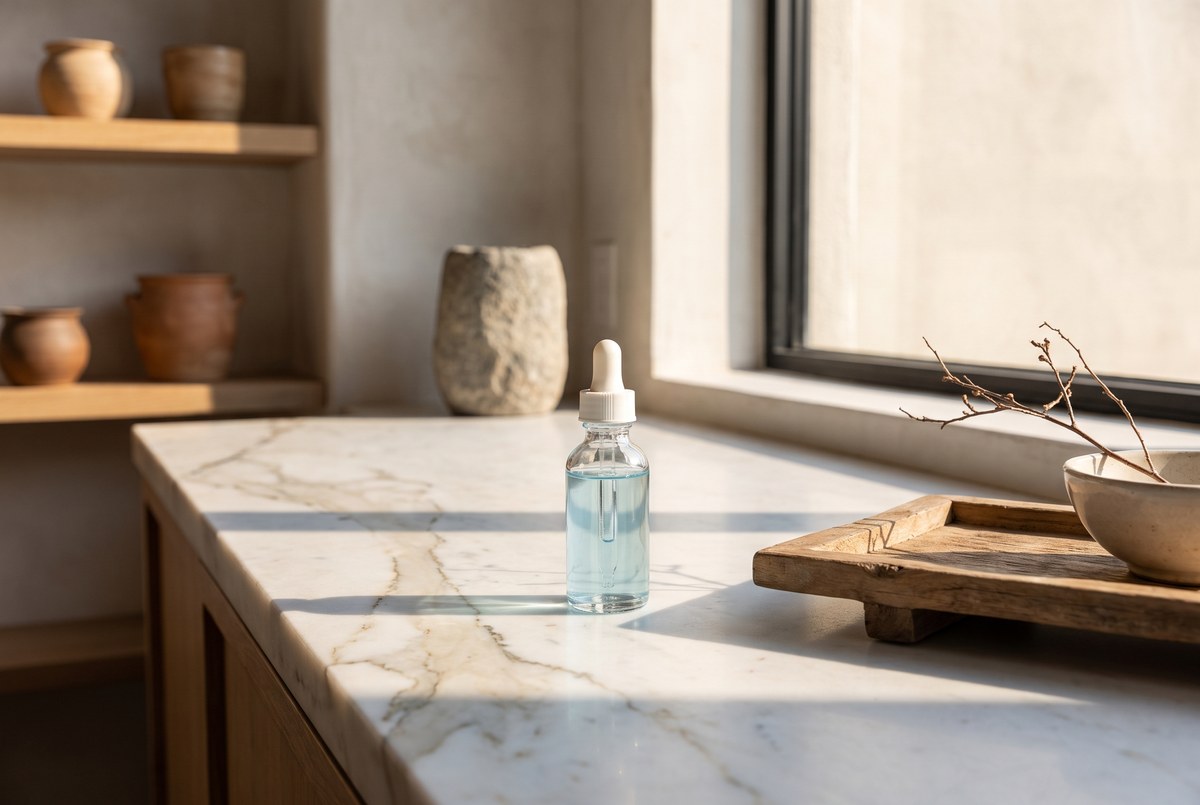
The dropper rises. The serum is blue — actually blue, the color of the copper itself — and down it goes onto the cheekbone, tap-tap-tap, in the nightly ritual known to every skincare forum on earth: cleanse, treat, seal, repeat. GHK-Cu! The peptide your own plasma already makes! Collagen in a bottle, the posts say — copper, the metal of wires and pennies, pressed into service against the wrinkle. The before-and-afters pile up. The subculture is certain. The trial literature is — well. The trial literature is a different conversation.
GHK-Cu is a real molecule with a real pedigree: glycyl-L-histidyl-L-lysine, a tripeptide found in human plasma, saliva and urine, where its concentration declines with age, chelated to a copper(II) ion for which it has high affinity. In skin it is reported to act as a remodeling signal — stimulating collagen, elastin and glycosaminoglycan synthesis while modulating the matrix metalloproteinases that break those structures down — with antioxidant and anti-inflammatory activity besides. That is a full mechanistic résumé, and it is exactly why the subculture fell for it.
So the question is exact: does putting it on your face visibly rejuvenate skin? The most defensible answer the evidence permits: the mechanism is genuinely interesting, the animal data are real, and the controlled human cosmetic evidence does not yet exist.
The case in the dish and the rat
Start where the case is strong. In 1993 the Journal of Clinical Investigation showed the GHK-Cu complex stimulated connective-tissue accumulation in rat wounds in vivo. Reviews in the Journal of Biomaterials Science (2008) and BioMed Research International (2015) catalogued its stimulation of collagen and repair and its role as a natural modulator of multiple cellular pathways in skin regeneration. A 2020 review in Aging Pathobiology and Therapeutics laid out its potential as an anti-aging peptide, and a 2017 Brain Sciences study documented effects of GHK on gene expression relevant to nervous-system function and cognitive decline — the molecule gets around. Across the reviews and laboratory studies, the compound is reported to support wound healing and to reduce inflammation and oxidative stress alongside its matrix-building effects. This is a serious signaling peptide, not a fragrance.
The split-face verdict
Now the cold water. There are no adequate placebo-controlled trials of GHK-Cu alone for photoaging or wrinkles — none. The best controlled human study, a randomized split-face trial performed after laser resurfacing, found no objective benefit over control for redness, wrinkles or skin quality. Patients reported higher satisfaction on the treated side, which is worth something and is also exactly what a perceived-effect looks like when the instruments disagree. An irradiated-wound animal model likewise found no benefit over control. The gap between the forum and the trial is the story.
The bottleneck
There is a physical reason the results keep stalling: skin is a barrier, and GHK-Cu penetrates it poorly. Recent formulation science — liposomal encapsulation — aims to solve the delivery problem, and it may. But improved delivery is a hypothesis about a vehicle, not evidence of an outcome, and no commercial serum has been tested in the cited studies. Dermatologists, on the record of this literature, generally regard the peptide as supportive rather than transformative.
Practical meaning
If you use it, use it with calibrated expectations: a plausible adjunct with an excellent safety-adjacent profile and an unproven cosmetic effect — not a retinoid-grade intervention, not a laser in a bottle.
Tap-tap-tap, the blue drop disappears into the cheekbone. Somewhere under that skin the fibroblasts are listening for a signal the lab says is real and the mirror has not confirmed. The serum is allowed to be promising. It has not yet earned certainty.
Educational, not medical advice.
The takeaway
GHK-Cu has a strong mechanistic and animal case as a skin-remodeling signal, but rigorous human cosmetic evidence does not exist: no adequate placebo-controlled trials for photoaging or wrinkles, and the best controlled trial found no objective benefit over control — so treat it as a plausible supportive ingredient, not a proven anti-aging treatment.
References
5 peer-reviewed sources, published 1993–2020, across 5 journals. 2 of them have a full Magellan study write-up linked below.
- J Biomater Sci Polym Ed · 2008 · PMID 18644225 · DOI 10.1163/156856208784909435The human peptide GHK and its copper complex GHK-Cu play a broad role in tissue repair and regeneration, with benefits for skin, hair, and various internal tissues. Read our full write-up →
- J Clin Invest · 1993 · PMID 8227353 · DOI 10.1172/JCI116842GHK-Cu stimulates the accumulation of connective tissue components like collagen and glycosaminoglycans in rat wounds. Read our full write-up →
- Biomed Res Int · 2015 · PMID 26236730 · DOI 10.1155/2015/648108
- Aging Pathobiol Ther · 2020 · PMID 35083444 · DOI 10.31491/apt.2020.03.014
- Brain Sci · 2017 · PMID 28212278 · DOI 10.3390/brainsci7020020
Mechanisms and molecules in this article
Each links to its Magellan monograph — what it is, what it does, and the studies behind it.
Related reading
Bakuchiol is marketed as retinol's gentler plant twin. A 12-week randomized trial backs the comparison —…
In a randomized Australian trial, adults assigned to daily sunscreen showed no detectable increase in skin…
Alpha-lipoic acid is a potent, unusually versatile antioxidant, and one good split-face trial found a 5%…
All Magellan articles → · More on Skin & Topical Longevity →
Prefer the interactive version? Open this article inside the Magellan app →