Creatine for Healthy Aging: Strong on Muscle, Promising on Brain, Best With Training
One of the most studied supplements helps preserve muscle and may aid memory in older adults, but the muscle benefit depends largely on pairing it with resistance exercise.
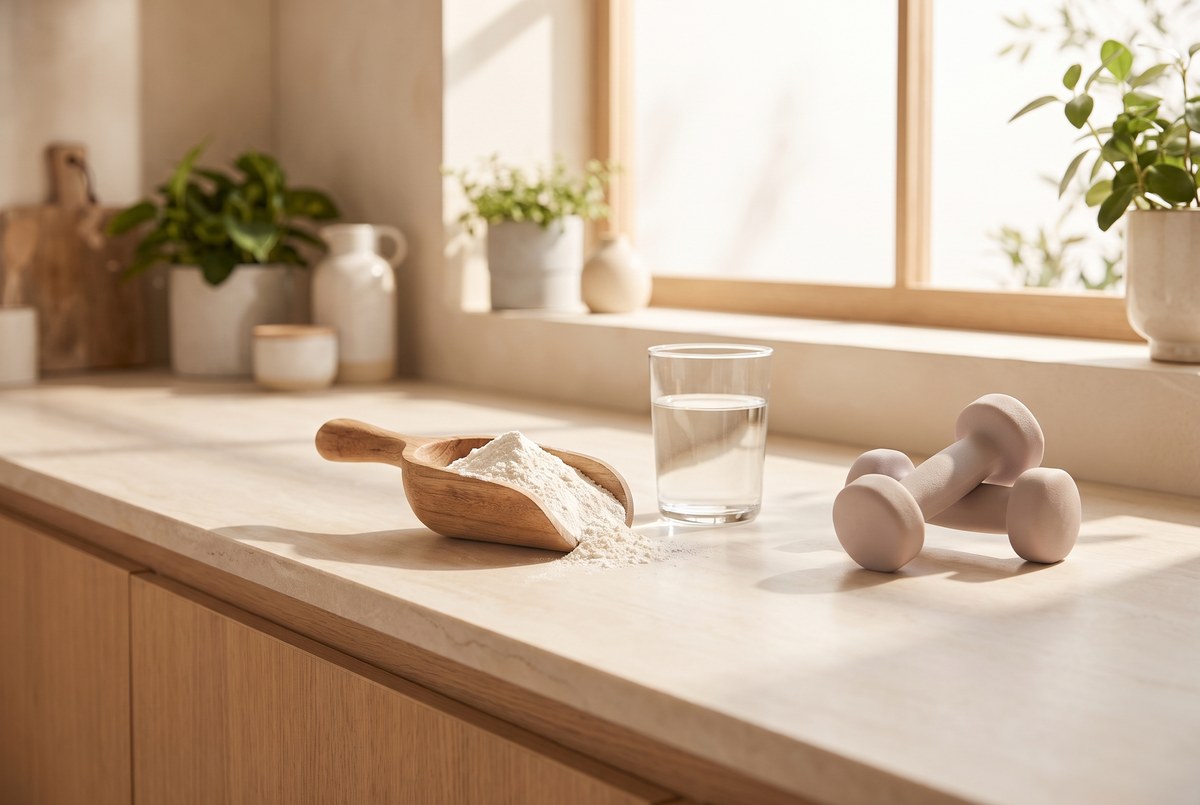
The weight room sets the terms. About twelve weeks of resistance training, a daily scoop of creatine monohydrate beside the bar — that is the protocol under which older adults gained more lean tissue and strength than training alone. Without the training, the same reviews found, creatine did little. The condition is visible in the scene itself: the powder amplifies the exercise. It does not replace it.
Muscle: the benefit is real, but mostly with resistance training
The strongest signal is for muscle when creatine is combined with resistance training. A meta-analysis of older adults (Forbes and colleagues, Nutrients, 2021) found that creatine taken alongside a resistance-training program produced greater gains in lean tissue mass and strength than placebo plus the same training. Tellingly, the same analysis found that when studies using a high-dose loading phase were excluded, creatine did not significantly beat placebo for chest-press or leg-press strength, a reminder that the effect sizes are real but not enormous and depend on the protocol.
The training requirement matters. A systematic review of randomized trials in aging populations (Stares and Bains, J Geriatr Phys Ther, 2020) concluded that additive benefits on strength, functional capacity, and lean mass generally required daily creatine combined with at least about 12 weeks of resistance training. Creatine is not a substitute for exercise; it is something that appears to amplify the muscle response to exercise. The same review found creatine alone, without training, had limited effect on most muscle outcomes.
Brain: promising, with honest uncertainty
Creatine also plays a role in brain energy metabolism, which has prompted trials on cognition. A systematic review and meta-analysis of memory (Prokopidis and colleagues, Nutr Rev, 2023) found that creatine supplementation improved measures of memory compared with placebo across healthy individuals, with a notably larger effect in older adults aged roughly 66 to 76 than in younger people. The benefit was statistically significant but modest, and the authors noted meaningful variability between studies.
It is important not to overstate this. A broader review of creatine for muscle, bone, and brain in older adults (Candow and Moriarty, Curr Osteoporos Rep, 2024) framed the cognitive evidence as a genuine but still-emerging ray of hope rather than settled fact, judged the muscle-plus-training evidence as more solid, and concluded the data do not support creatine as an effective strategy for bone in older adults. In short: muscle with training is the best-supported use, cognition is promising, and bone is largely unsupported so far.
Safety
Across these reviews, creatine monohydrate was consistently described as safe and well tolerated in older adults at common doses. It draws water into muscle, so a small early increase in body weight is normal and is not fat gain. As with anything, people with kidney disease or other medical conditions should check with a clinician first, since most safety data come from generally healthy participants.
For an older adult already doing or willing to start resistance training, creatine is one of the better-evidenced, lower-risk additions available, with a possible bonus for memory. Educational, not medical advice; consult a clinician before starting supplements, especially if you have kidney concerns. Educational, not medical advice.
The takeaway
Creatine monohydrate is safe and reliably boosts muscle and strength gains in older adults when paired with resistance training, with modest emerging benefits for memory but little effect on bone.
Train the numbers: Stronger for Longer
A free 12-week walking, strength and balance program for adults 50 and over, measured with five validated self-tests at weeks 0, 6 and 12. No supplements, nothing to buy.
Discussed here: Creatine Monohydrate
Strong evidenceWhat that grade means: Consistent randomized human trials — or large, convergent human cohort data — show a real benefit, usually for a specific measurable outcome rather than for lifespan itself.
Typical listed price $44.00 — check the live price before buying.
Read the full evidence page → View on Amazon ↗
See every graded product in Nutraceuticals & Cellular Energizers →
References
4 peer-reviewed sources, published 2020–2024, across 4 journals. 1 of them has a full Magellan study write-up linked below.
- Nutrients · 2021 · PMID 34199420 · DOI 10.3390/nu13061912
- J Geriatr Phys Ther · 2020 · PMID 30762623 · DOI 10.1519/JPT.0000000000000222Creatine supplementation combined with exercise may offer additive benefits for muscle strength, function, and lean mass in older adults, particularly women, but more research is needed for bone, cognition, and optimal dosing. Read our full write-up →
- Nutr Rev · 2023 · PMID 35984306 · DOI 10.1093/nutrit/nuac064
- Curr Osteoporos Rep · 2024 · PMID 39509039 · DOI 10.1007/s11914-024-00895-x
Mechanisms and molecules in this article
Each links to its Magellan monograph — what it is, what it does, and the studies behind it.
Related reading
Creatine monohydrate plus resistance training reliably adds modest lean mass and strength, including in…
Ranked by the strength of human evidence for an outcome that matters, not by mechanism. Creatine, protein,…
A striking result from one tiny overnight experiment is being sold as a universal brain boost. A newer…
All Magellan articles → · More on Nutraceuticals & Cellular Energizers →
Prefer the interactive version? Open this article inside the Magellan app →