Can Foods Reverse Biological Age? What the Study Actually Found
Tea, berries and spices were associated with a changing DNA-methylation clock in a small lifestyle trial. That is a research clue, not an age-reversal menu.
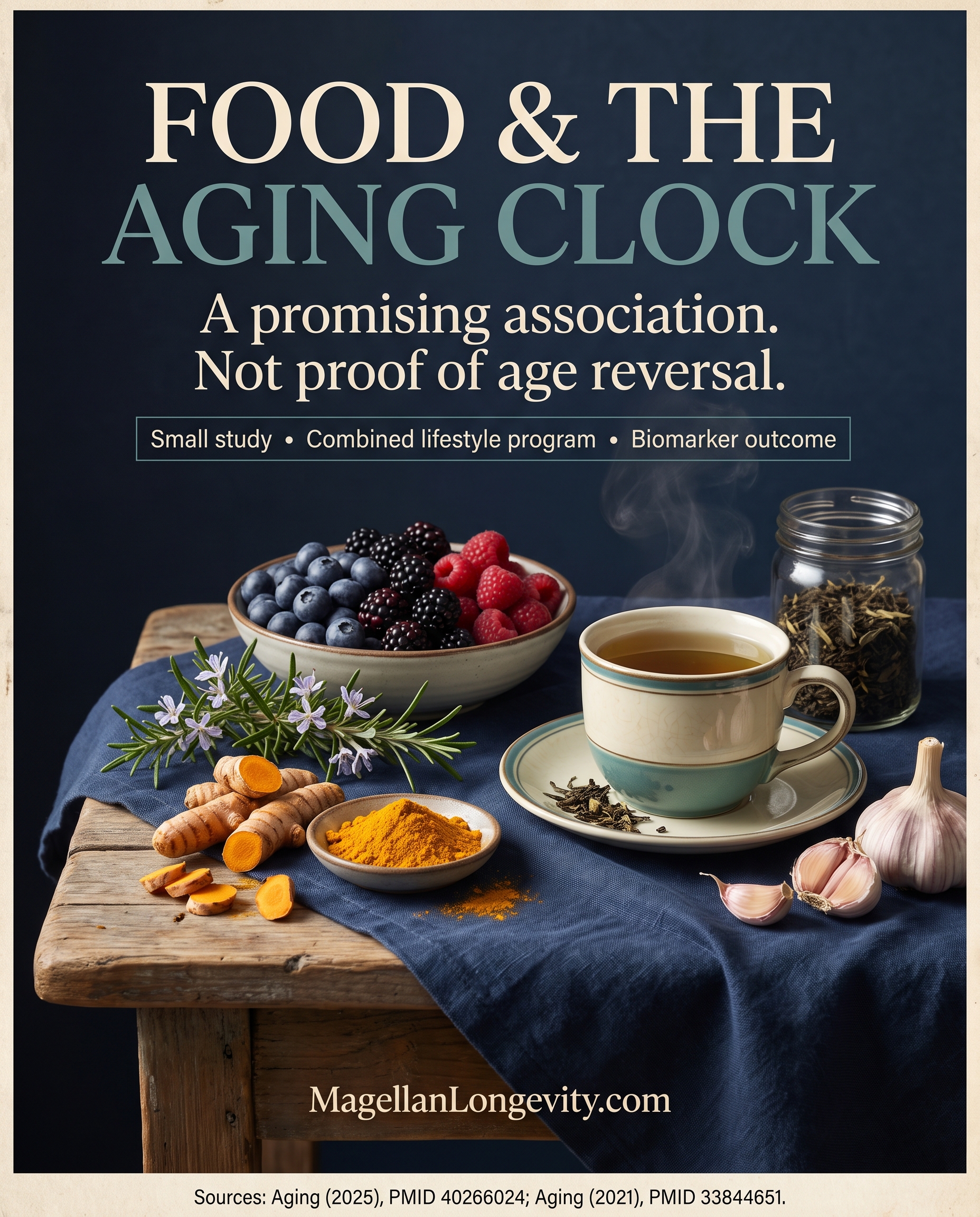
An intriguing dietary association came from a small lifestyle trial. It does not establish an age-reversal menu.
Green tea, oolong tea, turmeric, rosemary, garlic and berries: the list sounds more like a kitchen inventory than an aging experiment. In a 2025 paper, researchers grouped these foods together and asked whether reported consumption tracked changes in a DNA-methylation clock.
It did. But the finding answers a narrower question than the headline about foods reversing biological age. The analysis was exploratory, the foods were not separately randomized, and the outcome was an algorithmic estimate from saliva—not a measurement of years of life regained. Aging, 2025; PMID 40266024.
Two papers, one underlying experiment
The original pilot randomized trial enrolled 43 healthy men aged 50–72 in an eight-week program or a control group. The intervention combined diet with exercise, sleep and relaxation guidance, plus nutritional supplementation. Researchers measured DNA methylation and applied Horvath’s 2013 clock. Because several things changed together, the trial could not identify which component produced any observed difference. Aging, 2021; PMID 33844651.
The 2025 paper returned to that trial’s data. Its methods describe 38 completers and use self-reported food consumption to explore differences in clock response. This was not an independent replication or a new trial assigning people to berries versus no berries. The distinction matters: randomization of a whole program does not automatically make every food association within that program causal. 2025 full text.
What the food analysis found
Greater reported consumption of the combined tea, herb, spice, garlic and berry category was associated with a larger reduction in estimated epigenetic age. The association remained after adjustment for weight change and baseline epigenetic age acceleration. That adjustment strengthens the analysis, but cannot exclude all confounding or isolate individual ingredients.
The study called this category “methyl adaptogens.” That is the investigators’ grouping, not a clinically established class of rejuvenating foods. The statistical model used a logarithmically transformed measure of consumption. Its coefficient should not be translated into “one serving makes you a year younger.” 2025 full text, Tables 4–5.
Why “up to eight years” is misleading as a promise
The paper describes wide variation in clock changes, including both decreases and increases in the intervention group. An extreme individual decrease is not the average treatment effect, and neither is a guaranteed response to tea or turmeric. A biomarker moving over eight weeks does not establish fewer heart attacks, less disability, reduced cancer incidence or a longer lifespan.
A useful interpretation is that this result identifies a hypothesis for a larger trial. It does not identify a validated food prescription for reversing human aging.
Mechanisms remain hypotheses here
The authors discuss possible effects of food compounds on enzymes involved in DNA methylation and on signaling pathways such as PI3K/AKT/mTOR. Those discussions draw on other research. The dietary analysis did not demonstrate that eating these foods switched those pathways up or down in these men.
A responsible mechanism illustration therefore separates measured observations from proposed explanations. Saliva methylation patterns entered a clock algorithm; food reports were statistically associated with the resulting change. Dashed arrows can show candidate biochemical explanations, but a solid arrow from garlic to rejuvenation would claim an experiment that was not performed.
What this means for a food choice or supplement label
These findings do not establish that a turmeric capsule reproduces the result of the full lifestyle program, or that any one listed food produced it. Nor do they show that avoiding grains, legumes or dairy—the study restricted these categories—is necessary for healthy aging. The authors themselves discuss the distinction between study-specific exclusions and broader nutrition evidence.
For Magellan’s evidence review, the verdict is preliminary human biomarker evidence, with exploratory dietary associations. Any product-scanner explanation should identify that evidence level rather than awarding an “age reversal” claim to an ingredient.
Limitations and research transparency
The sample was small, all male and mostly white. Foods were correlated with one another, intake was self-reported, and the analysis could not account for all other lifestyle changes. It used a single clock and did not establish durable clinical benefits. Several authors disclosed developing the protocol for private clinical practice; one disclosed a related book.
There are also reporting discrepancies: the PubMed abstract and publisher text display different regression coefficients/confidence intervals, and the Results section’s dropout arithmetic differs from the Methods description. We therefore do not present those coefficients or an inferred per-serving benefit as settled numbers. The Methods describes 38 completers. These inconsistencies warrant clarification; they do not by themselves prove that the study is invalid.
Sources: Villanueva et al., Aging (Albany NY) (2025), DOI 10.18632/aging.206240; Fitzgerald et al., Aging (Albany NY) (2021), DOI 10.18632/aging.202913. Original study registration: NCT03472820. This review uses the published reports, not an independent reanalysis of participant data.
Educational, not medical advice.
The takeaway
Preliminary human biomarker evidence. Exploratory food associations do not establish individual food effects, whole-body rejuvenation or longer life.
References
2 peer-reviewed sources, published 2021–2025, across 1 journal. Every citation links to its PubMed record.
- Aging (Albany NY) · 2025 · PMID 40266024 · DOI 10.18632/aging.206240
- Aging (Albany NY) · 2021 · PMID 33844651 · DOI 10.18632/aging.202913
Mechanisms and molecules in this article
Each links to its Magellan monograph — what it is, what it does, and the studies behind it.
Related reading
Rentosertib has renewed the debate over biological age. A randomized human experiment offers an important…
A Nature Medicine study examines organ-age models separately by sex. Better references may sharpen research,…
A 2009–2012 CDC survey analysis found periodontitis in 46% of dentate American adults 30 and older.…
Prefer the interactive version? Open this article inside the Magellan app →