Aging Beyond the Average: What Repeated Blood Measurements Reveal
A Science study followed molecular changes in 335 women. Individual trajectories complicate the idea that one average curve describes how everyone ages.
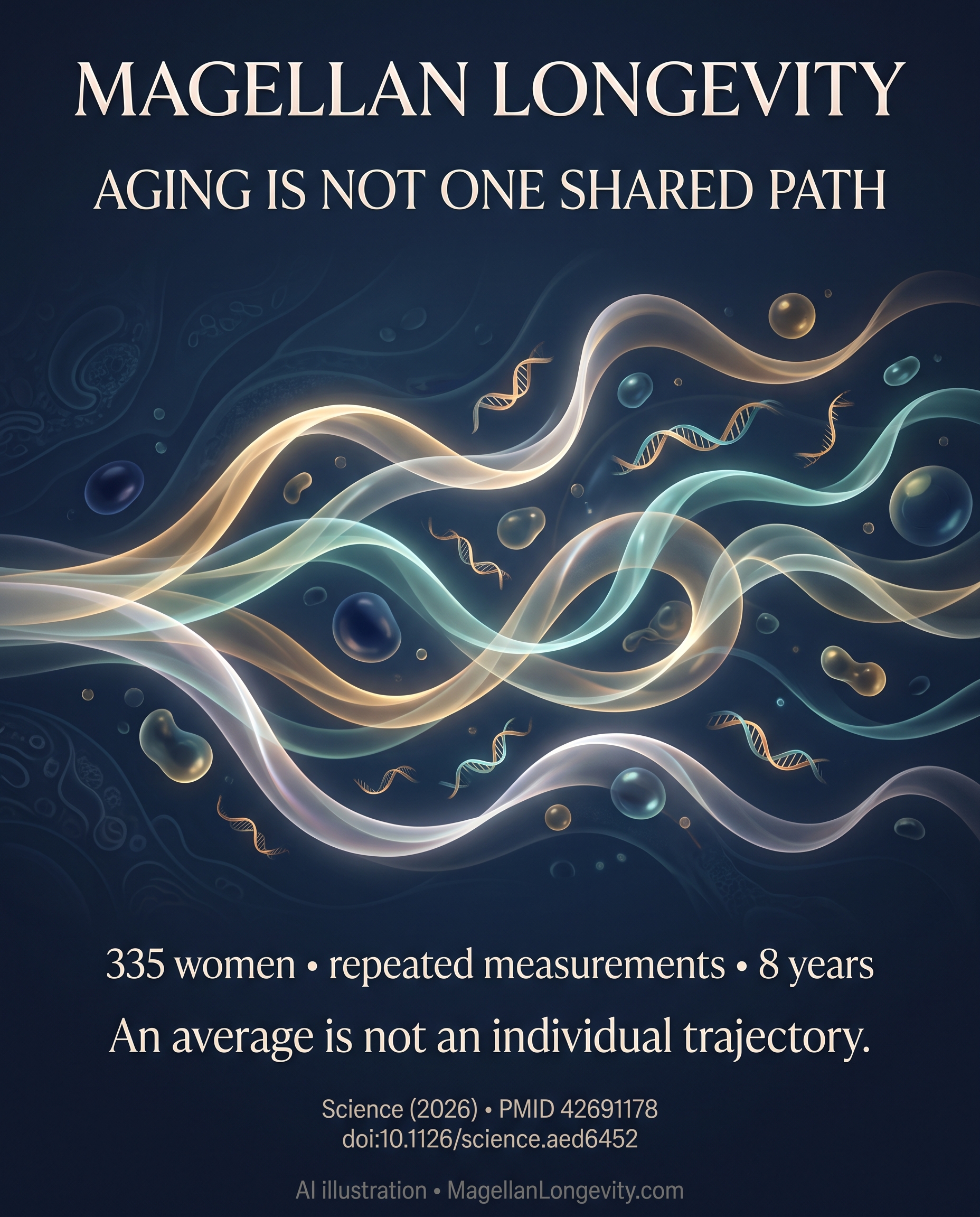
Blood RNA. Metabolites. Repeat visits. The important ingredient in this aging study was time: returning to the same people instead of treating a comparison between younger and older strangers as a record of one person's life.
In Science, El-Sayed Moustafa and colleagues report repeated whole-blood gene-expression and metabolite measurements in 335 women over an eight-year study period. Their central finding is that individual molecular trajectories can differ from population trends. The work supports more careful interpretation of aging measurements; it does not establish a personalized anti-aging treatment. Science (2026), PMID 42691178.
A snapshot and a trajectory answer different questions
A cross-sectional comparison asks how measurements differ between people of different ages. A longitudinal study asks how measurements change within the same people. Both are useful, but they are not interchangeable.
Imagine a purely hypothetical marker whose average level is higher among older participants. That does not require it to increase in every participant. Some people might show little change; others might move in the opposite direction. Following the same person helps reveal variation that the average conceals.
That distinction matters when a consumer report compresses many measurements into a single biological-age number. A number can be informative without describing every molecular process in the person who receives it.
What the researchers measured
The paper's abstract identifies 5,061 genes and 181 metabolites whose levels changed over time. It also reports cell-type-specific patterns and relationships involving genetic variation, circadian timing, seasonality and environmental pollutant exposures. These are observations about molecular dynamics, not a trial of a supplement or a program to extend life. Original journal article.
The study team places the work in the TwinsUK cohort. Its university summary highlights differing courses of change in CXCL9 and declining TP53 expression in some individuals. Those examples concern measured gene-expression patterns; they should not be translated into a claim that everyone's immune system follows the same trajectory or that a particular person will develop cancer. King's College London research summary.
Why a molecular arrow needs a label
RNA abundance, protein concentration and protein activity are different measurements. An increase in a transcript is not sufficient evidence that an entire pathway has become more active. A decrease is not automatically beneficial or harmful. The tissue, cell mixture, timing and biological context matter.
For that reason, the accompanying illustration uses diverging conceptual paths. It is not a plot of participant data, a protein structure or a diagram of experimentally established treatment effects. A genuine pathway illustration would need to distinguish measured changes from inferred connections and independently established mechanisms.
What this means for an aging test
Before interpreting a change in a commercial score, ask what was measured, whether the same method was used on both occasions, and how large normal test-to-test variation is. The next question is whether a change predicts something that matters: function, illness or survival.
This study does not show that buying more tests improves health. Nor does it show that a supplement that changes one laboratory measurement has slowed aging. A personalized measurement and an effective personalized intervention are separate achievements.
The evidence boundary
This is an observational study in women, not evidence that its findings apply identically to men or every population. The eight-year study window should not be read as a guarantee of eight complete years of follow-up for every participant. Molecular associations alone cannot establish the benefit of changing a marker.
Review scope: This explainer is based on the verified PubMed abstract, the university's publication record and its research summary. The publisher page and accepted-manuscript download were not accessible during preparation, so we do not claim a full-text or supplementary-methods appraisal. Exact sampling schedules, exclusions, effect sizes and technical sensitivity analyses require that further review.
For Magellan's product scanner, the appropriate classification is human observational biomarker research. This paper supplies no product-specific efficacy result or dose recommendation.
The useful lesson is to ask how a measurement changes in a person, what else can move it, and whether that change has clinical meaning. A population average is a starting point for those questions.
Educational, not medical advice.
The takeaway
Repeated measurements can reveal individual variation. They do not by themselves establish a treatment that slows aging.
References
1 peer-reviewed source, published 2026, across 1 journal. Every citation links to its PubMed record.
- Science · 2026 · PMID 42691178 · DOI 10.1126/science.aed6452
Related reading
Rentosertib has renewed the debate over biological age. A randomized human experiment offers an important…
Tea, berries and spices were associated with a changing DNA-methylation clock in a small lifestyle trial.…
A 2009–2012 CDC survey analysis found periodontitis in 46% of dentate American adults 30 and older.…
Prefer the interactive version? Open this article inside the Magellan app →