Feeding the Inner Crowd: What Inulin Can and Cannot Promise
Inulin reliably feeds beneficial gut bacteria, eases constipation and nudges metabolic markers in prediabetes and type 2 diabetes — but the average effects are small, the certainty is rated low, and the price of a high dose is often paid in gas.
There is a particular modern unease that arrives in the bathroom mirror or the waistband of a pair of trousers: the suspicion that something deep inside is off — that the gut, that unseen crowd of trillions we now read about constantly, is underfed, out of balance, silently voting against us. Behind every tub of prebiotic fiber sits that unease, and a hope attached to it: that by feeding the right bacteria, a person might fix themselves from the inside out — weight, blood sugar, even mood. Getting this wrong has a cost. Not catastrophe, but the slow drip of money spent on powders, of discomfort endured, of expectations quietly curdled.
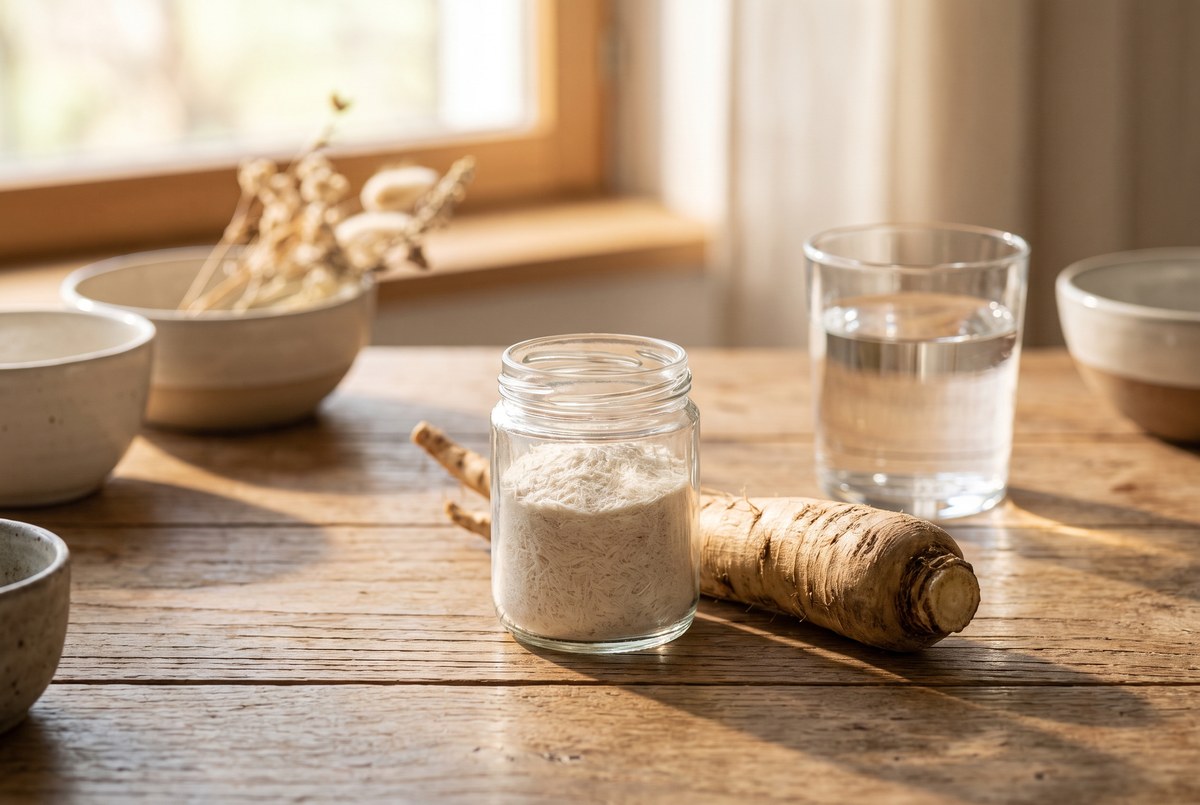
Inulin is where that hope meets some of its best evidence. It is a fructan — a chain of fructose molecules — found in plant roots, with chicory root the richest commercial source. Human digestive enzymes cannot break its fructose-fructose bonds, so it passes undigested to the colon, where resident bacteria such as Bifidobacterium and Lactobacillus ferment it, yielding short-chain fatty acids including butyrate and selectively promoting beneficial microbes. That mechanism is not marketing; it is the definition of a prebiotic.
The question is what that mechanism buys in human trials. The most defensible answer: something real, but modest — and mostly for specific people.
The dependable effects
Randomized trials and meta-analyses show inulin-type fructans reliably increase stool frequency and improve constipation — confirmed again in a 2025 trial using 12 grams a day — and can enhance calcium absorption. On metabolism, the glycemic benefits concentrate where metabolism is already strained. A GRADE-assessed systematic review and dose-response meta-analysis of 33 randomized controlled trials, published in the Journal of Translational Medicine in 2019, found improved glycemic control specifically in prediabetes and type 2 diabetes populations. A 12-week randomized, double-blind, placebo-controlled trial in elderly type 2 diabetes patients found milk powder co-supplemented with inulin and resistant dextrin improved glycemic control and insulin resistance. A 2021 pilot randomized trial in Nutrients tested inulin against peripheral insulin sensitivity in adults at elevated diabetes risk. The pattern is consistent: this is a fiber that helps most where glucose handling needs help.
The size of the average
Now the numbers that keep hope honest. Across 32 to 55 trials, depending on the meta-analysis, inulin-type fructans produce roughly 1 kilogram of weight loss and LDL cholesterol and triglyceride reductions of about 0.1 mmol/L — a 2021 review in Food Science & Nutrition and a 2024 meta-analysis with meta-regression in the American Journal of Clinical Nutrition both land in this territory. These are real averages and small ones. A kilogram is not a transformation; a tenth of a millimole per liter is a nudge, not a rescue. And reviewers rate the certainty of this cardiometabolic evidence as low to very low — meaning future trials could plausibly shift the estimate in either direction.
The complication in the colon
Some trials report no benefit at all. Prebiotics have failed to improve irritable bowel syndrome symptoms — a pointed null, since IBS sufferers are among the most hopeful buyers. And the fermentation that makes inulin work is also its tax: at higher doses it commonly causes gas, bloating and flatulence. The same microbial feast that produces butyrate produces the rest. Effects depend on dose, on the type of fructan, and on the population taking it; the average hides all three.
What the uneasy buyer should know
For someone with sluggish bowels, or prediabetes under a clinician's eye, inulin is among the more defensible items in the supplement aisle — a functional fiber, well tolerated at sensible doses. For the person hoping it will quietly reverse aging, the evidence simply does not go there; this research describes the compound and its mechanism, not any specific commercial product. The crowd inside can be fed. It just cannot be promised miracles. Educational, not medical advice.
The takeaway
Inulin is a genuinely functional prebiotic fiber — good for stool frequency, gut bacteria and modest glycemic and lipid improvements in the right populations — but it is not a proven treatment or longevity intervention, and bloating is a common, honest trade-off.
References
5 peer-reviewed sources, published 2018–2024, across 5 journals. 1 of them has a full Magellan study write-up linked below.
- Nutrients · 2021 · PMID 34579112Inulin supplementation did not improve peripheral insulin sensitivity in adults at risk for type 2 diabetes. Read our full write-up →
- J Transl Med · 2019 · PMID 31805963 · DOI 10.1186/s12967-019-02159-0
- Food Sci Nutr · 2021 · PMID 34401107 · DOI 10.1002/fsn3.2403
- Am J Clin Nutr · 2024 · PMID 39313030 · DOI 10.1016/j.ajcnut.2024.09.019
- Mol Nutr Food Res · 2018 · PMID 30346655 · DOI 10.1002/mnfr.201800865
Mechanisms and molecules in this article
Each links to its Magellan monograph — what it is, what it does, and the studies behind it.
Related reading
A plant alkaloid with real metabolic effects, an AMPK mechanism, and a marketing problem.
Green tea catechins produce small but measurable metabolic effects in pooled randomized trials, and habitual…
Citrus hesperidin improves endothelial function and inflammatory markers in small human trials and trims…
All Magellan articles → · More on Nutraceuticals & Cellular Energizers →
Prefer the interactive version? Open this article inside the Magellan app →