The Membrane Molecule That Keeps Changing Its Story
Phosphatidylcholine is a structural brick of every cell membrane and the diet's main form of choline — yet its clinical record is a stack of contradictions: a colitis program that soared and then failed phase 3, liver claims that stalled in large trials, and a gut-microbe caveat that complicates the whole idea of taking more.
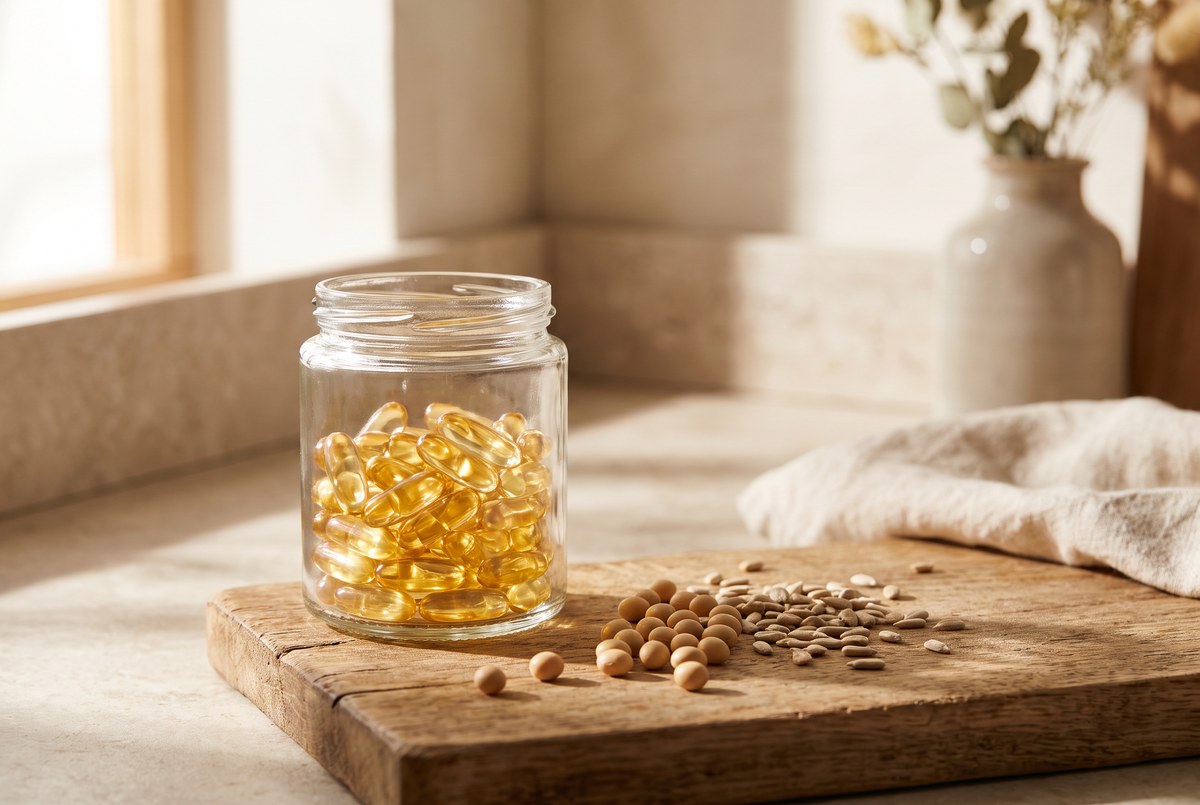
So here's a sentence nobody expects to need: the fatty yellow molecule that keeps every cell membrane you own from leaking — the lecithin in your eggs and soybeans, the stuff your liver manufactures to package and export its own fat, the principal dietary form of choline and therefore, a few enzymatic steps later, of the neurotransmitter acetylcholine — is the same molecule, give or take a purification step, that supplement companies sell as a liver cure-all, that pharmaceutical chemists spent two decades engineering into a delayed-release colon tablet for ulcerative colitis, and that your gut bacteria (this is the awkward part, so hold on to it) convert into a metabolite that large human cohorts keep associating with cardiovascular events and earlier death.
All of those phosphatidylcholines are real, and they do not reconcile into one tidy story, which is exactly why the molecule is worth a reader's skepticism. The honest question: what has phosphatidylcholine actually been shown to do in humans, and where does the record dissolve into mechanism and hope?
The colitis program that soared, then didn't
The most encouraging human evidence belongs to gastroenterology, not the supplement aisle. In a randomized trial published in Annals of Internal Medicine in 2007, delayed-release phosphatidylcholine — engineered to survive the stomach and coat the inflamed colon — outperformed placebo in patients whose chronic ulcerative colitis had not responded to steroids. A 2021 meta-analysis in Digestive Diseases pooled the delayed-release trials and found higher remission and endoscopic-improvement rates than placebo. That is a genuinely impressive arc for a membrane lipid. Then the pivotal modern program, a formulation called LT-02, failed both of its large phase 3 trials in 2024. Whether this molecule is a medicine for colitis is, as of today, an unresolved question with two contradictory answers, and the bigger, better-funded answer is the negative one.
The liver, the brain, and a stack of nulls
Purified "essential phospholipids" are widely used for liver disorders, and smaller studies do report improvements in some biochemical and steatosis measures. But the large Veterans Affairs randomized trial found no effect on the progression of alcoholic liver fibrosis — the outcome that actually matters — and a trial of a nutraceutical mixture in fatty liver disease showed no efficacy. For the brain, a Cochrane review of 12 trials found no clear benefit of lecithin for dementia or cognitive impairment. A 2025 study linking lecithin intake to protection against combined sarcopenia and cognitive decline, through a proposed muscle-to-brain signaling pathway, is intriguing and unreplicated — a hypothesis wearing a lab coat, not a result.
The mitochondrial aging headline, handled carefully
A 2026 paper in Nature Communications argues that the age-associated decline in phosphatidylcholine synthesis acts as a "malleable trigger" of natural mitochondrial aging, and earlier work in the Journal of Membrane Biology documented ageing-induced shifts in the lipid profiles of brain and liver mitochondria. This is real and interesting biology about why membranes age. It is not a human trial showing that swallowing phosphatidylcholine slows anything. Meanwhile, choline adequacy is a legitimate nutritional question — a 2016 assessment of American choline intakes using NHANES data exists precisely because intake is uncertain — but adequacy from food is a different claim than supplementation for longevity.
The complication the label won't mention
Gut microbiota convert dietary phosphatidylcholine into trimethylamine-N-oxide — TMAO — and large human cohorts associate higher TMAO levels with increased cardiovascular and all-cause mortality. That is an association, not proof that a lecithin capsule harms anyone. But it means "more of a membrane building block" is not automatically benign, and it has never been resolved in trials. One further caution: oral supplements share a name with unapproved injectable "fat-dissolving" phosphatidylcholine products that have drawn FDA safety warnings. They are not the same thing, and the injection story is not evidence about the capsule — but the confusion is common enough to be worth stating plainly.
What to do with a molecule this complicated
Eggs, soybeans, liver, and meat deliver choline in the form the human diet has always provided, and no trial has shown the supplement version prevents disease in healthy people. The colitis program, whatever its future, was a prescription-grade drug effort with a defined dose and release mechanism — nothing about it validates a lecithin capsule for a healthy gut. The molecule that seals your membranes turns out to be a story about the difference between a nutrient and a drug, and between a mechanism and a result. Educational, not medical advice.
The takeaway
Delayed-release phosphatidylcholine genuinely helped ulcerative colitis patients in randomized trials and a meta-analysis — until two large phase 3 trials failed in 2024 — while the liver, brain, and anti-aging claims rest on small studies, null results, or mechanistic work, not on proven human benefit.
References
5 peer-reviewed sources, published 2007–2026, across 5 journals. 1 of them has a full Magellan study write-up linked below.
- Nat Commun · 2026 · PMID 42000749 · DOI 10.1038/s41467-026-71508-7In worms and human cells, restoring phosphatidylcholine reversed key features of mitochondrial aging — making dietary PC/choline a promising, testable lever, but one not yet proven in human trials. Read our full write-up →
- J Membr Biol · 2007 · PMID 18097631 · DOI 10.1007/s00232-007-9086-0
- J Am Coll Nutr · 2016 · PMID 26886842 · DOI 10.1080/07315724.2015.1080127
- Dig Dis · 2021 · PMID 33440385 · DOI 10.1159/000514355
- Ann Intern Med · 2007 · PMID 17975182 · DOI 10.7326/0003-4819-147-9-200711060-00004
Mechanisms and molecules in this article
Each links to its Magellan monograph — what it is, what it does, and the studies behind it.
Related reading
L-carnitine ferries fat into mitochondria, and the heart runs on that ferry. Older trials suggest it helps…
A gut-derived metabolite that switches on mitochondrial cleanup has real human data, including trials that…
IV NAD sells immediacy; NR and NMN pills have more human data. Both can move biomarkers, but neither has…
All Magellan articles → · More on Nutraceuticals & Cellular Energizers →
Prefer the interactive version? Open this article inside the Magellan app →