The Squeeze: What Recovery Boots Actually Recover
Intermittent pneumatic compression is proven hospital medicine — it prevents deadly clots and helps diseased legs walk farther. The athletic 'recovery' version of the same squeeze is a much weaker story: trivial-to-small benefits, mostly in how sore you feel, not in what your muscles actually repaired.
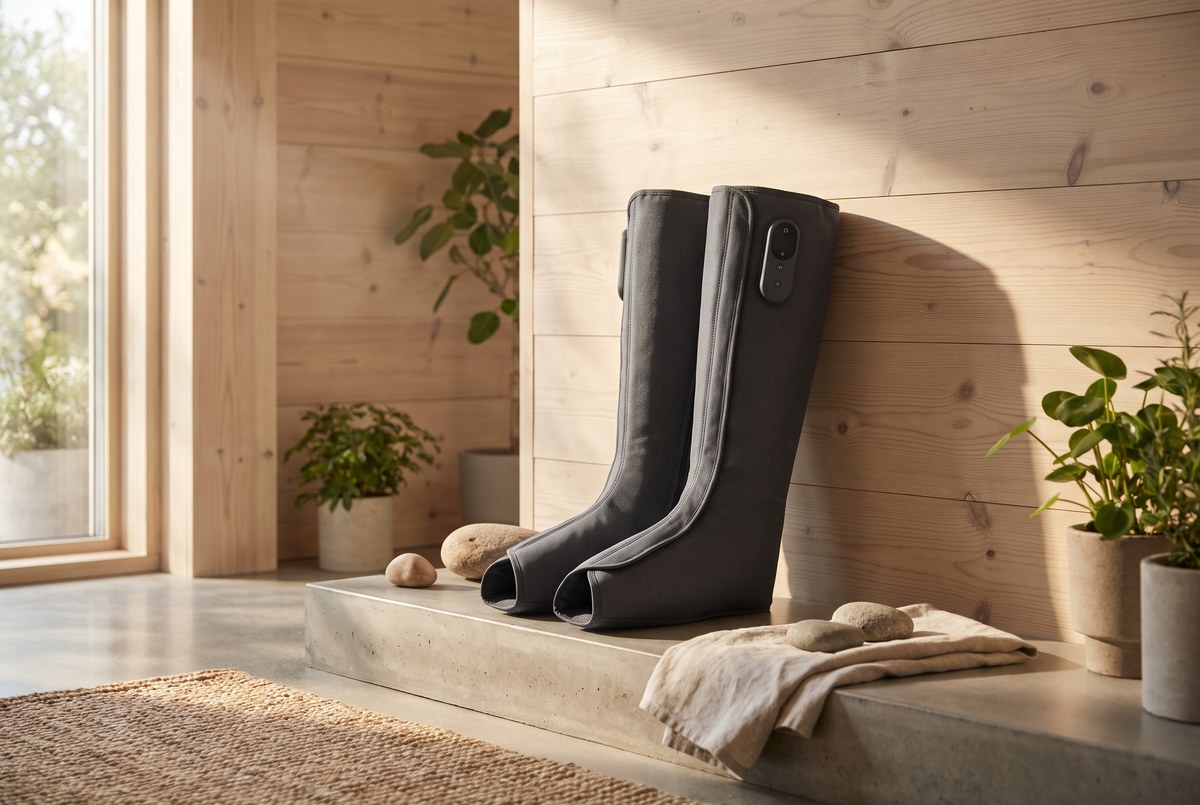
Inflate. Squeeze. Release. The boots seize the calves ankle-to-knee in waves — distal to proximal, a mechanical tide running up the legs of the half-wrecked marathoner flat on the locker-room floor. Recovery boots! The badge of the serious amateur — the ultrarunner, the CrossFitter, the Sunday-league striker with a Monday meeting. Hundreds of dollars of fabric and air, and here is the twist the box understates: the technology is borrowed wholesale from the hospital, where the same squeeze does something far less glamorous and far more proven — stopping blood clots from killing surgical patients.
The mechanism is genuinely elegant. The sleeves inflate and deflate in timed, sequential cycles, rhythmically emptying the leg veins, lowering venous pressure, raising the arteriovenous pressure gradient, and increasing limb blood flow — with proposed bonuses in nitric-oxide release and endothelial function. Real physiology. So the question splits cleanly in two: what does the squeeze do in medicine, and what does it do for your quads after leg day?
The defensible answer: in the hospital, a great deal; in the gym bag, mostly a feeling.
Where the evidence is hospital-grade
The clinical record is the strong one. Meta-analyses show intermittent pneumatic compression significantly lowers the risk of deep-vein thrombosis and pulmonary embolism in hospitalized and surgical patients — prevented events, not vibes, in the population that actually stands to lose the most. Randomized trials and reviews report meaningful gains in pain-free and absolute walking distance for people with intermittent claudication, and the same technology is used to manage lymphedema, chronic venous disease and peripheral arterial disease. This is a legitimate medical device with a legitimate evidence base, built on the simplest of engines: rhythmically emptying the leg veins so fresh arterial blood has somewhere to go.
The athletic claim, tested
Now the locker room. A 2024 systematic review in Biology of Sport found only trivial-to-small benefits for exercise recovery — mainly reduced perceived soreness. Read that again: perceived. Several randomized trials found no effect on muscle-damage markers or objective recovery. The surrounding literature is the same story in different uniforms: the 2021 Journal of Sport Rehabilitation trial on exercise-induced muscle damage in endurance athletes; the 2025 PM&R study on delayed-onset muscle soreness and recovery; the 2020 International Journal of Exercise Science trial in long-distance runners; and a 2025 systematic review in the Journal of Bodywork and Movement Therapies that stacked pneumatic compression against photobiomodulation and neuromuscular electrical stimulation for muscle recovery. A real literature — a modest result, and a telling one, because the trials kept finding the same split: how the leg felt improved more reliably than what the leg had objectively repaired.
The complication
Soreness scores are subjective, and unblinded squeeze-vs-no-squeeze trials are almost impossible to run cleanly; the placebo here inflates too. Serious adverse effects are rare with correct use, but compression is contraindicated in certain vascular conditions — the same veins it treats in the hospital are the reason some people should never strap in. And the evidence describes the mechanism, not any specific commercial boot.
Practical meaning
If the boots make your legs feel better after hard training, the literature says that feeling is the main deliverable — buy it for that, if the price is worth a feeling. Do not expect faster objective recovery, do not expect the damage markers to move, and do not confuse the athlete's toy with the patient's therapy.
The boots hiss, deflate, and come off. The marathoner stands, and the legs feel — something. Better, probably. The hospital downstairs, meanwhile, uses the identical squeeze to keep people alive, which is the whole parable: same machine, different evidence. Know which one you're buying.
Educational, not medical advice.
The takeaway
Meta-analyses show intermittent pneumatic compression significantly lowers the risk of deep-vein thrombosis and pulmonary embolism in hospitalized patients and improves walking distance in claudication — but a 2024 systematic review of athletic recovery found only trivial-to-small benefits, mainly reduced perceived soreness, with several trials showing no effect on muscle-damage markers.
References
5 peer-reviewed sources, published 2020–2025, across 5 journals. 3 of them have a full Magellan study write-up linked below.
- Biol Sport · 2024 · PMID 39416507 · DOI 10.5114/biolsport.2024.133665Intermittent pneumatic compression on lower limbs may help reduce perceived muscle soreness after exercise, with 20-30 minute sessions at 80 mmHg being common protocols. Read our full write-up →
- J Sport Rehabil · 2021 · PMID 33418535 · DOI 10.1123/jsr.2020-0364Intermittent pneumatic compression offers only short-term relief for muscle soreness and does not effectively reduce overall exercise-induced muscle damage in endurance athletes. Read our full write-up →
- PM R · 2025 · PMID 40094188 · DOI 10.1002/pmrj.13377Intermittent pneumatic compression may help reduce muscle soreness and improve muscle recovery 48-72 hours after intense exercise. Read our full write-up →
- J Bodyw Mov Ther · 2025 · PMID 40954632 · DOI 10.1016/j.jbmt.2025.06.021
- Int J Exerc Sci · 2020 · PMID 32148616 · DOI 10.70252/HSPN3402
Mechanisms and molecules in this article
Each links to its Magellan monograph — what it is, what it does, and the studies behind it.
Related reading
Breathing is the last thing most people think to train — until a climbing blood-pressure reading makes the…
The viral number comes from a Finnish cohort that measured fatal coronary disease, not a trial that…
Foam rolling is gym-bag gospel for recovery and flexibility. The trial record mostly agrees on soreness and…
All Magellan articles → · More on Recovery, Sauna & Light Therapy →
Prefer the interactive version? Open this article inside the Magellan app →