From Blueberries to Muscle Cells: What Pterostilbene Research Shows
A new cell study explains how pterostilbene may change lipid metabolism. Human trials show why the finding needs careful limits before becoming a supplement or fat-loss claim.

A handful of blueberries makes an inviting photograph. The experiment behind this particular headline began with cultured mouse muscle cells and an isolated compound. The distance between those two images is where the most important questions sit.
Pterostilbene, a compound reported in blueberries and grapes, reduced lipid accumulation in a laboratory model described in Food Bioscience. The paper offers a specific explanation involving the stability of PPARδ, a regulator of gene expression. It does not establish that eating either fruit, or taking a pterostilbene supplement, reduces muscle fat in people.
How this article was researched: we verified the new paper’s publisher-indexed abstract, highlights and available section excerpts, its Crossref and Elsevier bibliographic records, and the research team’s university announcement. Its complete methods and results were not available for review. We also read two relevant randomized human studies in full. The new paper is linked by DOI; no PubMed identifier was located for it.
What the muscle-cell experiment measured
Suzuki and colleagues studied C2C12 mouse muscle cells using an experimentally induced lipid-overload model. They screened food-derived compounds and identified pterostilbene as a suppressor of intracellular lipid accumulation. Their structure–activity experiments associated the effect with its 3,5-dimethoxy substitution. This is a finding about a defined molecule in a defined cellular setting. Food Bioscience, 2026.
The distinction between stored lipid and a clinical outcome is essential. A cellular lipid measurement does not tell us whether someone becomes stronger, more insulin-sensitive or less likely to develop diabetes. It also cannot establish how a person’s body composition changes over months. Each of those outcomes would need its own measurement in an appropriate study.
The Shinshu University research announcement reports that the tested conditions preserved cell growth and differentiation. That supports a narrower interpretation than a promise to protect muscle growth during human weight loss. A culture’s behavior and an adult’s response to food, exercise or supplementation are different questions.
The mechanism is about keeping PPARδ available
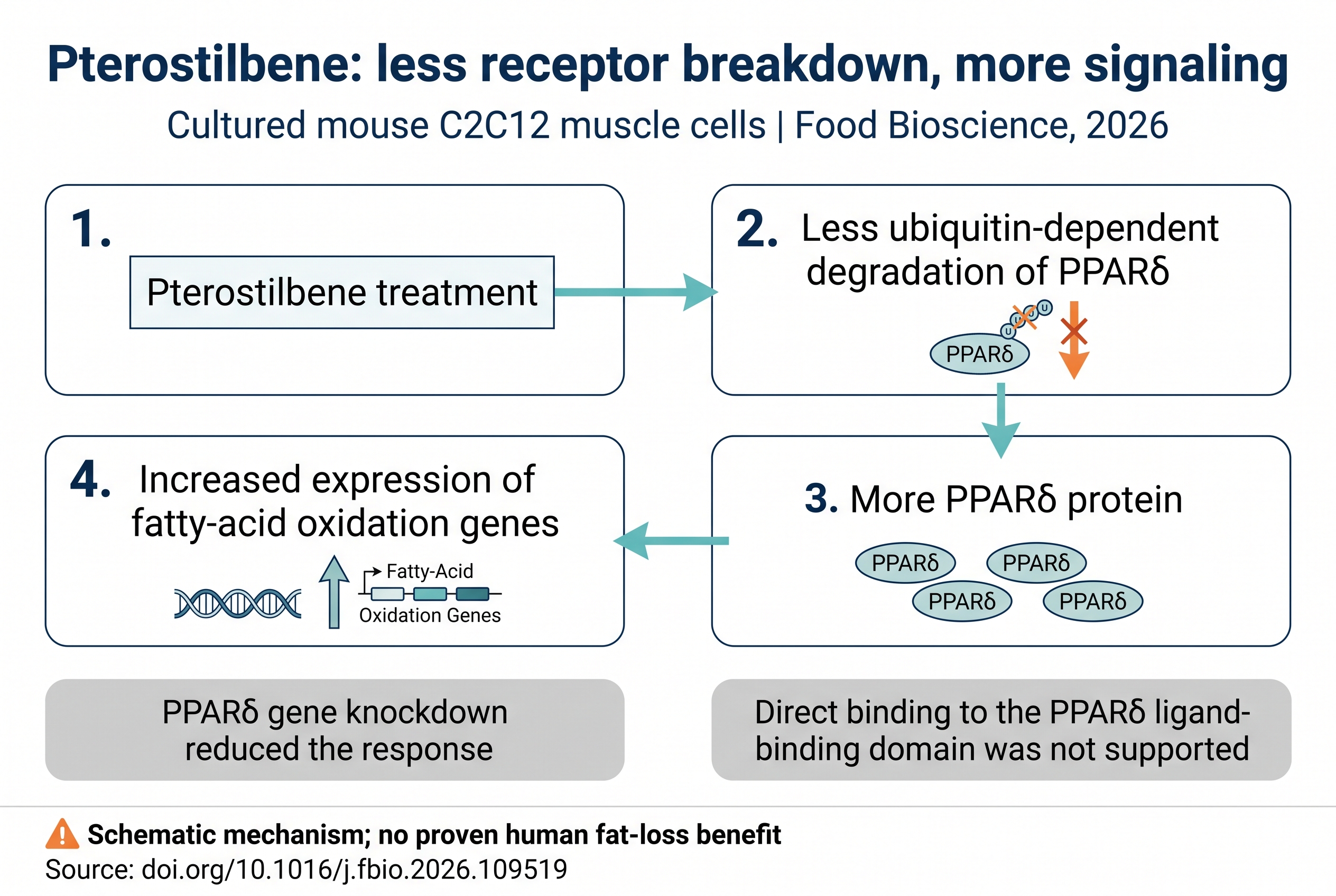
The paper reports increased expression of fatty-acid oxidation-related genes and greater PPARδ occupancy at target-gene DNA. PPARδ knockdown reduced the response. Rather than acting as a direct ligand for its ligand-binding domain, pterostilbene suppressed the receptor’s ubiquitin-dependent proteasomal degradation, increasing PPARδ protein abundance. The authors did not find altered extracellular fatty-acid uptake or lipogenic pathways in this system.
Our interpretation is that protein turnover is the distinctive research lead: changing how long a regulator remains available can change the signal it produces. The diagram separates reduced degradation from increased downstream expression. It does not depict a verified drug-docking pose, a whole-body metabolic effect or inhibition of every protein-degradation process.
Human evidence adds an important complication
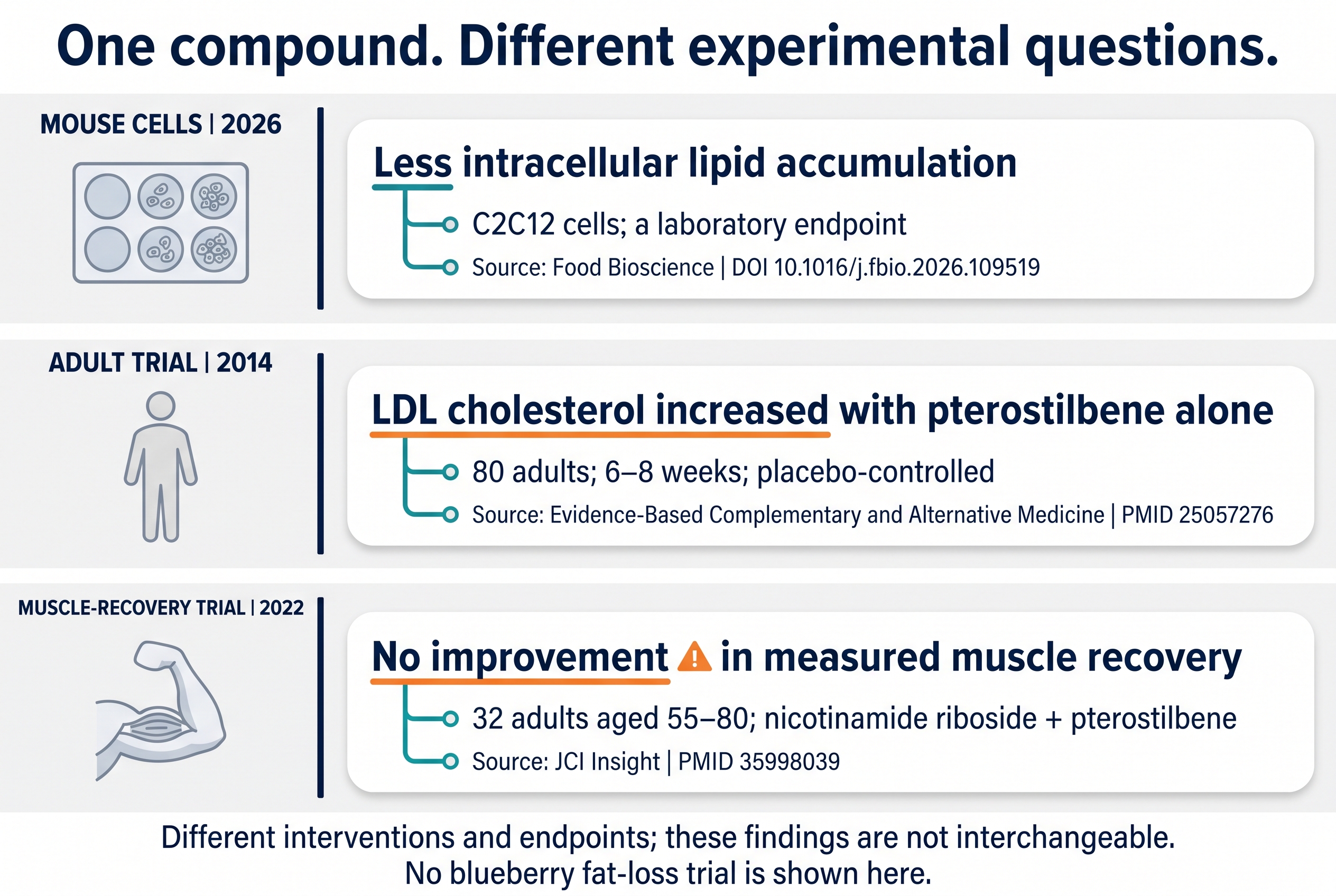
A randomized, double-blind study published in Evidence-Based Complementary and Alternative Medicine enrolled 80 adults with elevated total or LDL cholesterol. Participants received pterostilbene alone at 50 or 125 mg twice daily, a lower-dose pterostilbene–grape-extract combination, or placebo for 6–8 weeks. The trial measured lipids, blood pressure and weight; it did not directly measure muscle-fat clearance. Riche and colleagues, 2014.
Across the two pterostilbene-only arms, the reported LDL treatment effect was an increase of 17.1 mg/dL versus placebo. High-dose treatment also lowered blood pressure. These mixed findings matter: a mechanism that sounds metabolically attractive does not guarantee that every clinically relevant marker moves favorably. The LDL increase was not statistically significant in the combination arm, which cannot establish that adding grape extract reliably prevents it.
This was a small, short trial in a selected population, not a long-term cardiovascular-outcomes study. Its doses describe the experiment, not a recommendation. Nor does its supplement result establish an LDL effect from eating blueberries or grapes.
A muscle-recovery trial asked a different question
In JCI Insight, 32 adults aged 55–80 were randomized to nicotinamide riboside plus pterostilbene or placebo. Supplementation started two weeks before an experimentally induced muscle injury and continued through the 30-day follow-up. The researchers assessed muscle stem-cell recruitment and recovery. They found no improvement in the primary stem-cell endpoint or the other measured recovery outcomes. Jensen and colleagues, 2022.
That trial does not directly refute the new cell-culture finding. It tested a combination, in older adults, against an injury-and-regeneration endpoint. It cannot isolate pterostilbene’s contribution or answer whether it changes human muscle lipid. It does show why a cellular result should not be promoted into a general promise of better muscle health. One author disclosed employment and stock options with Elysium Health.
Why a fruit serving cannot be calculated from this headline
A food, a purified supplement and a compound placed directly into culture medium create different exposures. To translate between them, investigators would need reliable information about the amount in the food, absorption, metabolism, the concentrations reaching muscle and how long those concentrations persist. The accessible evidence here does not establish that chain.
For that reason, there is no scientifically justified “eat this many blueberries” prescription in this article. We also do not convert an unverified culture concentration into a supplement dose. The study identifies a question to test; it does not provide the missing exposure measurements.
What would change the practical conclusion?
A useful next clinical study would directly assess muscle lipid and relevant functional or metabolic outcomes, while also monitoring potential unwanted effects such as changes in blood lipids. The intervention would need to be specified clearly: whole fruit, isolated pterostilbene or a combination product. Blinding, an appropriate comparator and enough follow-up would help separate a treatment effect from other changes.
Replication of the cell mechanism and access to the full experimental record would strengthen the mechanistic claim. Human evidence of a worthwhile benefit, at a tolerable exposure, would be needed to change the therapeutic conclusion. These are complementary steps, not interchangeable forms of proof.
The blueberries in the photograph can stay blueberries. The molecule in the experiment remains an interesting lead whose effect in people still needs to be measured.
By the Magellan Longevity Editorial Desk. AI-assisted original research synthesis and Nano Banana Pro editorial illustrations. This is a focused comparison, not a systematic review. The new paper’s access limitations are disclosed above. No product recommendation or researcher endorsement is implied.
Educational, not medical advice.
The takeaway
Pterostilbene reduced lipid accumulation in cultured mouse muscle cells. That result does not establish fat loss or improved muscle health from blueberries or supplements in people; human trials add mixed metabolic and null muscle-recovery findings.
References
3 peer-reviewed sources, published 2014–2026, across 3 journals. Sources link to their journal or PubMed records.
- Food Bioscience · 2026 · DOI 10.1016/j.fbio.2026.109519
- Evidence-Based Complementary and Alternative Medicine · 2014 · PMID 25057276 · DOI 10.1155/2014/459165
- JCI Insight · 2022 · PMID 35998039 · DOI 10.1172/jci.insight.158314
Mechanisms and molecules in this article
Each links to its Magellan monograph — what it is, what it does, and the studies behind it.
Related reading
A 2009–2012 CDC survey analysis found periodontitis in 46% of dentate American adults 30 and older.…
The poster prices loneliness at fifteen cigarettes a day. The abstracts say something more careful and more…
Rentosertib has renewed the debate over biological age. A randomized human experiment offers an important…
Prefer the interactive version? Open this article inside the Magellan app →