Can Spermidine Supplements Like Purovitalis Improve Longevity?
Evidence suggests spermidine may support healthy aging, but human data is still emerging.
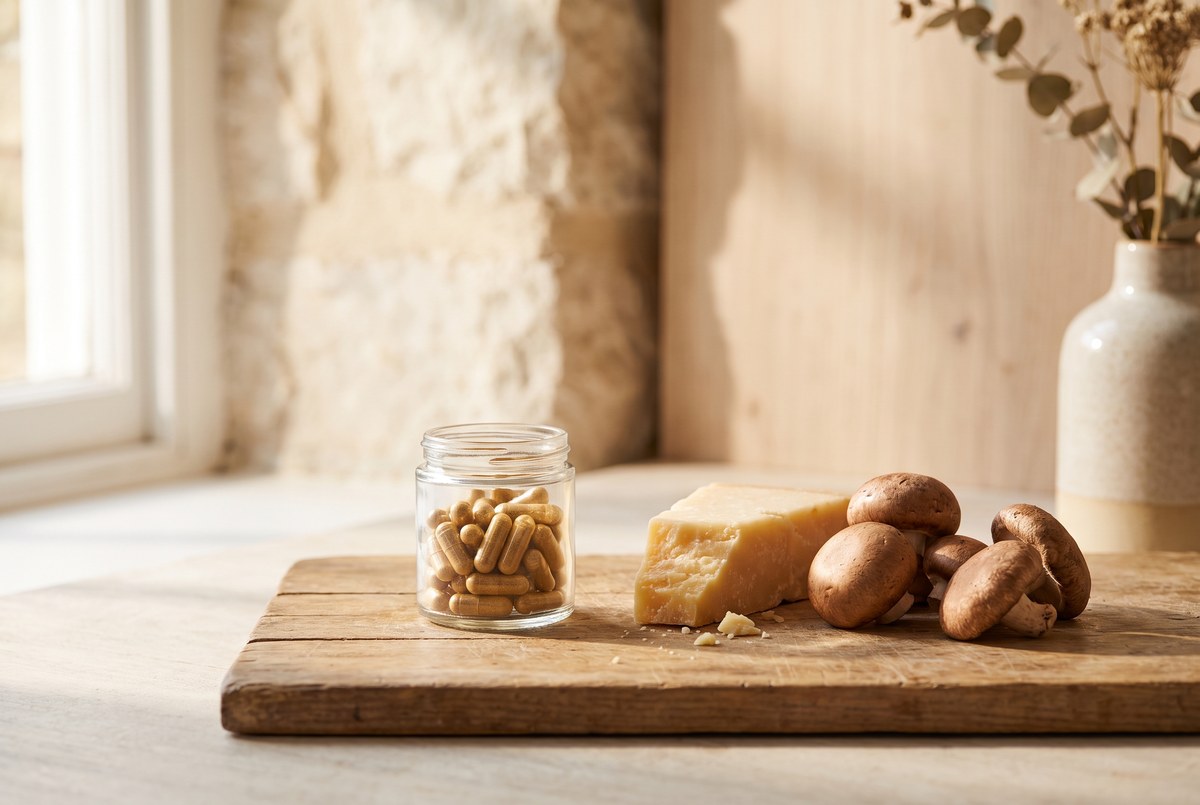
The experiment begins with organisms that do not know they are famous. Yeast. Flies. Worms. Human immune cells in culture. Each receives spermidine—a compound found in aged cheese, mushrooms, and soy—and in a 2009 Nature Cell Biology study, each lived longer, the effect traced to autophagy, the cell’s own cleanup process recycling damaged components. In a 2016 Nature Medicine study, mice given oral spermidine lived longer too, their hearts spared the enlargement and diastolic decline of age.
That is the documented scene behind every spermidine capsule. The precise question is whether any of it transfers to people—and the most defensible current answer is not yet demonstrated: human evidence remains limited, and the distance from extended worm life to extended human life is exactly where this article slows down.
Human Evidence: Preliminary But Encouraging
Human studies on spermidine are still limited but provide some encouraging signs. A 2018 population-based study in The American Journal of Clinical Nutrition linked higher dietary spermidine intake to lower mortality risk, with the difference between the highest and lowest consumers comparable to being 5.7 years younger. However, this observational study cannot prove causation.
A small 2022 randomized trial in JAMA Network Open looked at older adults with subjective cognitive decline. While it didn't find significant effects on most cognitive measures, exploratory analyses suggested possible benefits for verbal memory and reduced inflammation. These results are preliminary and require confirmation in larger studies.
So, while laboratory and animal research on spermidine is compelling, human evidence remains limited. Current studies hint at potential benefits for lifespan and age-related health outcomes, but more rigorous clinical trials are needed to confirm these effects and establish optimal dosing. Educational, not medical advice.
The takeaway
Spermidine shows promise for longevity based on lab and animal studies, with preliminary human evidence suggesting possible benefits, but more research is needed to confirm effects.
Discussed here: Spermidine (Wheat-Germ Extract)
Moderate evidenceWhat that grade means: Several human studies point the same way, but with limits — size, duration, funding, or mixed results.
Typical listed price $44.95 — check the live price before buying.
Read the full evidence page → View on Amazon ↗
See every graded product in Nutraceuticals & Cellular Energizers →
References
4 peer-reviewed sources, published 2009–2022, across 4 journals. 4 of them have a full Magellan study write-up linked below.
- The American Journal of Clinical Nutrition · 2018 · PMID 29955838Higher dietary intake of spermidine is associated with a lower risk of all-cause mortality in humans. Read our full write-up →
- Nature Cell Biology · 2009 · PMID 19801973 · DOI 10.1038/ncb1975Spermidine extends lifespan and reduces oxidative stress by triggering autophagy through epigenetic changes in various organisms and human cells. Read our full write-up →
- Nature Medicine · 2016 · PMID 27841876 · DOI 10.1038/nm.4222Spermidine supplementation improves heart health and extends lifespan in animal models, and higher dietary intake is linked to better cardiovascular outcomes in humans. Read our full write-up →
- JAMA Netw Open · 2022 · PMID 35616942 · DOI 10.1001/jamanetworkopen.2022.13875A 12-month daily spermidine supplement did not improve memory or biomarkers in older adults with subjective cognitive decline, though exploratory findings suggest possible benefits for verbal memory and inflammation. Read our full write-up →
Mechanisms and molecules in this article
Each links to its Magellan monograph — what it is, what it does, and the studies behind it.
Related reading
Learn what the evidence says about key ingredients in this all-in-one longevity formulation.
The evidence for acetyl-L-carnitine is limited to specific conditions, with no direct support for lifespan…
One of the most studied supplements helps preserve muscle and may aid memory in older adults, but the muscle…
All Magellan articles → · More on Nutraceuticals & Cellular Energizers →
Prefer the interactive version? Open this article inside the Magellan app →