The Red Pigment Under the Trial Lights
Astaxanthin, the carotenoid that colors salmon, reliably shifts oxidative-stress biomarkers in human trials — lowering malondialdehyde, raising antioxidant capacity — but no large trial has tested clinical endpoints, and the pooled evidence is only hundreds of participants deep.
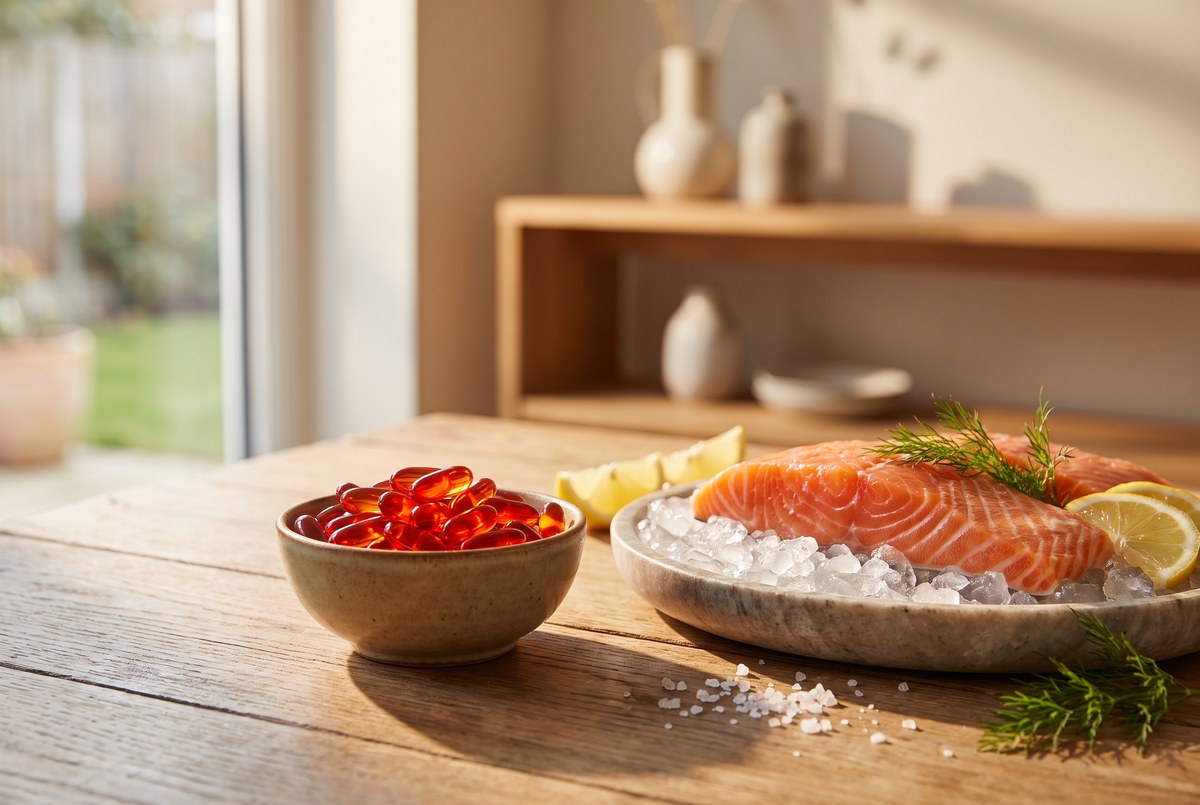
In the triple-blind trial, no one is permitted to know. Not the volunteers swallowing the capsules, not the staff handing them over, not the analysts reading the blood work. The capsules themselves disclose nothing: small, soft, each carrying a few milligrams of a pigment so red it colors the flesh of salmon and the shells of shrimp. Down the hall, the laboratory waits for its numbers — malondialdehyde, superoxide dismutase, total antioxidant capacity — the quiet arithmetic of oxidation in human blood.
The pigment began in an alga. Haematococcus pluvialis produces astaxanthin, and the salmon, trout, shrimp, and krill that accumulate it carry the redness up the food chain. In the supplement, it arrives esterified and lipid-soluble, typically 4 to 12 milligrams a day, built to slot into cell membranes, where it quenches singlet oxygen, scavenges free radicals, and modulates redox-sensitive signaling pathways such as NF-κB and Nrf2. The mechanism is documented. The question the trials exist to answer is whether any of it registers on a human being.
The most defensible answer the evidence permits: the oxidative-stress biomarkers move, consistently; almost everything beyond them is modest, mixed, or extrapolated.
What the blood work shows
The most consistent human finding is biochemical. Meta-analyses and randomized trials — including a 2023 record in Frontiers in Endocrinology and a 2019 analysis in the International Journal for Vitamin and Nutrition Research — show astaxanthin supplementation lowers malondialdehyde — a marker of lipid peroxidation, the slow rusting of fats in cell membranes — and raises total antioxidant capacity and the activity of superoxide dismutase, one of the body's own frontline antioxidant enzymes. The 2023 triple-blind randomized trial in Phytotherapy Research measured insulin resistance, lipid profile, blood pressure, and oxidative stress together — the design that puts the laboratory and the volunteer under the same blind. The pigment is biologically active in people; that much the assays agree on.
Skin, joints, and the smaller signals
Beyond the markers, the signals are real but modest: small improvements in skin moisture and elasticity, in fatigue, and in some cognitive and motor measures. A 2023 multicenter, randomized, double-blind trial in Nutrients tested a complex of krill oil, astaxanthin, and oral hyaluronic acid on joint health in people with mild osteoarthritis — a combination product, which means astaxanthin's own contribution cannot be isolated from it. A 2025 randomized trial in Food & Function reported that astaxanthin improved clinical outcomes, quality of life, and inflammatory factors in patients with rheumatoid arthritis. Encouraging results, small samples, specific populations.
Where the evidence thins
The complications are structural. Meta-analyses of cardiometabolic outcomes find largely neutral-to-modest effects. Wrinkle-depth reduction was not significant in meta-analysis. The pooled trials total only hundreds of participants, often drawn from a small set of research groups — a literature narrow enough that a few labs could tilt it. And no large trial has tested clinical endpoints: no heart-attack rates, no dementia diagnoses, no mortality. Anti-aging claims beyond skin and oxidative-stress markers are extrapolations from mechanism, not observations in people. Astaxanthin does appear well tolerated across the trials, with no major safety signal in the pooled data — which matters, because tolerance is nearly the only thing this evidence is generous about.
For a reader, the practical meaning is calibration: a supplement that demonstrably shifts oxidative-stress biochemistry, plausibly helps skin moisture and fatigue a little, and has not been asked the biggest questions.
So the trial ends the way it began — the capsules counted, the codes still sealed, the blood numbers quietly lower on one marker and higher on another — while the larger questions wait, unasked, in the red pigment.
Educational, not medical advice.
The takeaway
Astaxanthin is biologically active as an antioxidant in humans, with modest signals for skin moisture, fatigue, and some joint and inflammatory outcomes; anti-aging claims beyond biomarkers and skin are extrapolations, not findings.
References
5 peer-reviewed sources, published 2019–2025, across 5 journals. 3 of them have a full Magellan study write-up linked below.
- Front Endocrinol · 2023 · PMID 37020589 · DOI 10.3389/fendo.2023.1144323Astaxanthin supplementation improved markers of inflammation and oxidative stress, and enhanced ART outcomes in infertile women with endometriosis. Read our full write-up →
- Int J Vitam Nutr Res · 2019 · PMID 30982442 · DOI 10.1024/0300-9831/a000497Astaxanthin may have some antioxidant effects in humans, particularly at higher doses and shorter durations, but the overall evidence is unclear. Read our full write-up →
- Phytother Res · 2023 · PMID 37874168 · DOI 10.1002/ptr.8037Astaxanthin supplementation may improve insulin resistance, lipid profiles, and oxidative stress in infertile women with PCOS. Read our full write-up →
- Nutrients · 2023 · PMID 37686801 · DOI 10.3390/nu15173769
- Food Funct · 2025 · PMID 40569081 · DOI 10.1039/d5fo00949a
Mechanisms and molecules in this article
Each links to its Magellan monograph — what it is, what it does, and the studies behind it.
Related reading
Blood ergothioneine falls with age, and low levels track with cognitive decline, cardiovascular disease,…
Grape seed extract pools to a systolic blood-pressure reduction of roughly 2–6 mmHg across meta-analyses —…
Observational cohorts tie polyphenol-rich diets to lower mortality, and randomized trials show modest…
All Magellan articles → · More on Nutraceuticals & Cellular Energizers →
Prefer the interactive version? Open this article inside the Magellan app →