The Stackers' Favorite Family: Polyphenols, Pills and the Long Game
Observational cohorts tie polyphenol-rich diets to lower mortality, and randomized trials show modest improvements in blood pressure, lipids and glucose — but the big supplement trials have come up mixed, and no blend on a shelf has been tested as itself.
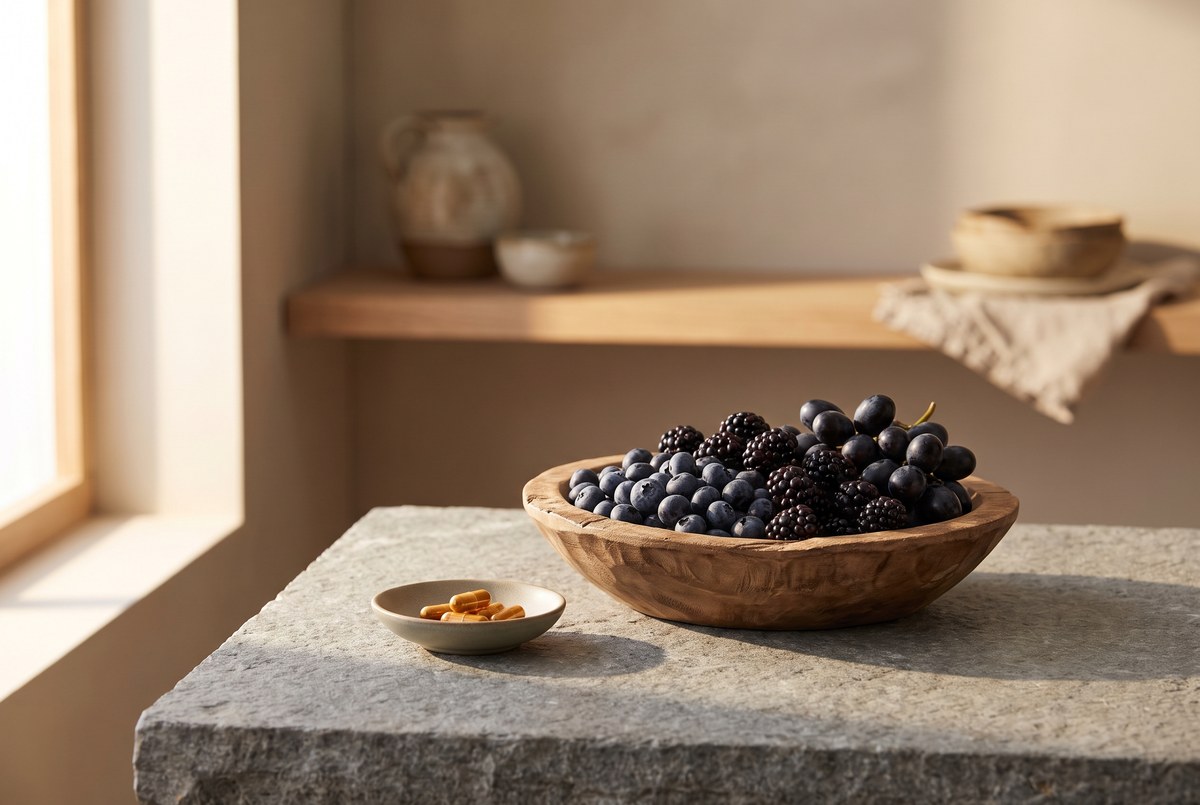
Scroll the biohacker forums at midnight and there it is — the stack. Resveratrol! Quercetin! Cocoa flavanols, green tea extract, anthocyanins, the whole polyphenol rainbow capsulized and lined up on a kitchen counter like a tiny pharmaceutical militia. Pop. Another capsule down. The logic is seductive and everywhere: plants make these compounds, plant-eaters live longer, therefore — capsule. It is one of the great leaps of the supplement subculture. And buried underneath the enthusiasm, there is a real question with a real, complicated answer.
Polyphenols are a large family of plant compounds — flavonoids, phenolic acids, stilbenes like resveratrol, lignans — abundant in fruits, vegetables, tea, coffee, cocoa, olive oil and whole grains. They are among the most abundant antioxidants in the human diet. A blend supplement simply bottles a mix of them.
The question: does swallowing the mix do what eating the pattern does? The most defensible answer — the evidence is strongest for varied, polyphenol-rich diets; supplements show modest, mixed effects; and no commercial blend, including this one, has been tested in human trials.
The big numbers, and their catch
The cohort data are genuinely impressive. A meta-analysis of 16 cohorts covering 462,194 adults found roughly 13 to 15 percent lower all-cause mortality with higher flavonoid intake. A 2025 UK Biobank analysis went further: greater flavonoid diversity — not just quantity — tracked with 6 to 20 percent lower mortality and chronic-disease incidence. Polyphenol-rich foods recur throughout the long-lived Blue Zone diets. But hold the leap. These are associations. People who eat diverse plant-rich diets differ from people who don't in a hundred ways a statistical model can't fully strip out. Association is not causation — it is a lead.
Where trials actually landed
Randomized evidence is more sober and more interesting. A meta-analysis of 281 randomized trials found modest improvements in blood pressure, lipids and glucose markers — real, but surrogate markers, not heart attacks prevented. Then the big test: COSMOS, the large cocoa-flavanol randomized trial published in the American Journal of Clinical Nutrition in 2022, did not reduce total cardiovascular events. It did reduce cardiovascular death — a secondary signal worth noting, not a headline rewritten. On the brain side, a 2023 PNAS trial found dietary flavanols restored hippocampal-dependent memory in older adults — specifically those with lower diet quality and low habitual flavanol intake, which suggests the capsule may be patching a dietary hole rather than building a superpower. And the DIRECT PLUS trial, published in 2022, found a high-polyphenol Mediterranean diet combined with physical activity slowed age-related brain atrophy — note the company it keeps: food pattern plus exercise, not extract alone.
The mechanistic temptation
Resveratrol is the subculture's darling, and its story shows why mechanism isn't destiny. A 2015 review in Mechanisms of Ageing and Development traced how resveratrol engages SIRT1, the same sirtuin pathway implicated in caloric restriction's effects on aging — elegant biology. But oral polyphenol bioavailability is generally low and varies wildly by compound, and single-compound human results are inconsistent. Other antioxidant strategies, like the GlyNAC trial's improvements in oxidative stress and physical function in older adults, show the broader approach can move aging hallmarks — in small, specific trials that replication has to earn.
The honest bottom line for a stacker
Eat the pattern first — the evidence for dietary diversity beats the evidence for any bottle. A blend may plausibly fill gaps for someone whose diet is poor, as the memory trial hints, but it is an inference, not a tested intervention. The counter full of capsules is a bet; the diet is the evidence — and the popping sound of the lid is not, by itself, a mechanism of action. Educational, not medical advice.
The takeaway
The strongest evidence favors varied, polyphenol-rich dietary patterns; supplement trials show modest metabolic effects and some nulls, so a mixed polyphenol blend is an inference from the diet literature, not a tested product.
References
5 peer-reviewed sources, published 2015–2023, across 4 journals. 2 of them have a full Magellan study write-up linked below.
- Mechanisms of Ageing and Development · 2015 · PMID 25824609 · DOI 10.1016/j.mad.2015.03.008Caloric restriction, resveratrol, and melatonin may combat aging and age-related diseases by activating sirtuins and scavenging free radicals. Read our full write-up →
- The Journals of Gerontology: Series A · 2022 · PMID 35975308 · DOI 10.1093/gerona/glac135GlyNAC supplementation in older adults can reverse several age-related health declines, including oxidative stress and mitochondrial dysfunction. Read our full write-up →
- Am J Clin Nutr · 2022 · PMID 35294962 · DOI 10.1093/ajcn/nqac055
- Proc Natl Acad Sci U S A · 2023 · PMID 37252983 · DOI 10.1073/pnas.2216932120
- Am J Clin Nutr · 2022 · PMID 35021194 · DOI 10.1093/ajcn/nqac001
Mechanisms and molecules in this article
Each links to its Magellan monograph — what it is, what it does, and the studies behind it.
Related reading
Resveratrol became famous as the red-wine compound that extended lifespan in laboratory organisms. Two…
All-in-one longevity formulas bundle a dozen compounds aimed at the hallmarks of aging. The strongest…
Astaxanthin, the carotenoid that colors salmon, reliably shifts oxidative-stress biomarkers in human trials…
All Magellan articles → · More on Nutraceuticals & Cellular Energizers →
Prefer the interactive version? Open this article inside the Magellan app →