The Molecule That Made Yeast Live Longer — and What It Actually Does in People
Resveratrol became famous as the red-wine compound that extended lifespan in laboratory organisms. Two decades into human testing, the picture is quieter: modest vascular and anti-inflammatory effects in people who already carry metabolic risk, and no trial yet on the outcomes that matter most.
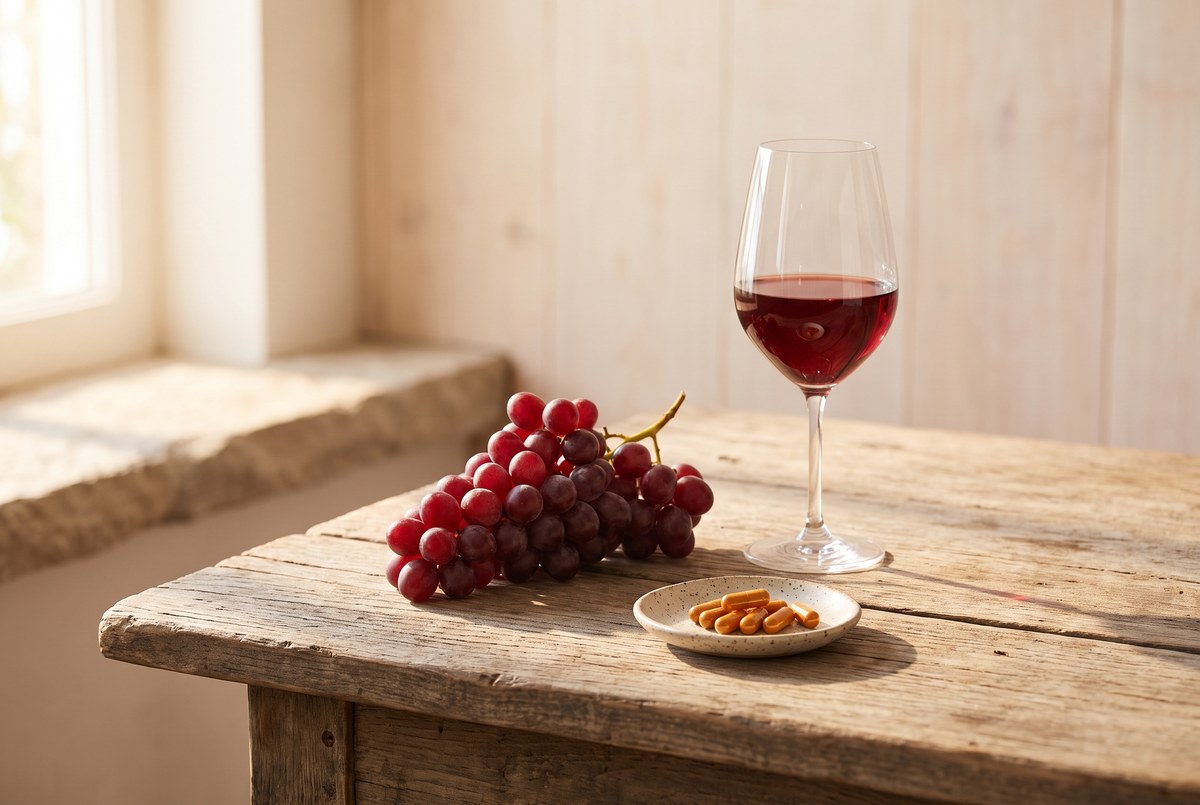
It is possible to hold a year's worth of hope in one hand. It weighs almost nothing — a capsule, sometimes two, taken with breakfast by people who are not sick, exactly, but who have begun to notice the arithmetic of aging: the parent who faded early, the blood-work numbers drifting the wrong way, the suspicion that time has started keeping receipts. Few supplements have carried more of that hope than resveratrol, the polyphenol launched by a beautiful story — the stuff in red wine that made yeast cells live longer, that flipped on the same nutrient-sensing pathways as near-starvation, that might deliver the benefits of deprivation without the deprivation.
The hope is understandable, and it is not nothing. But hope deserves accurate bookkeeping, and resveratrol's ledger, twenty years into human trials, is more modest than the story that launched it.
Here is the honest state of the evidence: the strongest human data show real but small effects on blood-vessel function and inflammation in people who already have metabolic or cardiovascular risk; the celebrated longevity mechanism remains confined to laboratories; and no trial has shown resveratrol changing a hard outcome — not a heart attack prevented, not a dementia delayed, not a life extended.
What the pooled human trials actually show
The best-supported effects come from randomized trials and meta-analyses in people with metabolic or cardiovascular risk. Across pooled trials, supplementation modestly improved endothelial function — the ability of blood vessels to dilate, measured as flow-mediated dilation — and produced small reductions in C-reactive protein, an inflammation marker, especially at doses of 500 mg per day or more continued for ten weeks or longer. Trials in people with diabetes report improved glucose control. Effects on blood pressure have been inconsistent overall.
Individual trials supply both the encouragement and the caution. A 24-month trial in postmenopausal women reported better cognition, cerebral blood flow and insulin sensitivity — a striking result that nonetheless comes largely from one research group and awaits independent replication. A 2020 randomized, placebo-controlled trial in the Journal of Bone and Mineral Research reported improved bone mineral density in postmenopausal women taking resveratrol regularly. And the compound has been put to direct placebo-controlled testing where inflammation does its daily work: the 2024 ARTHROL trial in PLoS Medicine randomized adults with knee osteoarthritis to oral resveratrol or placebo, and a 2025 randomized study in Inflammopharmacology reported improved functional performance in knee osteoarthritis alongside upregulation of sirtuin 1 — one of the very pathways that made the molecule famous. The clinical picture in joint disease, in other words, is still being written.
The gap between the dish and the person
The origin story deserves respect but not worship. Resveratrol (trans-3,5,4'-trihydroxystilbene) is a defensive phytoalexin produced by grapes, berries and peanuts under stress, and interest in it as a longevity compound began with reports that it extended lifespan in yeast and other model organisms, acting through SIRT1 and AMP-activated protein kinase. But a 2021 review in Advances in Nutrition, drawing on studies in mice, concluded that resveratrol's potential to act as a caloric-restriction mimetic appears to be limited. The sirtuin longevity mechanism remains preclinical. An umbrella review of the human trial literature rates much of the evidence as low certainty.
The complications run further. Oral bioavailability in humans is low — the body clears the molecule quickly — which is why liposomal formulations exist, though their superiority has never been proven in human trials. Studies in healthy young adults have come back null. And the red-wine rationale that first popularized the compound has collapsed under current health guidance that no level of alcohol consumption is safe.
What this means in practice
For a reader weighing a bottle, the defensible position is narrow. The human evidence points to modest improvements in vascular and inflammatory markers in people who already carry metabolic risk — not disease prevention in people who do not. Nothing in the literature supports expecting resveratrol to slow aging, protect memory, or extend life; those claims live in yeast, mice, and marketing. Liposomal delivery is a plausible answer to a real absorption problem, not a proven one, and no commercial product has itself been tested in the cited trials.
The capsule in the hand, then, is neither miracle nor fraud. It is a small bet on modest, surrogate improvements — the kind that register on an ultrasound of an artery rather than in the length of a life. That may still be worth something. It is simply worth knowing exactly what something is.
Educational, not medical advice.
The takeaway
In people with metabolic or cardiovascular risk, resveratrol at 500 mg/day or more modestly improves endothelial function and inflammation markers — but it has never been shown to prevent heart attacks, dementia, or early death, and its celebrated longevity mechanism remains preclinical.
References
5 peer-reviewed sources, published 2015–2025, across 5 journals. 3 of them have a full Magellan study write-up linked below.
- Mechanisms of Ageing and Development · 2015 · PMID 25824609 · DOI 10.1016/j.mad.2015.03.008Caloric restriction, resveratrol, and melatonin may combat aging and age-related diseases by activating sirtuins and scavenging free radicals. Read our full write-up →
- Advances in Nutrition · 2021 · PMID 33271594 · DOI 10.1093/advances/nmaa148Resveratrol's ability to mimic caloric restriction and provide significant health benefits in mice is largely unproven and inconsistent across studies. Read our full write-up →
- J Bone Miner Res · 2020 · PMID 32564438 · DOI 10.1002/jbmr.4115Daily resveratrol supplementation may help slow bone loss in the spine and hip of postmenopausal women. Read our full write-up →
- PLoS Med · 2024 · PMID 39137167 · DOI 10.1371/journal.pmed.1004440
- Inflammopharmacology · 2025 · PMID 41037125 · DOI 10.1007/s10787-025-01967-9
Mechanisms and molecules in this article
Each links to its Magellan monograph — what it is, what it does, and the studies behind it.
Related reading
Grape seed extract pools to a systolic blood-pressure reduction of roughly 2–6 mmHg across meta-analyses —…
Observational cohorts tie polyphenol-rich diets to lower mortality, and randomized trials show modest…
What the evidence actually shows about resveratrol's healthspan potential, from bone density to knee pain.
All Magellan articles → · More on Nutraceuticals & Cellular Energizers →
Prefer the interactive version? Open this article inside the Magellan app →