The Night the Ring Went to the Sleep Lab
Consumer wearables now measure sleep, heart rate and HRV well enough to survive comparison with laboratory gold standards — and the signals they track genuinely predict mortality in large cohorts. What no study has shown is that wearing one adds years.
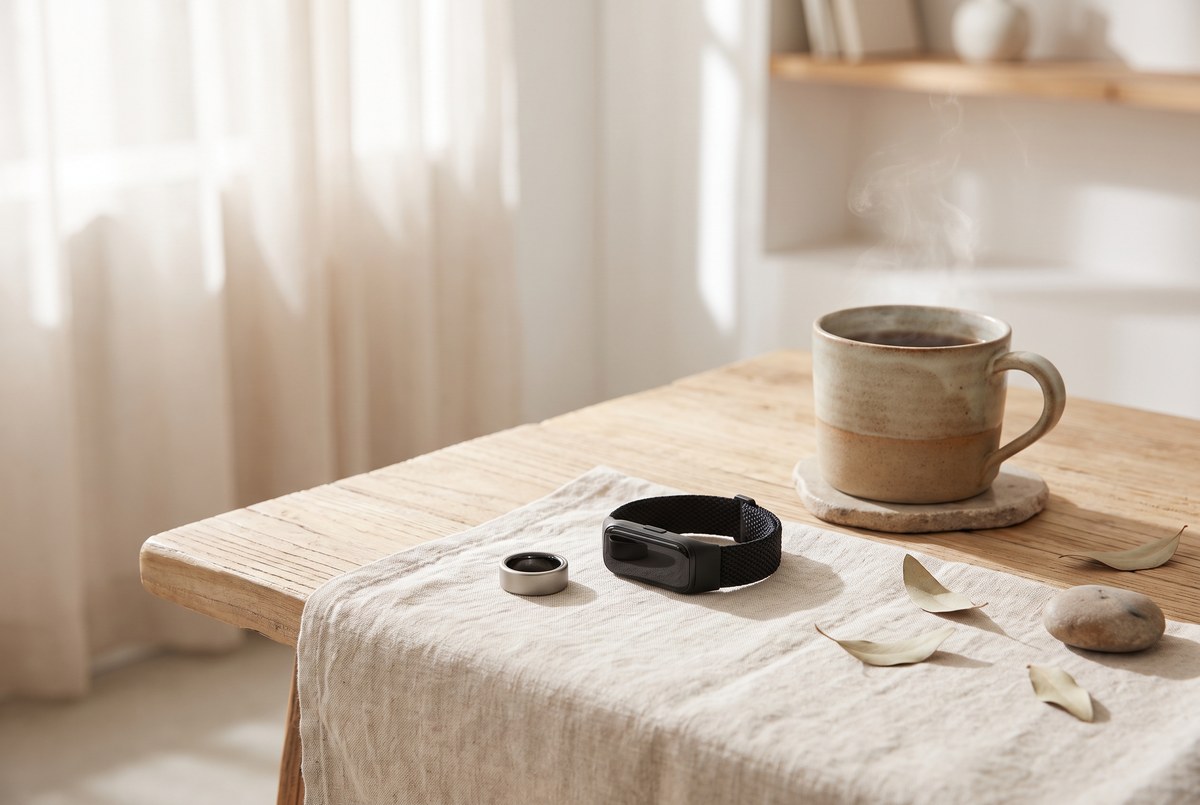
The room is dark, and it is supposed to be. On the sleeper's scalp and face sit the electrodes of polysomnography, the wired apparatus that sleep medicine has treated for decades as the gold standard: brain activity, eye movement, muscle tone, breathing, all of it written out epoch by epoch while the night passes. On the sleeper's finger there is also a ring. No wires. Inside it, an optical sensor fires light into the skin and reads the pulse of blood volume back, an accelerometer logs the small movements of the hand, a thermistor tracks skin temperature. The ring does not know it is being tested. It simply records, the way it records every night, on millions of fingers, in millions of unobserved bedrooms.
In one such validation, published in Sleep Medicine in 2024, ninety-six participants wore the third-generation Oura ring across multiple nights of ambulatory polysomnography, producing 421,045 scored epochs for comparison — each epoch a small verdict on whether the ring's algorithm and the laboratory's technicians saw the same night. Another 2024 study, in Sensors, ran three commercial wearables through the same kind of trial in healthy adults. This is how the consumer wearable grew up: not in keynote presentations, but in rooms like this one, epoch by epoch, against machines that cost more than a car.
The question these rooms answer is narrower than the marketing and more interesting. Can a device bought in a store measure physiological signals that actually matter for long-term health? The most defensible answer the evidence permits: yes for some signals, partially for others — and nothing yet shows that wearing the device, as opposed to the biology it tracks, changes how long anyone lives.
What the machines get right
Across brands — smartwatches, wrist bands and rings from makers such as Apple, Garmin, Fitbit, WHOOP, Polar and Oura — independent validations find close agreement with polysomnography for the basic question of sleep versus wake, and with electrocardiography for heart rate and time-domain heart-rate variability, the RMSSD figure that recovery apps display each morning. Atrial-fibrillation screening has been validated at a scale no ordinary trial can match: the Apple and Fitbit heart studies each enrolled more than 400,000 people and found high positive predictive value for irregular-rhythm notifications, meaning most people alerted really did show atrial fibrillation on confirmatory monitoring.
Why the signals carry weight
The numbers these devices surface are not trivia. A 2018 systematic review and meta-analysis in Epidemiology and Psychiatric Sciences linked sleep duration to all-cause mortality. A 2019 meta-analysis in Biological Research for Nursing tied heart-rate variability to all-cause death and cardiovascular events in patients with cardiovascular disease, and a 2024 study in the Annals of Noninvasive Electrocardiology extended the point to visit-to-visit HRV. Resting heart rate, daily steps, cardiorespiratory fitness and HRV all predict mortality in cohort research. Wearables also move behavior, modestly: an umbrella review of 39 meta-analyses found activity trackers add roughly 1,800 steps per day.
Where the picture blurs
The honest accounting starts here. Four-stage sleep staging — the pretty graph dividing your night into light, deep and REM — agrees with polysomnography only moderately, roughly 50 to 75 percent of epochs. Energy-expenditure estimates are poor. Several validation studies are industry-funded. The confirmatory single-lead ECG behind an irregular-rhythm alert has only modest sensitivity, and false alerts can undermine users' well-being. Above all, every link between these biomarkers and mortality is associational: cohort studies show that people with certain patterns fare better, not that nudging a score on a screen causes the better outcome. No study shows that wearing any of these devices lengthens lifespan.
What a reader can do with that
Used as instruments rather than oracles, these devices earn their place: trends in resting heart rate, sleep duration and HRV are real physiological information, a step goal demonstrably adds steps, and a persistent rhythm alert is a reasonable prompt to see a clinician. What they cannot do is certify health or promise years. The evidence concerns the biomarkers and the measurement accuracy — not these specific commercial products.
Back in the laboratory, the night ends, the electrodes come off, and the technicians finish scoring. The ring's version of the night and the laboratory's version now agree about the large facts and disagree about the fine grain, and that is roughly where the science stands: the counting is good, the staging is approximate, and the lifespan question remains — as it was when the lights went down — unanswered by any device. Educational, not medical advice.
The takeaway
Modern wearables measure sleep-versus-wake, heart rate and HRV with clinically respectable accuracy, and those biomarkers robustly predict long-term health — but the evidence is about the signals, not about any device extending life.
References
5 peer-reviewed sources, published 2018–2024, across 5 journals. 3 of them have a full Magellan study write-up linked below.
- Annals of Noninvasive Electrocardiology · 2024 · PMID 38288511 · DOI 10.1111/anec.13094Both very low and very high heart rate variability between doctor visits are linked to a higher risk of death in people with atrial fibrillation. Read our full write-up →
- Epidemiology and Psychiatric Sciences · 2018 · PMID 30058510 · DOI 10.1017/S2045796018000379Sleeping more than 9 hours per night is associated with an increased risk of all-cause mortality, but this might be due to underlying health issues. Read our full write-up →
- Biol Res Nurs · 2019 · PMID 31558032 · DOI 10.1177/1099800419877442Lower heart rate variability is linked to a higher risk of death and cardiovascular problems in people with heart disease. Read our full write-up →
- Sensors (Basel) · 2024 · PMID 39460013 · DOI 10.3390/s24206532
- Sleep Med · 2024 · PMID 38382312 · DOI 10.1016/j.sleep.2024.01.020
Mechanisms and molecules in this article
Each links to its Magellan monograph — what it is, what it does, and the studies behind it.
Related reading
A look at what consumer wearables like the Garmin Forerunner 265 can and can’t tell us about healthspan.
A body-composition scale tracks biomarkers genuinely linked to cardiovascular risk and mortality, but…
With roughly 15% of 'gluten-free' foods contaminated in meta-analysis and accidental exposures running near…
All Magellan articles → · More on Biometric Wearables & Sensors →
Prefer the interactive version? Open this article inside the Magellan app →