Ten Thousand Lux Before Breakfast
Bright light therapy is an established first-line treatment for seasonal depression, and meta-analyses now show meaningful effects as an adjunct in nonseasonal depression too — roughly doubled remission rates in the largest analysis. But the benefits depend on correct use, the evidence certainty is still rated low, and light can backfire in susceptible people.
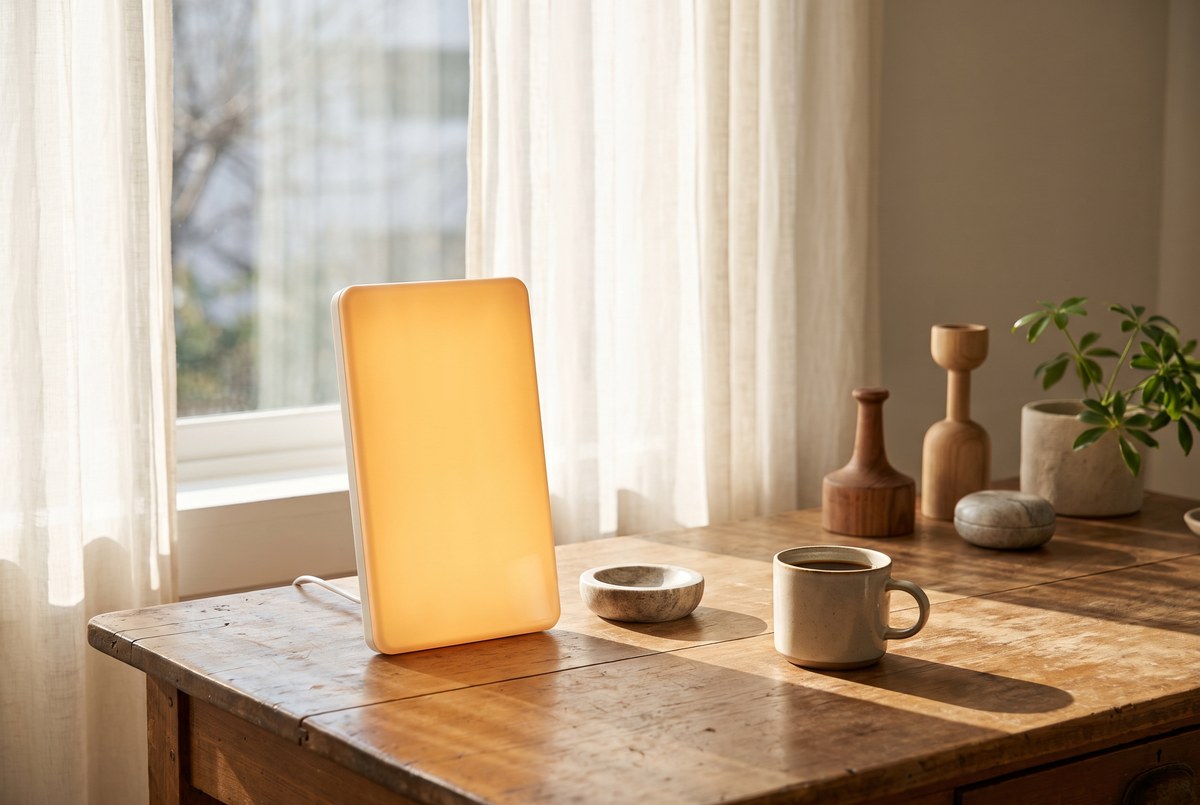
Consider the strangeness of the prescription: sit in front of a glowing box, roughly the brightness of a summer morning compressed into a rectangle of plastic and LEDs, for thirty minutes, every day, before your life begins — and your brain, that ancient photovoltaic organ running its master clock off photons landing on the retina, will (maybe, conditionally, with caveats we'll get to) start producing something closer to a livable mood. It sounds like wellness-catalog mysticism. It is, in fact, one of the most legitimately evidence-backed non-drug interventions in psychiatry — which makes it almost unique in the gadget aisle, and worth taking seriously on the evidence's own terms.
The question worth asking precisely: for whom does bright light therapy demonstrably work, and how big is "works"? The defensible answer: for seasonal affective disorder the evidence is established and first-line; for nonseasonal depression, as an adjunct, the largest meta-analysis to date found effects big enough to matter; and the whole enterprise rests on study quality that reviewers keep, pointedly, rating as low certainty.
The numbers, since numbers are the point
A recent systematic review and meta-analysis in JAMA Psychiatry pooled the trials of bright light for nonseasonal depressive disorders and found roughly doubled remission rates — 40.7 percent versus 23.5 percent for controls — and response rates of 60.4 percent versus 38.6 percent. Those are not miracle numbers; they are the size of numbers that make psychiatrists take a device seriously. Earlier syntheses point the same direction: a 2016 meta-analysis in BJPsych Open found benefit for non-seasonal depression, and a 2019 meta-analysis in Sleep Medicine Reviews directly compared light therapy against antidepressant drugs in major depressive episodes — a comparison that would be absurd if light were mere placebo theater. The mechanism is not mystical either: retinal light signals the suprachiasmatic nucleus, the brain's master circadian clock, entraining rhythm and influencing melatonin and mood-related neurotransmitters like serotonin, as a 2019 review in Psychotherapy and Psychosomatics lays out.
Sleep, dementia, and the edges of the map
Timed bright light also produces small-to-medium improvements in sleep problems — insomnia, circadian-rhythm sleep disorders, and sleep disturbance in dementia — with larger effects at higher light intensities. Early meta-analytic support extends to bipolar and perinatal depression, two populations where a non-drug option carries unusual weight.
The complication: certainty is low and light has a dark side
Now the discipline. Several systematic reviews still rate the overall evidence as low certainty, because the studies are small and heterogeneous — different devices, different durations, different patient populations, different control conditions (and blinding a light trial is its own philosophical problem). Benefits depend on correct use, which is a real dependency: typically 10,000 lux, about 30 minutes, each morning, timed right. Blue-light-only variants, sold as more convenient, remain unproven — a 2022 meta-analysis in the Canadian Journal of Psychiatry examined them for seasonal and non-seasonal depression and the case is not made. And light can provoke harm in the wrong brain: rarely, hypomania in susceptible individuals, which is why bipolar-spectrum illness turns this from a shopping decision into a clinical one. Side effects in general are mild and uncommon — eye strain, headache — but "uncommon" is not "never." None of these trials tested any specific commercial lamp; they tested the exposure itself.
What a reader can do with a glowing box
If winter reliably flattens your mood, the evidence supports trying a properly specified light box — 10,000 lux, thirty morning minutes — with a clinician in the loop if you have any history of mania or bipolar illness. If your depression is nonseasonal, light looks like a reasonable adjunct, not a replacement for care. The glowing rectangle on the breakfast table is, improbably, one of the few gadgets whose promise the trials actually half-keep — half being, in this aisle, close to a standing ovation. Educational, not medical advice.
The takeaway
Thirty minutes of 10,000-lux light each morning is among the best-evidenced non-drug treatments for seasonal affective disorder and a legitimate adjunct in nonseasonal depression — but the trials are small and heterogeneous, blue-light variants remain unproven, and anyone with bipolar-spectrum illness should involve a clinician first.
References
5 peer-reviewed sources, published 2016–2025, across 5 journals. 3 of them have a full Magellan study write-up linked below.
- Psychother Psychosom · 2019 · PMID 31574513 · DOI 10.1159/000502891Bright light therapy effectively reduces depression symptoms and increases treatment response rates in adults with seasonal affective disorder. Read our full write-up →
- Blue-Light Therapy for Seasonal and Non-Seasonal Depression: A Systematic Review and Meta-Analysis ↗Can J Psychiatry · 2022 · PMID 35522196 · DOI 10.1177/07067437221097903Blue-light therapy's effectiveness for seasonal and non-seasonal depression remains unproven based on current evidence. Read our full write-up →
- Sleep Med Rev · 2019 · PMID 31600678 · DOI 10.1016/j.smrv.2019.101213Combining light therapy with antidepressants is more effective than antidepressants alone for major depressive episodes, and light therapy alone is comparable to antidepressants alone. Read our full write-up →
- JAMA Psychiatry · 2025 · PMID 39356500 · DOI 10.1001/jamapsychiatry.2024.2871
- BJPsych Open · 2016 · PMID 27703764 · DOI 10.1192/bjpo.bp.115.001610
Mechanisms and molecules in this article
Each links to its Magellan monograph — what it is, what it does, and the studies behind it.
Related reading
Ambulatory blood pressure — especially nighttime and 24-hour averages — predicts death and cardiovascular…
Nighttime traffic noise is a documented cardiovascular risk factor, and white-noise masking genuinely helps…
Evening blue light genuinely suppresses melatonin, but the best-controlled evidence — a Cochrane review of…
All Magellan articles → · More on Air, Water & Sleep Systems →
Prefer the interactive version? Open this article inside the Magellan app →