Two Amino Acids Walk Into a Capsule: What Carnosine Actually Did in Human Trials
Carnosine — the muscle dipeptide that buffers acid and traps glycation chemistry — modestly lowered fasting glucose and HbA1c in meta-analyses of randomized trials in prediabetes and type 2 diabetes. The effects are real, modest, and short-term.
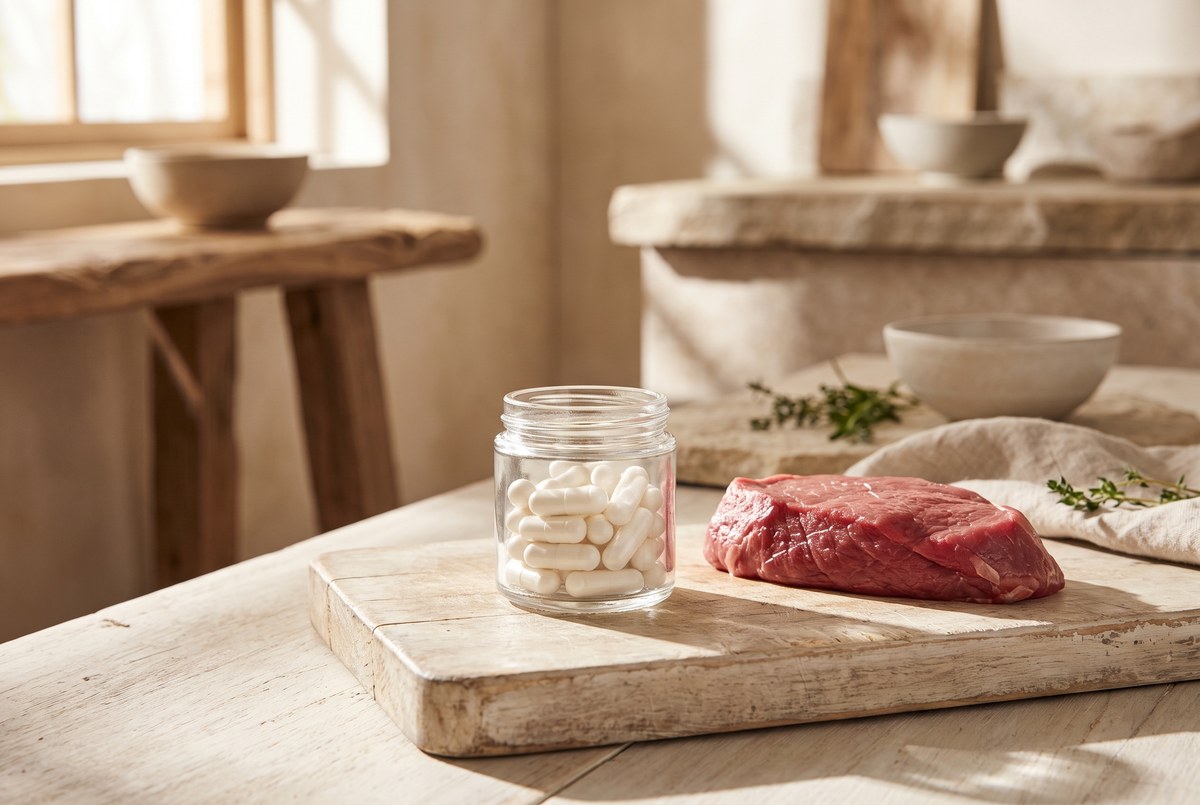
Scroll the metabolic-health forums at six in the morning. The stacks scroll past — glucose monitors pinned to biceps, berberine debates, fasting windows logged to the minute. And there, again and again: carnosine. The anti-glycation dipeptide. Two amino acids — beta-alanine and L-histidine — clicked together, packed into capsules, swallowed with black coffee. Clink. The promise is chemical and seductive: trap the reactive sugar fragments that gum up proteins, buffer the acid, mop up the radicals.
Strip the hype and the molecule is still interesting. Carnosine concentrates in skeletal muscle, cardiac muscle, and brain, where it buffers intracellular pH, scavenges reactive oxygen and nitrogen species, chelates transition metals, and traps reactive carbonyls such as methylglyoxal before they can form advanced glycation end-products — AGEs, the browning chemistry of the body. Endogenous levels decline with age. The forum question, asked soberly: does swallowing more of it change anything that matters?
The most defensible answer: yes, modestly, on glycemic markers, in people who already have metabolic trouble — and provisionally, on little else.
The glycemic signal, pooled three times
The strongest evidence is a stack of meta-analyses pointing the same direction. A 2019 meta-analysis in Complementary Therapies in Medicine pooled randomized trials on lipid profile, fasting blood glucose, HbA1c and insulin resistance. A 2021 systematic review in Advances in Nutrition combined human and animal data on glycemic control and insulin-resistance markers. A 2025 meta-analysis in BMC Endocrine Disorders focused on carnosine or beta-alanine in prediabetes and type 2 diabetes — and found supplementation modestly improved glycemic control, lowering fasting glucose and HbA1c. Behind the pools sit individual randomized trials, including a 2023 trial in Nutrition, Metabolism and Cardiovascular Diseases reporting improved glucose control in adults with prediabetes and type 2 diabetes. Modest is the operative word throughout: these are improvements in surrogate markers, not demonstrations that anyone avoided a diagnosis or a complication.
Beyond glucose: waistlines, words, and carbonyls
Pooled trials of histidine-containing dipeptides also report reduced waist circumference and a small improvement in delayed verbal recall — an intriguing cognitive whisper, nothing more. Smaller trials report reductions in circulating AGEs, triglycerides, inflammatory markers, and oxidative-stress and kidney-injury markers. Mechanistic and animal work links the anti-glycation activity to protection of proteins and even to lifespan extension in a model organism — a model organism, which is a long way from a person. The BMJ Open record in the evidence file sits behind this anti-glycation, antioxidant framing.
The nulls, the size, the strange reversal
Now the complications, which deserve the same volume as the hype. Human trials are generally small and short. Several outcomes — musculoskeletal measures, AGEs in autism, some insulin measures — showed no benefit. Effect sizes are modest. And one observational study found higher endogenous muscle carnosine associated with insulin resistance, a reminder that supplementation and native tissue levels are not the same thing and that the body's own allocation of the dipeptide may track with dysfunction rather than prevent it.
For a reader scanning the stack threads, the practical meaning is this: carnosine is biologically active, plausibly useful for glycemic markers in people with prediabetes or type 2 diabetes, and unproven for the grander claims. Nothing in the literature shows it slowing aging in humans; nothing shows it preventing disease. The evidence supports a nudge, not a rescue.
Which leaves the morning scene more or less intact — the capsule, the coffee, the hopeful arithmetic — minus the certainty. The molecule does its quiet chemistry. The forums do theirs. Between the two sits a stack of meta-analyses saying: a little, for some markers, in some people, so far.
Educational, not medical advice.
The takeaway
Across meta-analyses, carnosine or beta-alanine supplementation modestly improves glycemic markers in people with prediabetes or type 2 diabetes; the trials are small and short, several outcomes were null, and nothing yet shows it changes long-term health outcomes.
References
5 peer-reviewed sources, published 2017–2025, across 5 journals. 2 of them have a full Magellan study write-up linked below.
- BMJ Open · 2017 · PMID 28864708 · DOI 10.1136/bmjopen-2017-017691This study protocol outlines a trial to investigate if carnosine supplementation improves cardiometabolic health and cognitive function in individuals with pre-diabetes and type 2 diabetes. Read our full write-up →
- Complement Ther Med · 2019 · PMID 31987255 · DOI 10.1016/j.ctim.2019.102241Carnosine supplementation may help lower HbA1C levels, but it does not appear to impact other markers of glucose metabolism or lipid profile. Read our full write-up →
- BMC Endocr Disord · 2025 · PMID 40999397 · DOI 10.1186/s12902-025-02016-w
- Adv Nutr · 2021 · PMID 34333586 · DOI 10.1093/advances/nmab087
- Nutr Metab Cardiovasc Dis · 2023 · PMID 38172006 · DOI 10.1016/j.numecd.2023.10.012
Mechanisms and molecules in this article
Each links to its Magellan monograph — what it is, what it does, and the studies behind it.
Related reading
A plant alkaloid with real metabolic effects, an AMPK mechanism, and a marketing problem.
Randomized trials and meta-analyses support alpha-lipoic acid for relieving diabetic-neuropathy symptoms,…
Vinegar can blunt some post-meal glucose responses, but the weight-loss evidence is small, heterogeneous,…
All Magellan articles → · More on Nutraceuticals & Cellular Energizers →
Prefer the interactive version? Open this article inside the Magellan app →