The Most Studied Powder in the Gym Still Has Fine Print
Creatine monohydrate plus resistance training reliably adds modest lean mass and strength, including in older adults, and modestly improves memory — but the bone benefits are unproven and the powder does little without the training.
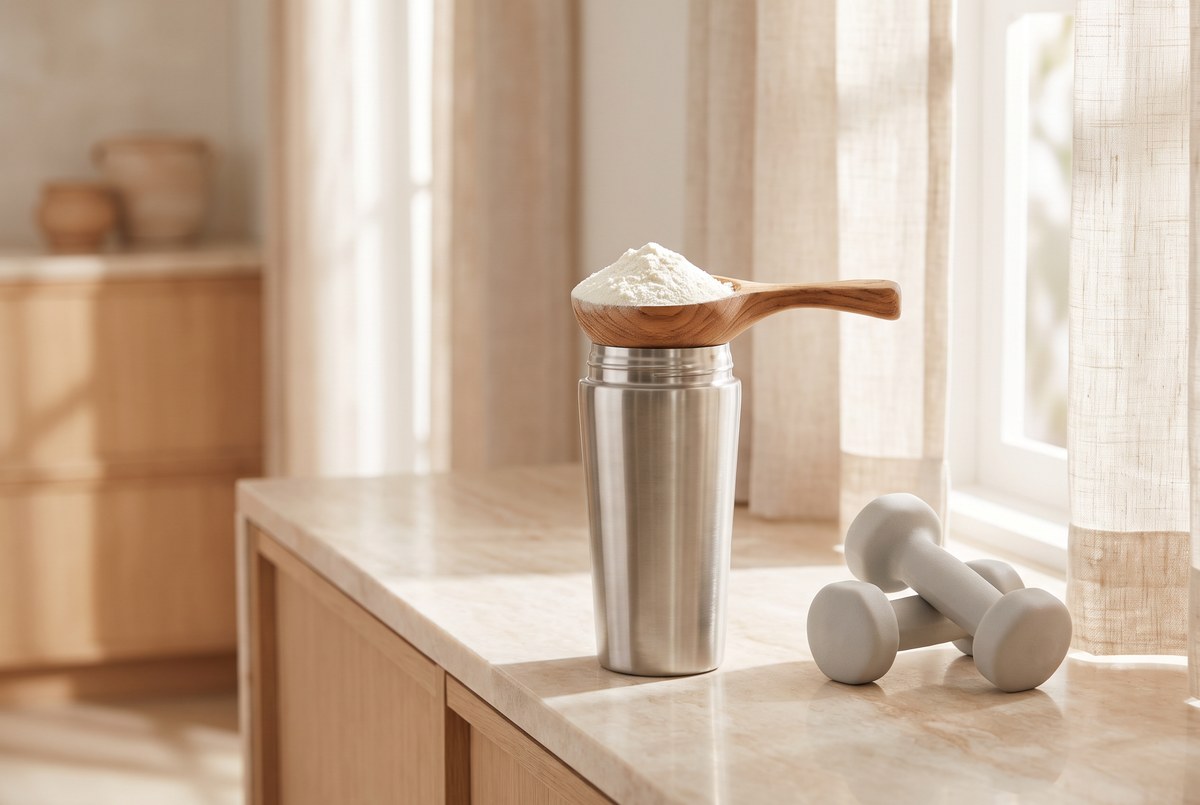
So here is the thing about creatine — and this comes from watching the same tub of white powder migrate across years of kitchen counters (yours, maybe; certainly a training partner's, the one who reads studies at one in the morning and texts you effect sizes) — which is that almost everything the fitness world believes about it is, for once, roughly true, except for the parts that are not, and those parts turn out to matter precisely where the marketing is loudest.
Tighten it up. Creatine is a nitrogen-containing compound the body synthesizes from arginine, glycine, and methionine and also takes in from meat and fish; about 95% of it sits in skeletal muscle, phosphorylated into phosphocreatine, where it rapidly regenerates ATP during short bursts of high-intensity effort. Supplementation raises muscle and, to a lesser extent, brain creatine and phosphocreatine stores — which is the entire rationale for the tub. The precise question is what swallowing the monohydrate form — the most studied one — actually adds in humans. The defensible answer: modest, real gains in muscle and strength when combined with resistance training; modest average gains in memory; and a trail of unproven claims beyond that.
Strength and muscle: the solid ground
The muscle evidence is the deepest. A 2014 meta-analysis in Medicine & Science in Sports & Exercise pooled trials of creatine during resistance training in older adults; a 2024 meta-analysis in Nutrients did the same for adults under 50; a 2020 systematic review in the Journal of Geriatric Physical Therapy examined the additive effects of creatine and exercise training in aging populations; and a 2023 trial in Frontiers in Public Health measured resistance training plus creatine on oxidative stress, strength, and quality of life in older adults. The consistent finding across this literature: combining creatine with resistance training modestly increases lean mass — about +1.4 kg in older-adult trials — and improves upper- and lower-body strength, including in people past middle age. None of it is dramatic; the word this literature keeps returning to is modest.
The brain, the bones, and the borderline
Memory performance improves modestly on average, with the largest effects in adults 66 to 76 years old — an aging-brain signal more than a young-brain one. The bone story is weaker. A 2026 meta-analysis in postmenopausal women found meaningful strength gains only when at least 5 g/day was paired with training, and no bone-density benefit; other long-term bone trials are inconsistent, several showing no benefit. The 2022 record in Bone in this evidence file documents the phosphocreatine–ATP mechanism itself, not an outcome. And a pattern repeats across the literature: gains are generally smaller when creatine is taken without exercise.
What it will not do
The complications deserve equal light. Creatine is not a muscle shortcut — the trials that show benefit almost all pair it with actual resistance training. Bone claims remain unproven. Cognitive effects are modest and age-dependent. The safety side, at least, is reassuring: at recommended doses of 3–5 g/day, creatine monohydrate is well tolerated in healthy people, with an extensive safety record — one reason it has survived decades of scrutiny that flashier supplements have not.
For a reader, the practical meaning is unglamorous: if you lift, creatine is one of the few supplements with a real, replicated, modest effect; if you do not, you are buying a small bet on biomarkers. Everything else is extrapolation.
Which brings the story back to the tub on the counter, the scoop, the training partner texting effect sizes at 1 a.m. For once, he was mostly right about the powder — as long as the barbell was part of the plan.
Educational, not medical advice.
The takeaway
At 3–5 g/day, creatine is among the best-evidenced and best-tolerated supplements for strength and lean mass when paired with resistance training; claims beyond that — bone density, big cognitive effects, benefits without exercise — are weak, inconsistent, or absent.
Train the numbers: Stronger for Longer
A free 12-week walking, strength and balance program for adults 50 and over, measured with five validated self-tests at weeks 0, 6 and 12. No supplements, nothing to buy.
References
5 peer-reviewed sources, published 2014–2024, across 5 journals. 3 of them have a full Magellan study write-up linked below.
- Bone · 2022 · PMID 35688360 · DOI 10.1016/j.bone.2022.116467Creatine supplementation combined with resistance training may help improve muscle and bone health in older adults and could be a treatment for frailty and cachexia. Read our full write-up →
- Front Public Health · 2023 · PMID 37206869 · DOI 10.3389/fpubh.2023.1062832Resistance training improves antioxidant defense, muscle strength, and quality of life in older adults, and creatine supplementation further enhances muscle strength gains. Read our full write-up →
- J Geriatr Phys Ther · 2020 · PMID 30762623 · DOI 10.1519/JPT.0000000000000222Creatine supplementation combined with exercise may offer additive benefits for muscle strength, function, and lean mass in older adults, particularly women, but more research is needed for bone, cognition, and optimal dosing. Read our full write-up →
- Med Sci Sports Exerc · 2014 · PMID 24576864 · DOI 10.1249/MSS.0000000000000220
- Nutrients · 2024 · PMID 39519498 · DOI 10.3390/nu16213665
Mechanisms and molecules in this article
Each links to its Magellan monograph — what it is, what it does, and the studies behind it.
Related reading
One of the most studied supplements helps preserve muscle and may aid memory in older adults, but the muscle…
Ranked by the strength of human evidence for an outcome that matters, not by mechanism. Creatine, protein,…
A striking result from one tiny overnight experiment is being sold as a universal brain boost. A newer…
All Magellan articles → · More on Nutraceuticals & Cellular Energizers →
Prefer the interactive version? Open this article inside the Magellan app →