Niacinamide at 4 Percent: What the Split-Face Trials Actually Show
Topical niacinamide at 4–5% over 8–12 weeks modestly improves fine lines, hyperpigmented spots, blotchiness, and barrier function in mostly split-face trials — real, gradual, industry-sponsored, and far less dramatic than the marketing.
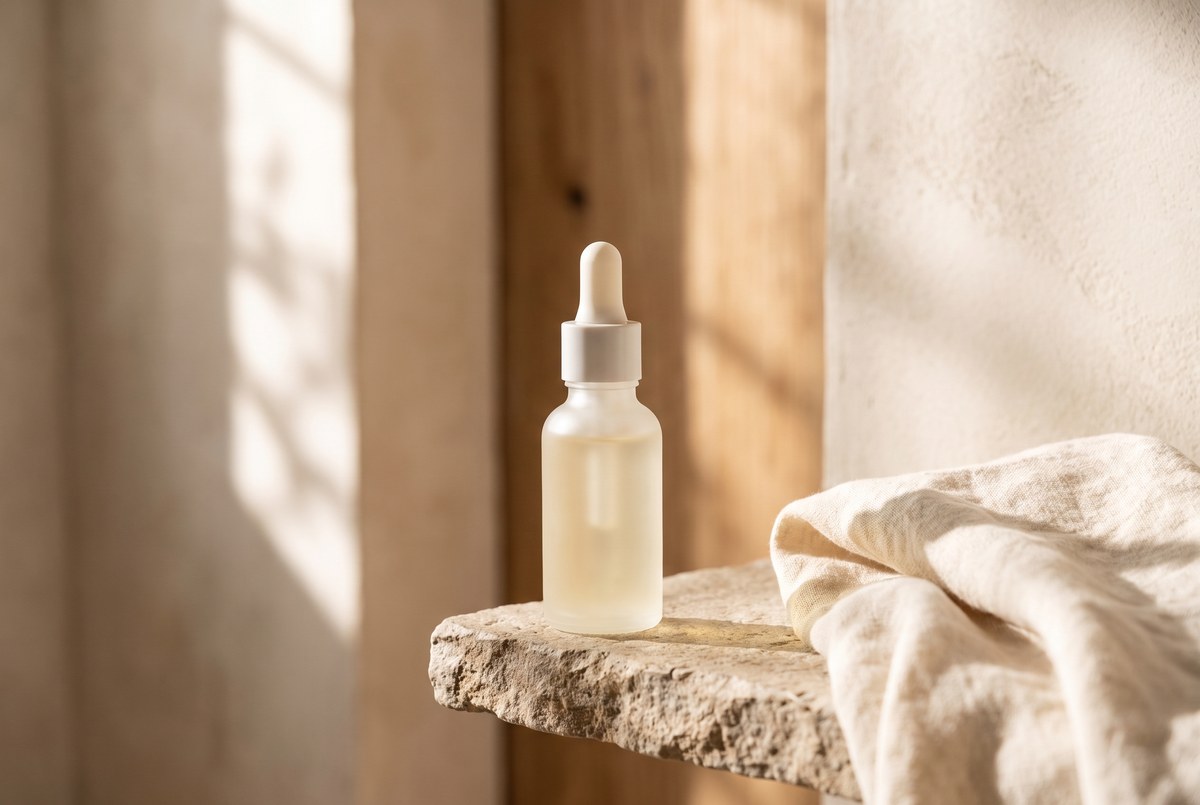
The routine has steps now. Cleanser, essence, serum, moisturizer — and in the middle, the dropper. Niacinamide! Two percent, four percent, ten percent, layered and patted and debated in comment threads with the intensity of a contact sport. Plip — that is the dropper. The skincare internet made vitamin B3's amide a star. The question is what the trials, not the threads, actually say.
Niacinamide is the amide form of vitamin B3, a precursor of the cellular cofactors NAD+ and NADP+ — the same molecule, swallowed, that shows up in the NAD+ literature, though topical use is a different pharmacology entirely. On skin — a small, water-soluble molecule, typically at 2 to 5 percent — it has been reported to stimulate the synthesis of ceramides and other stratum-corneum lipids, to inhibit melanosome transfer from melanocytes to keratinocytes, and to modulate sebum production. Mechanistically tidy. But mechanism is marketing's favorite costume. The trials are the test.
The split-face verdict
The core evidence is a series of randomized, mostly split-face trials — one half of the face treated, the other half control, the volunteer serving as their own placebo. A 2004 study in the International Journal of Cosmetic Science reported that topical niacinamide reduced yellowing, wrinkling, red blotchiness, and hyperpigmented spots in aging facial skin. A 2005 paper in Dermatologic Surgery underpins the barrier and pigment-modulation claims. A 2007 randomized controlled trial in the Journal of Cosmetic Dermatology tested the clinical anti-aging effects of topical kinetin and niacinamide in Asian skin. A 2008 study in the Journal of Dermatology evaluated the anti-wrinkle effects of a cosmetic containing niacinamide, and a 2025 double-blind, placebo-controlled study in Current Medicinal Chemistry tested topical niacinamide combined with ultrasound.
Across this literature the pattern holds: modest improvement in the appearance of fine lines and wrinkles, hyperpigmented spots, red blotchiness, sallowness, and elasticity — plus a stronger skin barrier with reduced transepidermal water loss, arguably the driest and best-supported claim of the set. Most positive studies used 4 to 5 percent niacinamide over 8 to 12 weeks. The benefits are gradual — weeks, not mornings. It is also worth noting what the trials used: 4 to 5 percent. The stronger serums the internet favors are extrapolations past the studied range, not refinements of it, and the same modest register covers the sebum and redness claims.
The caveats are structural
Many of these trials were sponsored by cosmetic manufacturers. Many tested niacinamide inside multi-ingredient formulations, which makes the effect attributable to niacinamide alone genuinely hard to isolate. Split-face designs are clever but carry their own limits: cosmetic grading scales, short horizons, a face that cannot be fully blinded to itself. And modest means modest: this is a molecule that shifts appearance incrementally, not one that reverses aging.
The cancer headline is a different route
The most dramatic niacinamide numbers do not belong to serums. A large oral — not topical — phase 3 trial found nicotinamide reduced new non-melanoma skin cancers by 23 percent in high-risk patients, with the benefit waning after the supplement was stopped. A 2025 propensity-matched cohort of more than 33,000 veterans associated oral nicotinamide use with about 16 percent lower skin-cancer risk — observational, not causal. Neither result applies to a topical serum, and neither should be borrowed for one. The evidence describes the compound, not any specific commercial product, which has not itself been tested in the cited studies.
So the dropper keeps its place in the routine — honestly earned, honestly modest. Plip. Weeks later: a little smoother, a little more even, a barrier a little better sealed. That, on the evidence, is what four percent buys. Educational, not medical advice.
The takeaway
One of the better-evidenced cosmetic actives for modest, gradual improvement in photoaged skin; the striking skin-cancer numbers concern oral niacinamide in high-risk patients, not any serum.
References
5 peer-reviewed sources, published 2004–2025, across 5 journals. 3 of them have a full Magellan study write-up linked below.
- Dermatol Surg · 2005 · PMID 16029679 · DOI 10.1111/j.1524-4725.2005.31732Topical niacinamide improves multiple signs of facial aging, including wrinkles, hyperpigmentation, redness, yellowing, and elasticity. Read our full write-up →
- J Cosmet Dermatol · 2007 · PMID 18047609 · DOI 10.1111/j.1473-2165.2007.00342.xA combination of kinetin and niacinamide significantly improved multiple signs of skin aging in Asian subjects, outperforming niacinamide alone for some parameters. Read our full write-up →
- Curr Med Chem · 2025 · PMID 39171587 · DOI 10.2174/0109298673325125240813075250A topical niacinamide formulation improved skin hydration and reduced sebum, with subjective benefits in appearance, firmness, and wrinkles, especially when combined with ultrasound. Read our full write-up →
- Int J Cosmet Sci · 2004 · PMID 18492135 · DOI 10.1111/j.1467-2494.2004.00228.x
- J Dermatol · 2008 · PMID 19017042 · DOI 10.1111/j.1346-8138.2008.00537.x
Mechanisms and molecules in this article
Each links to its Magellan monograph — what it is, what it does, and the studies behind it.
Related reading
Topical azelaic acid is one of the few skincare actives with high-certainty randomized-trial evidence — for…
Bakuchiol is marketed as retinol's gentler plant twin. A 12-week randomized trial backs the comparison —…
Copper tripeptide-1 stimulates collagen in the lab and connective tissue in rat wounds, and it has become a…
All Magellan articles → · More on Skin & Topical Longevity →
Prefer the interactive version? Open this article inside the Magellan app →