The Red Threads: What Saffron Trials Actually Measure
In small randomized trials, saffron extract at roughly 20–30 mg/day reduces mild-to-moderate depressive symptoms and performs comparably to SSRIs with fewer adverse events, and modestly improves subjective sleep — but the studies are short, small, often industry-funded, and still await independent replication.
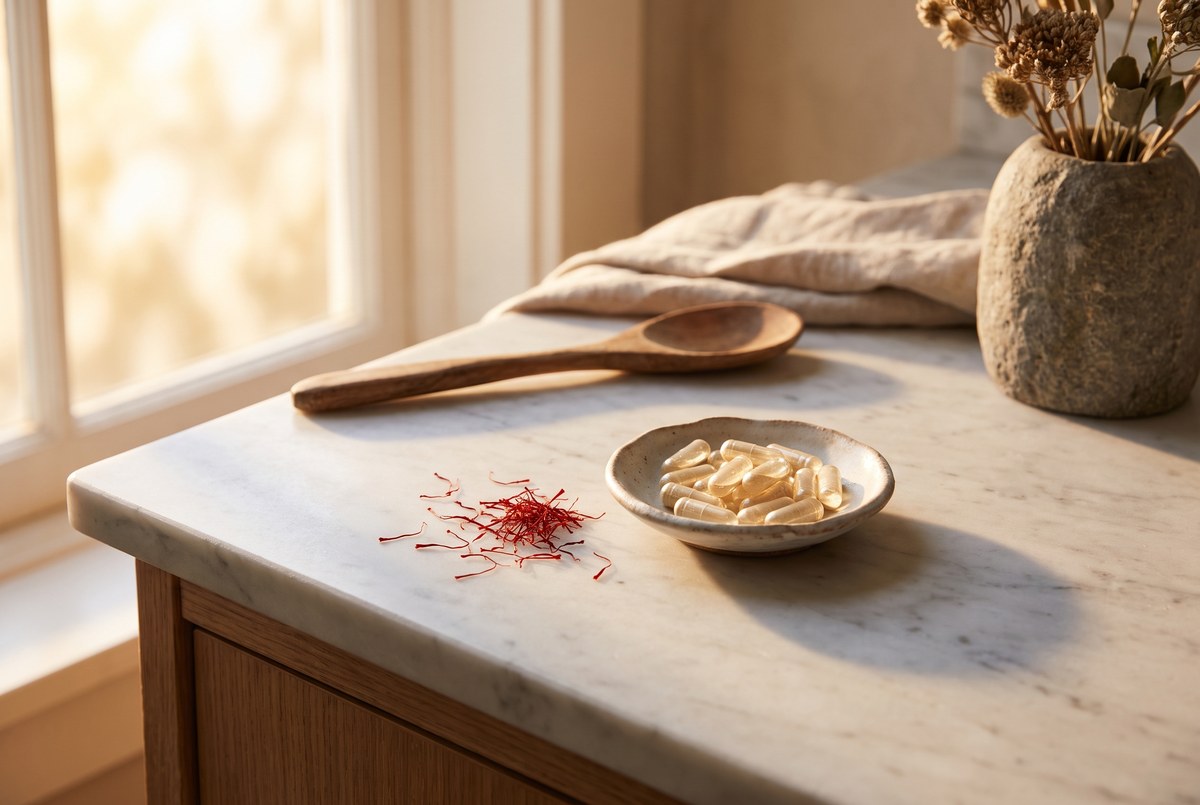
The stigma is red, thread-thin, and dried. Three of them per flower — Crocus sativus, harvested by hand, which is why saffron has always cost more by weight than almost anything else in the kitchen. In the laboratory the spice becomes an extract, standardized under names like affron and Safr'Inside, its chemistry reduced to known quantities of its principal constituents: the carotenoids crocin and crocetin, the volatile compound safranal.
In the trial the extract becomes a capsule. Fourteen to 100 milligrams a day for the sleep studies, about 20 to 30 for mood, taken for four to eight weeks. The volunteers fill in questionnaires. Some wear actigraphs on their wrists. Some sleep wired to EEGs while the delta power is recorded. Some have their evening melatonin measured. Nobody speaks. This is how a spice gets interrogated.
The question under all of it: does saffron do anything measurable for mood, sleep, or the aging retina — and how much trust do the answers so far deserve?
Mood: the strongest signal
Multiple randomized controlled trials and meta-analyses report that saffron reduces symptoms of mild-to-moderate depression versus placebo — and in head-to-head trials performs comparably to SSRI antidepressants, with fewer adverse events. A 2025 meta-analysis of randomized controlled trials in Nutrition Reviews pooled the saffron-versus-SSRI literature. In healthy adults, a 2017 trial in Complementary Therapies in Medicine found the affron extract improved mood over four weeks. The doses in this literature are modest — a small fraction of a gram of a spice sold by the gram — and the proposed mechanisms, antioxidant and anti-inflammatory activity and modulation of serotonin and melatonin synthesis, are at least biologically coherent.
Sleep and the retina: smaller, newer
The sleep trials report modest improvements in subjective sleep quality and insomnia severity — a 2021 study in Nutrients documents improved sleep latency and duration — with some objective correlates: increased evening melatonin, greater EEG delta power. Early randomized trials in age-related macular degeneration report improved retinal function and modest visual-acuity gains, consistent with the proposed neuroprotective effects of saffron's carotenoids in retinal tissue. These are early trials in early disease: a signal worth following, not a treatment claim.
Separately, crocin — the principal carotenoid — carries its own small clinical literature in osteoarthritis: trials in Iran report immunoregulatory effects and significant changes in the expression of microRNA-21 and microRNA-155 in patients. These are single-center studies; they extend the compound's reach without strengthening its central claims.
The complication, placed prominently
The trials are generally small, short, and often industry-funded or single-center. The sleep evidence has holes: a saffron-containing nutraceutical blend failed to beat placebo on actigraphy, and meta-analytic evidence for insomnia is rated very-low-to-moderate quality. Independent, large-scale replication of the mood findings is lacking — comparability to SSRIs in small short trials is not the same as proven equivalence. Tolerability looks good over four to eight weeks, but long-term data are limited, adulteration of commercial saffron is common enough that extract standardization genuinely matters, and saffron is not a replacement for prescribed treatment — the trials themselves say so by design, enrolling mild-to-moderate severity for a handful of weeks. The evidence describes saffron and its standardized extracts as a category, not any specific commercial product.
For a reader, the practical shape: for mild symptoms, saffron is one of the more interesting botanicals in the controlled literature — which is not the same as proven therapy, and is miles from a claim on severe illness.
The threads still come three to a flower, still dried, still red. The capsule on the shelf is an attempt to make that ancient harvest behave like a drug: measured, blinded, counted. So far the counting says maybe — a cautious, moderately supported maybe. Educational, not medical advice.
The takeaway
Saffron is among the better-supported botanicals for mild mood and sleep complaints, yet the evidence base is small, short-term, partly industry-funded, and not a substitute for prescribed treatment.
References
5 peer-reviewed sources, published 2017–2025, across 4 journals. 3 of them have a full Magellan study write-up linked below.
- Nutrients · 2021 · PMID 33925432 · DOI 10.3390/nu13051473Saffron extract improved objective and subjective measures of sleep quality and duration in people with mild to moderate sleep disorders and anxiety. Read our full write-up →
- Complement Ther Med · 2017 · PMID 28735826 · DOI 10.1016/j.ctim.2017.06.001A daily dose of 28mg of affron, a saffron extract, improved mood and reduced stress and anxiety in healthy adults with low mood. Read our full write-up →
- Nutr Rev · 2025 · PMID 38913392 · DOI 10.1093/nutrit/nuae076Saffron appears to be as effective as SSRIs for depression and anxiety, with fewer side effects. Read our full write-up →
- Iran J Allergy Asthma Immunol · 2022 · PMID 35822682 · DOI 10.18502/ijaai.v21i3.9805
- Iran J Allergy Asthma Immunol · 2020 · PMID 32615659 · DOI 10.18502/ijaai.v19i3.3453
Mechanisms and molecules in this article
Each links to its Magellan monograph — what it is, what it does, and the studies behind it.
Related reading
Randomized trials and meta-analyses support alpha-lipoic acid for relieving diabetic-neuropathy symptoms,…
Vinegar can blunt some post-meal glucose responses, but the weight-loss evidence is small, heterogeneous,…
The giant COSMOS trial gave cocoa flavanols the fairest test any supplement has had. The headline outcome…
All Magellan articles → · More on Nutraceuticals & Cellular Energizers →
Prefer the interactive version? Open this article inside the Magellan app →