The Foam Roller on the Living-Room Floor: What Rolling Actually Does, Per the Trials
Foam rolling is gym-bag gospel for recovery and flexibility. The trial record mostly agrees on soreness and range of motion — and mostly shrugs at strength, power, and anything grander.
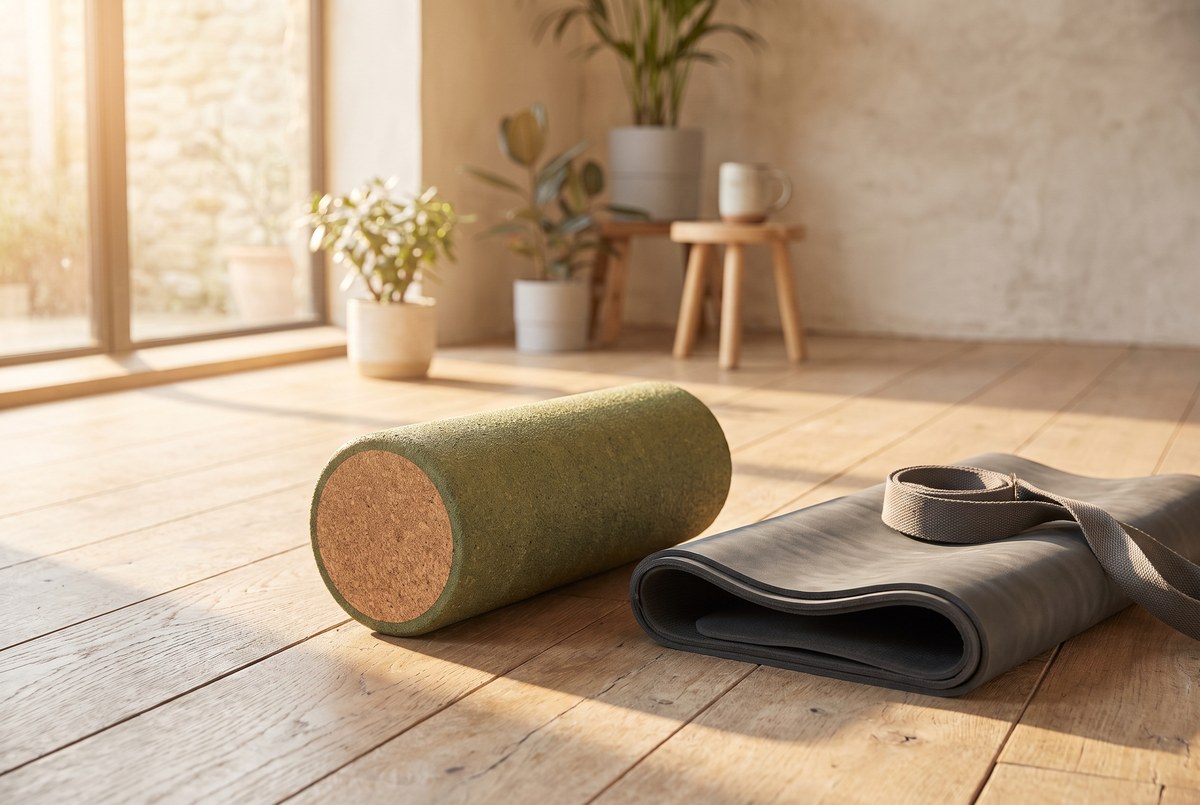
OK so if you've spent any time in a gym in the last decade — or on the floor of a living room, wincing, dragging your thigh back and forth over what is essentially a dense pool noodle with ambitions — you already know the foam roller occupies a strange cultural position, which is that everyone uses it, everyone swears by it, everyone has a vague and slightly mystical theory about fascia and knots and 'release,' and almost nobody can tell you what the actual trials found, which is what we're here for.
The claims out in the wild are big: it melts adhesions, it detoxifies, it remodels tissue, it makes you faster. The precise question for the evidence: what does self-myofascial release — using your own body weight to apply rolling pressure to muscle and fascia — measurably do in controlled studies? The most defensible answer: it is a real flexibility and short-term recovery tool, a trivial performance tool, and not a structural remodeling tool at all.
Range of motion: the solid finding
Multiple systematic reviews land in the same place. A 2020 multilevel meta-analysis in Sports Medicine and a 2022 systematic review and meta-analysis in the same journal found that foam rolling acutely increases joint range of motion — to a degree broadly comparable with static stretching. A 2016 trial in the Journal of Sport Rehabilitation directly compared foam rolling with static and dynamic stretching for flexibility and strength. Translation into human: if you roll before you move, you will likely move through a larger range, about as much as if you'd stretched, and the proposed mechanisms are immediate and unglamorous — increased stretch tolerance, reduced musculotendinous stiffness, neural and pain modulation, transient circulatory changes — not lasting structural change to fascia.
Soreness: the other solid finding
A 2024 meta-analysis of 16 randomized trials, 515 participants, found foam rolling moderately reduces delayed-onset muscle soreness 24 to 48 hours after exercise — standardized mean differences of about −0.53 to −0.77 — with a small carryover to sprint and strength recovery. A 2020 systematic review in the Journal of Bodywork and Movement Therapies, covering range of motion, recovery, and performance markers, reached a broadly consistent conclusion, as had a 2015 review of self-myofascial release in the same journal. For the sore-human-being use case — the day after the workout, the stairs taken like a hostage negotiation — the evidence is genuinely supportive.
Performance and grandeur: the weak findings
Now the complication, which the gym conversation omits. Effects on maximal strength, power, and jump performance are trivial or inconsistent. Several analyses find foam rolling no more effective than other warm-up activities. Most of this research was done in young, healthy adults — not the fifty-year-old whose back is the actual reason the roller is in the cart. A small crossover trial did link a single rolling session to reduced arterial stiffness and improved vascular endothelial, nitric-oxide-related function, which is intriguing and preliminary in equal measure. And the big mystical claims — long-term structural change to fascia, detox, anti-aging — have no human evidence. None. The cylinder does not know your longevity goals.
What a reader should take from this
Use it for what it demonstrably does: a few minutes before training for range of motion, a few minutes after for the next day's soreness. Expect modest, temporary, real effects — not transformation. It is cheap, safe, and honest about its ceiling, which is more than most recovery gadgets can say.
So the roller stays on the living-room floor, faintly judgmental, entirely literal: a piece of foam that improves your range today and your soreness tomorrow, and never once promised to remake you — a reminder, in dense polyurethane, of how rare an honest tool actually is.
Educational, not medical advice.
The takeaway
Foam rolling acutely increases range of motion comparably to static stretching and moderately reduces delayed-onset muscle soreness 24–48 hours post-exercise (a 2024 meta-analysis of 16 RCTs, n=515, found SMD −0.53 to −0.77), but effects on strength, power, and jump performance are trivial or inconsistent.
References
5 peer-reviewed sources, published 2015–2022, across 3 journals. 2 of them have a full Magellan study write-up linked below.
- J Bodyw Mov Ther · 2015 · PMID 26592233 · DOI 10.1016/j.jbmt.2015.08.007Self-myofascial release can acutely improve flexibility, reduce muscle soreness, and aid recovery, but its long-term effects on flexibility are unclear. Read our full write-up →
- J Sport Rehabil · 2016 · PMID 27736289 · DOI 10.1123/jsr.2016-0102Foam rolling acutely improves flexibility more than static or dynamic stretching, and maintains or improves muscle strength, making it a good warm-up option. Read our full write-up →
- Sports Med · 2022 · PMID 35616852 · DOI 10.1007/s40279-022-01699-8
- Sports Med · 2020 · PMID 31628662 · DOI 10.1007/s40279-019-01205-7
- J Bodyw Mov Ther · 2020 · PMID 32825976 · DOI 10.1016/j.jbmt.2020.01.007
Mechanisms and molecules in this article
Each links to its Magellan monograph — what it is, what it does, and the studies behind it.
Related reading
The viral number comes from a Finnish cohort that measured fatal coronary disease, not a trial that…
Breathing is the last thing most people think to train — until a climbing blood-pressure reading makes the…
Intermittent pneumatic compression is proven hospital medicine — it prevents deadly clots and helps diseased…
All Magellan articles → · More on Recovery, Sauna & Light Therapy →
Prefer the interactive version? Open this article inside the Magellan app →