The Hot Shower Question: Chlorine By-Products, a Cancer Signal, and a Filter's Untested Promise
Trihalomethanes and other disinfection by-products are absorbed through skin and lungs during hot showers, and epidemiology links high exposure to elevated bladder-cancer risk — but the evidence is associational, and no study has shown a shower filter improves any health outcome.
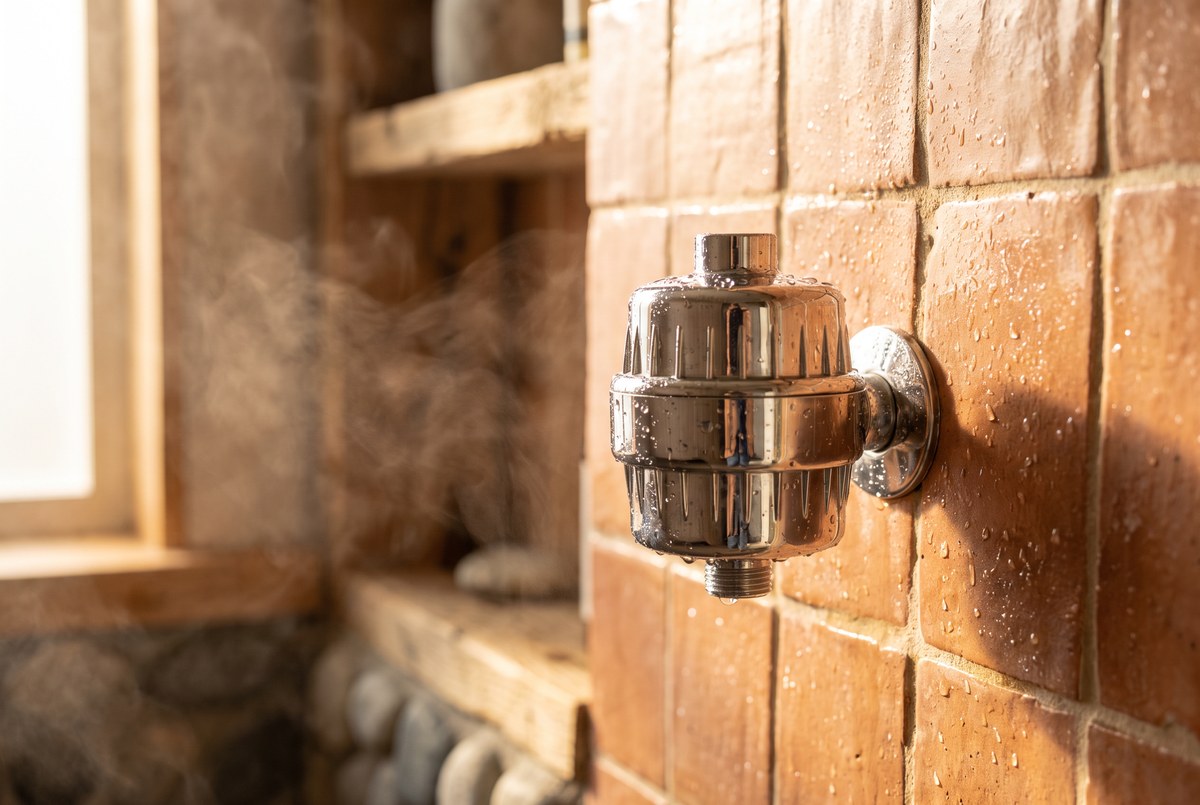
Turn the handle. Hot water — full blast, steam climbing, the bathroom a cloud. Every shower is also an exposure event, and the clean-water people know it. Chlorine in, by-products out: trihalomethanes, haloacetic acids, volatile, skin-permeable, riding the vapor into the lungs — whoosh. In human exposure studies, a single hot shower measurably raised chloroform levels on the breath!
Here is the chain of facts, each link real. Chlorination is the most common method of disinfecting drinking water — a triumph of public health. But chlorine reacting with natural organic matter forms by-products: THMs such as chloroform, plus haloacetic acids. These compounds are volatile and skin-permeable, so they can be inhaled and absorbed through the skin during hot showers; in the exposure studies, the dermal dose absorbed was roughly equal to the inhaled dose. Heat is the multiplier: hot water drives these compounds into the air, which is why the shower, not the cold tap, is the exposure event. Exposure research estimates that the majority of household THM uptake comes from showering and bathing — not from drinking the water. That inversion — the bathroom out-dosing the kitchen — is the entire rationale for a point-of-use device at the showerhead. And the risk framing deserves the same care: chlorination prevents waterborne disease at population scale, so the honest question is dose reduction at the margin, not danger versus safety. Every step of that chain is documented; only the last step — proven health benefit — is missing.
So the question: does that exposure carry meaningful risk, and does a point-of-use shower filter reduce it enough to matter?
What the epidemiology shows
The most consistent human signal is bladder cancer. Meta-analyses — a 2022 review in Environmental Health Perspectives, a 2025 time-updated trihalomethane meta-analysis in the Journal of Hazardous Materials, and a 2025 systematic review with dose-response meta-analysis in Environmental Health Perspectives — report roughly 30 to 60 percent higher bladder-cancer risk among the most exposed. A 2006 study in the American Journal of Epidemiology belongs to the same literature, and a 2023 population-based cohort in the Journal of the National Cancer Institute added a more recent, modest colorectal-cancer association.
The words that matter: association, not causation
Several large cohort studies and reviews caution explicitly: the evidence is associational and does not establish causation. And relative risk is not absolute risk — a proportional elevation of 30 to 60 percent lands on each person's baseline, and what it adds in absolute terms is a different, smaller-sounding number. The pregnancy-outcome literature is mixed: some studies link blood trihalomethane levels to reduced fetal growth, others find no association. Chlorination by-products such as trichloramine are also implicated in respiratory irritation. And the health benefits of water disinfection itself are widely regarded as outweighing these risks — no one serious proposes unchlorinated water.
The unproven last step
Carbon-based filtration can lower levels of common by-products such as trihalomethanes and haloacetic acids. That part is chemistry. But here is the gap the marketing steps over: no study has shown that a shower filter improves any health outcome. No one has followed filtered households to disease endpoints. Every benefit claim rests on plausible exposure reduction, not proven risk reduction — and the evidence describes the by-products and the exposure route, not any specific commercial filter.
For a reader: shorter, cooler, better-ventilated showers and filtration all plausibly cut the dose. Plausible is the operative word — the honest ceiling of the science.
The steam still climbs. The chlorine still does its ancient, necessary work in the pipes. What a filter buys, on present evidence, is a smaller dose of the trade-off — not a proven escape from it. Educational, not medical advice.
The takeaway
The exposure pathway is well documented and the cancer association is real but not proven causal; filtration plausibly lowers exposure while proven risk reduction remains undemonstrated.
References
5 peer-reviewed sources, published 2006–2025, across 4 journals. 3 of them have a full Magellan study write-up linked below.
- Am J Epidemiol · 2006 · PMID 17079692 · DOI 10.1093/aje/kwj364Long-term exposure to trihalomethanes (THMs) from chlorinated water, through drinking, showering/bathing, and swimming, is associated with an increased risk of bladder cancer. Read our full write-up →
- Environ Health Perspect · 2022 · PMID 35536285 · DOI 10.1289/EHP9895Exposure to disinfection by-products in drinking water may interact with a specific genetic variant to increase bladder cancer risk. Read our full write-up →
- J Natl Cancer Inst · 2023 · PMID 37551954 · DOI 10.1093/jnci/djad145High levels of trihalomethanes in drinking water may increase the risk of proximal colon cancer in men. Read our full write-up →
- Environ Health Perspect · 2025 · PMID 39837568 · DOI 10.1289/EHP14505
- J Hazard Mater · 2025 · PMID 40043398 · DOI 10.1016/j.jhazmat.2025.137833
Related reading
Ambulatory blood pressure — especially nighttime and 24-hour averages — predicts death and cardiovascular…
HEPA filtration demonstrably cuts indoor PM2.5 and nudges blood pressure down by a few millimeters of…
Nighttime traffic noise is a documented cardiovascular risk factor, and white-noise masking genuinely helps…
All Magellan articles → · More on Air, Water & Sleep Systems →
Prefer the interactive version? Open this article inside the Magellan app →