Two Thousand Years of Milk Thistle, One Missing Endpoint
Milk thistle's extract, silymarin, is the world's default herbal answer to a frightening diagnosis: fatty liver. Meta-analyses show it modestly improves liver enzymes and metabolic markers — but the hardest tests, biopsies and survival, have so far refused to follow.
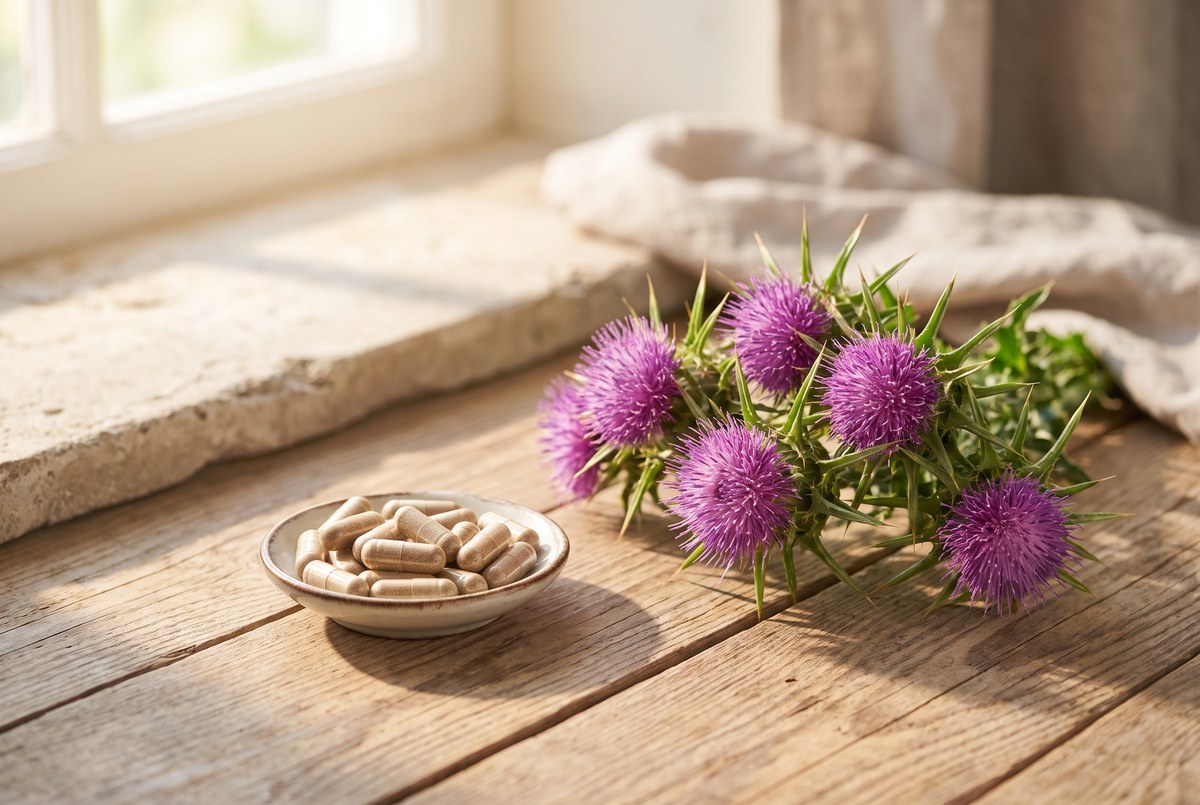
The diagnosis usually arrives by accident — an ultrasound ordered for something else, a casual line on the report: hepatic steatosis. Fatty liver. The person holding that paper is rarely sick yet, and that is the peculiar terror of it: a disease announced early enough to fear and too early to feel. Into that gap between knowledge and symptom walks one of the oldest remedies on earth. Milk thistle — Silybum marianum — has been used medicinally for over two thousand years, and its extract, silymarin, is what worried people reach for first.
The fear deserves a straight answer, and the straight answer requires separating the compound's three reputations: the ancient one, the laboratory one, and the one earned in randomized trials.
Here is the honest state of the evidence. Silymarin — a mixture of flavonolignans, principally silybin at roughly 70–80% of the extract, with silychristin, silydianin and the flavonoid taxifolin — shows antioxidant, anti-inflammatory, antifibrotic, membrane-stabilizing and liver-regenerating properties in laboratory and animal models. In human trials it modestly improves the numbers doctors watch. On the outcomes patients actually fear — scarring, cirrhosis, death — it has not yet delivered.
What the pooled trials show
In non-alcoholic fatty liver disease, multiple meta-analyses of randomized trials — a 2017 PRISMA meta-analysis in Medicine, a 2017 systematic review in the World Journal of Gastroenterology, a 2020 meta-analysis in Nutrition, and a 2023 record in Annals of Hepatology — find silymarin modestly lowers the liver enzymes ALT and AST and improves metabolic markers including cholesterol, triglycerides and fasting insulin. A 2018 review in Phytotherapy Research made the case across metabolic syndrome. Meta-analyses also report modest reductions in fasting glucose in type 2 diabetes, and a randomized prophylaxis trial reported less anti-tuberculosis drug-induced liver injury with milk thistle. The reviewers' own caveat matters: the underlying trials are small and of variable quality.
Where it has failed the big tests
The harder the endpoint, the quieter the result. A rigorous biopsy-based NASH trial missed its primary histologic endpoint — the disease, looked at directly, did not yield — though it showed a fibrosis signal worth naming precisely: improvement in 22.4% of treated patients versus 6.0% on placebo. A landmark trial in alcoholic cirrhosis found no survival benefit. No study demonstrates prevention of cirrhosis or liver-related death. Two thousand years of use is a history of hope, not a data set.
The complication: getting it in
Plain silymarin is poorly absorbed — a real pharmacological limitation, not a marketing talking point — and phosphatidylcholine (phytosome) formulations only partly address it. Some of the extract's ancient reputation may simply never have reached the liver in meaningful amounts, which cuts both ways: it explains weak results, and it warns against assuming a better capsule changes the outcome story. No commercial product has itself been tested in the cited studies.
Practical meaning
Read silymarin as a low-risk adjunct for people whose liver enzymes are elevated — a plausible nudge to ALT, AST and metabolic markers, alongside the unglamorous interventions that actually reverse fatty liver. It is not a rescue for a scarred liver, not a license to ignore the cause, and never a substitute for evaluating why the enzymes rose in the first place.
The person with the ultrasound report will get the blood drawn again next year, and the numbers may well look a little better. Whether that is the thistle, the diet, or the fear itself doing the work — the literature, honestly kept, cannot yet say. What it can say is what was never proven, and that too is a kind of care.
Educational, not medical advice.
The takeaway
Silymarin modestly lowers ALT and AST and improves cholesterol, triglycerides and fasting insulin in pooled NAFLD trials — but a rigorous biopsy-based NASH trial missed its primary endpoint (with only a fibrosis signal: 22.4% vs 6.0% over placebo), a landmark cirrhosis trial found no survival benefit, and nothing shows it prevents cirrhosis or liver-related death.
References
5 peer-reviewed sources, published 2017–2023, across 5 journals. 2 of them have a full Magellan study write-up linked below.
- Ann Hepatol · 2023 · PMID 38579127 · DOI 10.1016/j.aohep.2023.101174Silymarin supplementation may improve liver enzymes, lipid profiles, and liver histology in individuals with nonalcoholic fatty liver disease. Read our full write-up →
- Phytother Res · 2018 · PMID 30015401 · DOI 10.1002/ptr.6153Milk thistle and its component silymarin show promise for treating metabolic syndrome due to their various health benefits. Read our full write-up →
- Nutrition · 2020 · PMID 33418491 · DOI 10.1016/j.nut.2020.111092
- Medicine (Baltimore) · 2017 · PMID 29245314 · DOI 10.1097/MD.0000000000009061
- World J Gastroenterol · 2017 · PMID 28785154 · DOI 10.3748/wjg.v23.i27.5004
Mechanisms and molecules in this article
Each links to its Magellan monograph — what it is, what it does, and the studies behind it.
Related reading
A plant alkaloid with real metabolic effects, an AMPK mechanism, and a marketing problem.
Carnosine — the muscle dipeptide that buffers acid and traps glycation chemistry — modestly lowered fasting…
Inulin reliably feeds beneficial gut bacteria, eases constipation and nudges metabolic markers in…
All Magellan articles → · More on Nutraceuticals & Cellular Energizers →
Prefer the interactive version? Open this article inside the Magellan app →