The Case for Watching a Number on Your Nightstand
Research links indoor air that's too dry to impaired airway defense and better viral survival, and air that's too wet to mold and mites — with several reviews converging on 40–60% relative humidity as the favorable band. But no trial has tested humidity monitors themselves, and the health evidence is thinner than the product category suggests.
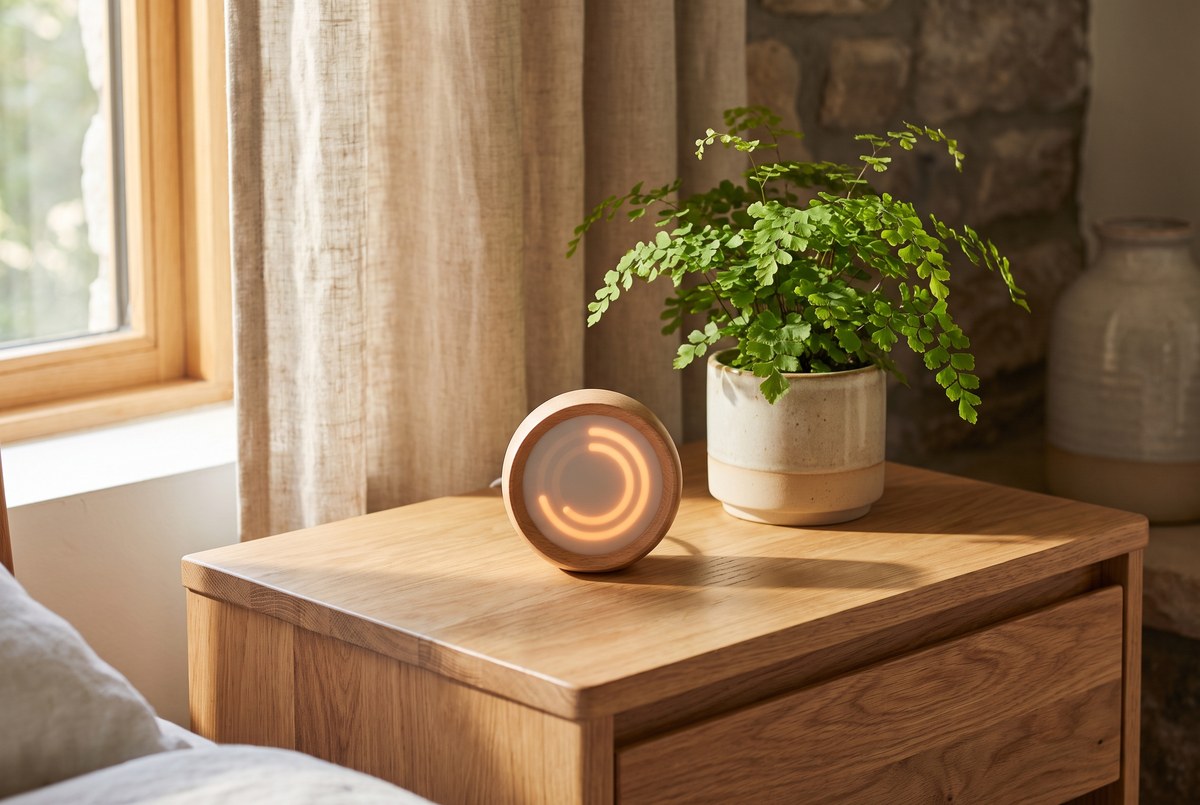
Here's a small domestic humiliation most of us have performed without quite admitting it: waking in January with a throat like sandpaper and eyes that burn, glancing at some glowing little gadget on the nightstand that reads 28% — twenty-eight percent relative humidity, a figure that means the heated air in your bedroom holds barely a quarter of the water it could — and thinking, with the particular optimism of a person who buys measuring devices, that knowing the number is the same as fixing it. A smart humidity monitor is a hygrometer with opinions: it tracks indoor relative humidity continuously so you can nudge it into a target band, usually cited as roughly 40 to 60 percent, with humidifiers, dehumidifiers, or ventilation. The question worth asking, since the category sells wellness by implication: what does the evidence actually say humidity does to human health — and where does measuring it fit in?
The defensible answer splits in two. The science of humidity and health is real, convergent, and interesting. The science of humidity monitoring as a health intervention does not exist — no trial has ever tested the monitor itself.
The dry-air case, which is genuinely documented
The evidence against very dry indoor air has breadth. A 2019 study in the Proceedings of the National Academy of Sciences found that low ambient humidity impairs airway barrier function and innate resistance against influenza — the first lines of respiratory defense, measurably weakened. Reviews link dry air to impaired mucociliary clearance, the conveyor-belt mechanism that sweeps pathogens out of the airway, and to irritation of eyes, skin, and airways. On the viral side, a 2020 study in Environmental Science & Technology examined an airborne common-cold virus's susceptibility to relative humidity, and the broader literature finds greater survival and airborne transmission of influenza and other respiratory viruses in dry conditions. This is why winter is respiratory season in heated buildings, not just in cold ones.
The wet-air case, and the band in between
Push the number the other direction and different problems bloom: high humidity favors dust mites, mold, and allergen growth — a mapping laid out as far back as a 1986 review in Environmental Health Perspectives on the indirect health effects of indoor humidity. Between the two failure modes sits the band several reviews converge on, roughly 40 to 60 percent, as most favorable for health. A multinational COVID-19 analysis published in the Journal of the Royal Society Interface in 2022 added a modern, population-scale data point to that convergence, and a 2021 review in the International Journal of Hygiene and Environmental Health examined temperature, humidity, and ventilation together in office-like environments — health, work performance, and infection risk sharing the same air.
The complication: certainty is low, and the monitor is unproven
Now the honest discounting. A Cochrane review of indoor-air humidification found only low-certainty benefit for dry-eye symptoms, little effect on dry nose or skin, and — this should stop the marketing copy cold — no trials reporting infection outcomes at all. Some modeling studies conclude ventilation reduces respiratory-virus risk more effectively than humidification, which makes humidity one dial on a panel, not the master switch. And the device in the nightstand scenario? No study has tested whether monitoring humidity changes behavior enough to change health. The evidence concerns the exposure — the air itself — not the instrument reading it.
What a reader can actually do
The practical upshot is old-fashioned: if winter air leaves your throat raw, a humidifier aimed at the 40–60 percent band is a reasonable, evidence-adjacent response; if your basement smells of mildew, the same band argues the other direction. A monitor's honest job is feedback — keeping you from overshooting into mold territory while fixing dryness. That is a real service, quietly delivered.
So the little number earns its place on the nightstand — not as a health device with outcomes to its name, but as a gauge for an exposure that genuinely matters. The air was always the intervention. The number just keeps you honest about it. Educational, not medical advice.
The takeaway
Keeping indoor humidity near 40–60% is supported by reviews, lab studies, and a multinational COVID-19 analysis as favorable for airway defense and viral control — but a Cochrane review found only low-certainty benefit from humidification, ventilation may matter more, and no study has tested whether owning a monitor changes any health outcome.
References
5 peer-reviewed sources, published 1986–2022, across 5 journals. 2 of them have a full Magellan study write-up linked below.
- J R Soc Interface · 2022 · PMID 36382379 · DOI 10.1098/rsif.2021.0865Indoor relative humidity between 40-60% is associated with better COVID-19 outbreak outcomes compared to humidity levels outside this range. Read our full write-up →
- Environ Sci Technol · 2020 · PMID 33332096 · DOI 10.1021/acs.est.0c06197The survival of airborne common cold virus (HRV-16) is significantly higher when aerosols are in a solid, effloresced state or within a specific humidity range, compared to a liquid, deliquesced state. Read our full write-up →
- Environ Health Perspect · 1986 · PMID 3709462 · DOI 10.1289/ehp.8665351
- Int J Hyg Environ Health · 2021 · PMID 33601136 · DOI 10.1016/j.ijheh.2021.113709
- Proc Natl Acad Sci U S A · 2019 · PMID 31085641 · DOI 10.1073/pnas.1902840116
Related reading
Ambulatory blood pressure — especially nighttime and 24-hour averages — predicts death and cardiovascular…
HEPA filtration demonstrably cuts indoor PM2.5 and nudges blood pressure down by a few millimeters of…
Nighttime traffic noise is a documented cardiovascular risk factor, and white-noise masking genuinely helps…
All Magellan articles → · More on Air, Water & Sleep Systems →
Prefer the interactive version? Open this article inside the Magellan app →