Three A.M.: The Tart Cherry Promise and the Science of a Sleepless Ceiling
For the person staring at the ceiling at three in the morning, tart cherry extract offers a gentle, food-level hope. Small trials say it may add sleep; better-powered trials say maybe not. Both deserve a hearing.
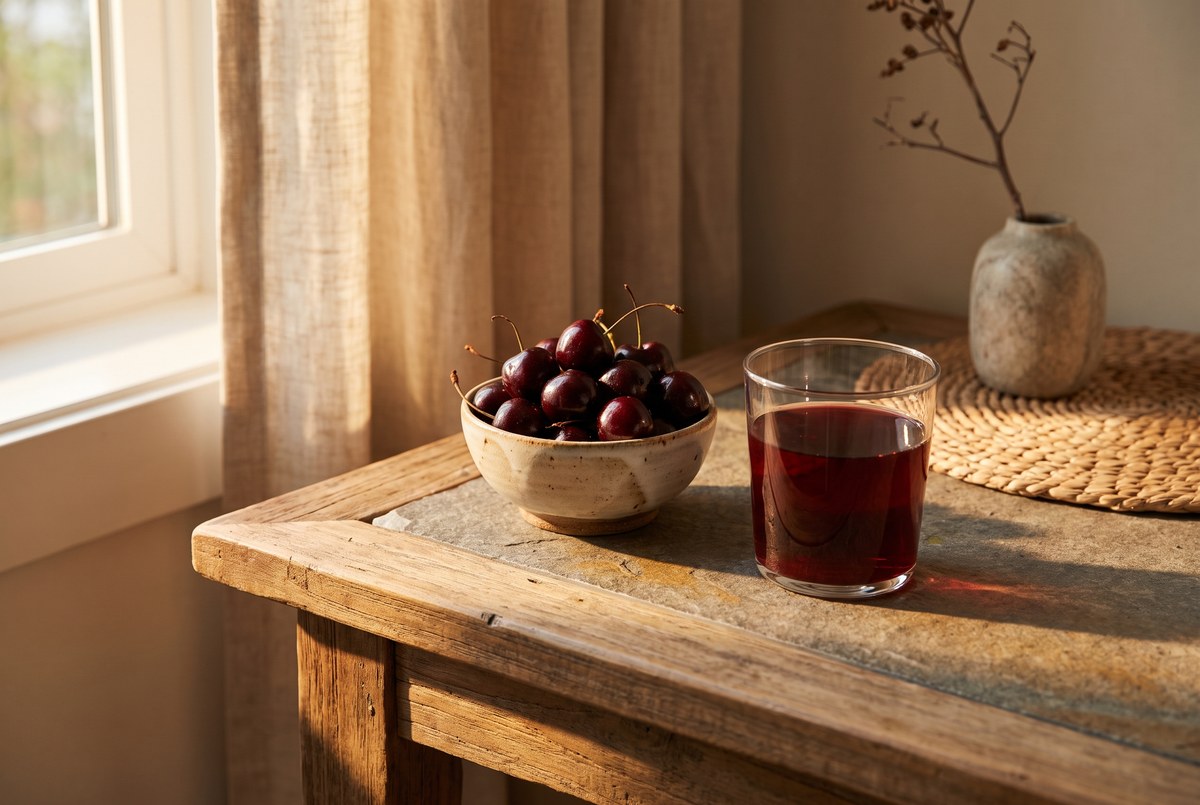
Anyone who has lain awake at three in the morning knows the peculiar arithmetic of insomnia: the counting backward from the alarm, the bargaining, the mounting certainty that tomorrow is already ruined. Sleep loss is not just fatigue — it is fear, the sense of a body quietly falling out of repair. It is exactly this fear that the sleep-supplement aisle is built on, and tart cherry extract sits on that shelf wearing the friendliest possible costume: a fruit.
The question beneath the hope is specific. Tart cherry — usually the Montmorency variety, taken as juice, concentrate, powder, or capsule — naturally contains melatonin, the hormone that regulates the sleep-wake cycle, along with tryptophan and polyphenols such as anthocyanins and procyanidins with antioxidant and anti-inflammatory activity. Does consuming it actually help a human being sleep? The most defensible answer: possibly, a little — the positive evidence is small and real, and the strongest recent evidence is null.
The case for: small trials, measurable sleep
In a 2018 pilot study published in the American Journal of Therapeutics, older adults with insomnia who drank tart cherry juice gained more than an hour of objectively measured total sleep time — not a diary entry, but measured sleep — in a trial explicitly designed to probe mechanisms as well. A 2011 study in the European Journal of Nutrition found that tart cherry juice affected melatonin levels and enhanced sleep quality, connecting the outcome to the proposed pathway. Narrative and network-meta-analytic reviews, including a 2021 assessment in Nutrients, list tart cherry among nutritional interventions that can promote sleep quantity. Small randomized and crossover trials have also found modest gains in sleep efficiency and self-reported sleep quality.
The case against: the better-powered trials said no
Here the story turns, and honesty requires the turn to be prominent. Recent, better-powered trials have been null: commonly used powder doses did not improve sleep or inflammation in adults with overweight or obesity, nor sleep, body composition, or blood pressure in healthy adults. When a literature's small trials are positive and its stronger trials are not, the statistically literate reading is that the true effect, if any, is small and fragile — sensitive to dose, formulation, and population. The evidence is limited throughout by small samples, varied dosing, and short duration.
The second act: muscles, not just melatonin
Tart cherry has a separate, arguably sturdier reputation in exercise recovery. A 2019 trial in the European Journal of Sport Science found that Montmorency tart cherry supplementation accelerated recovery from exercise-induced muscle damage in females, and a broader set of trials shows it can speed recovery of muscle strength and reduce soreness and inflammatory markers after strenuous exercise — though results are heterogeneous. A 2013 randomized double-blind crossover study even tested a tart cherry juice blend for knee osteoarthritis. The anti-inflammatory rationale runs through both literatures: dampen the oxidative and inflammatory noise, and sleep and recovery may both breathe easier.
What this means for a reader
Tart cherry is at best a mild, food-level sleep aid. It is low-risk, mechanistically plausible, and supported by small trials — a reasonable thing to try as part of ordinary sleep hygiene, and an unreasonable thing to lean on for chronic insomnia, which deserves proper evaluation. No one should trade a diagnosis for a capsule.
Three a.m. will come again, as it does. What the evidence offers the person watching the ceiling is not a cure but a small, red, fruit-flavored maybe — an hour more sleep in one pilot study, a null in the trials that followed, and the durable knowledge that the fear itself deserves more respect than the supplement does.
Educational, not medical advice.
The takeaway
Small randomized and crossover trials show tart cherry modestly increases sleep time and quality (over an hour of extra objectively measured sleep in one pilot), but recent better-powered trials were null — at best a mild, food-level sleep aid, not a treatment for insomnia.
References
5 peer-reviewed sources, published 2011–2021, across 5 journals. 2 of them have a full Magellan study write-up linked below.
- Nutrients · 2021 · PMID 34068512 · DOI 10.3390/nu13051586Certain nutritional interventions like tart cherry juice, herbal supplements, kiwifruit, and protein can improve sleep in athletes and healthy adults, but more specific research is needed for athletic populations. Read our full write-up →
- Am J Ther · 2018 · PMID 28901958 · DOI 10.1097/MJT.0000000000000584Tart cherry juice may help older adults with insomnia sleep longer and more efficiently, possibly by affecting tryptophan metabolism and inflammation. Read our full write-up →
- Osteoarthritis Cartilage · 2013 · PMID 23727631 · DOI 10.1016/j.joca.2013.05.009
- Eur J Sport Sci · 2019 · PMID 30058460 · DOI 10.1080/17461391.2018.1502360
- Eur J Nutr · 2011 · PMID 22038497 · DOI 10.1007/s00394-011-0263-7
Mechanisms and molecules in this article
Each links to its Magellan monograph — what it is, what it does, and the studies behind it.
Related reading
The giant COSMOS trial gave cocoa flavanols the fairest test any supplement has had. The headline outcome…
Magnesium genuinely lowers blood pressure by a couple of points in pooled trials and shows modest sleep…
Randomized trials and meta-analyses support alpha-lipoic acid for relieving diabetic-neuropathy symptoms,…
All Magellan articles → · More on Nutraceuticals & Cellular Energizers →
Prefer the interactive version? Open this article inside the Magellan app →