One Face, Two Fates: The Half-Side Experiment Behind Vitamin C Serum
Topical vitamin C has real, controlled-trial support for photoaged skin — fine lines, texture, pigmentation — but the trials are small, the formulations vary, the molecule is notoriously unstable, and the benefits are cosmetic rather than systemic.
The face is divided, quietly, down the middle. On one side, the study cream with vitamin C; on the other, the vehicle — the same base, the same texture, the same smell, minus the active. The patient does not know which side is which. Neither does the dermatologist grading the result. This is the half-face study, dermatology's most elegant instrument, published in Dermatologic Surgery in 2002: one person supplying both the treatment and the control, the same sun history, the same genetics, the same frown lines, split by an invisible meridian into experiment and counterfactual.
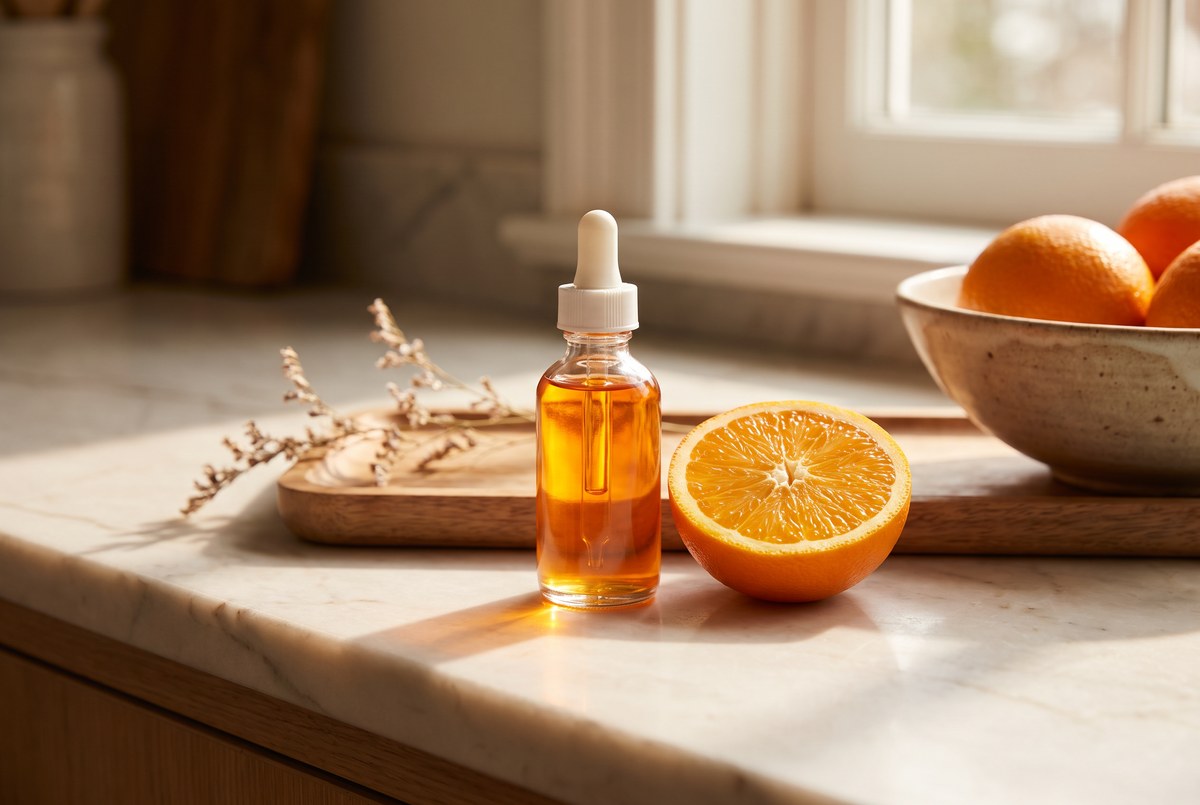
It is an oddly intimate way to do science. Every cream on the shelf behind it — the amber dropper bottles, the stability promises, the percentages — rests on comparisons like this one.
The question that face answers: does topical vitamin C do anything real to photoaged skin? The most defensible answer: yes, measurably, on appearance — with firm limits on how much evidence, for which molecule, and toward what end.
Why the skin needs it applied, not eaten
Vitamin C is a water-soluble antioxidant present at high concentrations in healthy skin, where it serves as an essential cofactor in collagen biosynthesis — promoting the formation and stabilization of collagen fibers — and neutralizes reactive oxygen species generated by sun exposure and pollution. It also inhibits tyrosinase, the enzyme driving melanin production, which is the basis for its use on uneven pigmentation. Dietary vitamin C reaches the skin poorly, which is the entire rationale for serums: deliver the molecule directly. A 2003 review in Experimental Dermatology lays out this mechanism — collagen synthesis plus photoprotection — and controlled studies have produced reductions in fine lines and wrinkles, increased dermal collagen, elastic-tissue repair, and modest additional photoprotection when layered under sunscreen.
The formulation is the active ingredient
Here is the complication the mirror can't show. L-ascorbic acid is chemically unstable — it oxidizes, degrades, turns in the bottle — so concentration, pH and packaging strongly influence whether a serum delivers anything at all. The literature is preoccupied with this problem: a 2021 Drug Delivery study built elastic vesicles called spanlastics to stabilize L-ascorbic acid against UVB-damaged skin; a 2021 Journal of Cosmetic Dermatology trial evaluated a lipophilic pro-vitamin C derivative, tetra-isopalmitoyl ascorbic acid, for anti-wrinkle effect — a different molecule chosen largely because the original keeps falling apart. A 2023 clinical evaluation tested a formulation pairing vitamin C with astaxanthin and fermented turmeric. When the science spends this much effort on delivery systems, the delivery system is the story.
How much evidence, honestly
For wrinkle appearance, skin texture and pigmentation, the evidence is relatively strong by cosmetic standards. But the trials are many and small, the concentrations and formulations differ across studies, and a Cochrane review found only limited controlled data for ascorbic acid specifically — a sobering asterisk on a popular ingredient. Benefits require consistent use over weeks to months. And the category matters: these are cosmetic and dermatologic effects. Topical vitamin C is not a systemic or longevity intervention; nothing here touches lifespan, and this evidence describes topical L-ascorbic acid in general, not any specific commercial serum.
What a bathroom shelf can reasonably claim
A stable, well-packaged vitamin C serum, used consistently and paired with sunscreen — the photoprotection literature is clear that it complements rather than replaces — is among the better-evidenced items in the entire skincare aisle. Expect gradual, modest, visible improvement, not reversal.
Months after the half-face study ended, its logic endures as the fairest question any serum can face: put yourself on one side, nothing on the other, and wait. The creams that survive that test have earned their shelf space. Educational, not medical advice.
The takeaway
Consistent use of a well-formulated vitamin C serum can measurably improve the appearance of photodamaged skin over weeks to months, but evidence is limited for L-ascorbic acid specifically, results depend on formulation stability, and this is dermatology, not longevity medicine.
References
5 peer-reviewed sources, published 2002–2023, across 4 journals. 3 of them have a full Magellan study write-up linked below.
- Exp Dermatol · 2003 · PMID 12823436 · DOI 10.1034/j.1600-0625.2003.00008.xA 5% vitamin C cream applied topically improved the appearance and structure of sun-damaged skin over 6 months. Read our full write-up →
- Drug Deliv · 2021 · PMID 33620008 · DOI 10.1080/10717544.2021.1886377L-ascorbic acid delivered via spanlastic vesicles is more stable, penetrates skin better, and offers superior protection against UV-induced skin damage compared to a standard LAA solution. Read our full write-up →
- J Cosmet Dermatol · 2023 · PMID 37608511 · DOI 10.1111/jocd.15967A topical serum containing vitamin C, astaxanthin, and fermented turmeric improved skin quality and reduced fine lines and wrinkles in a 12-week study. Read our full write-up →
- Dermatol Surg · 2002 · PMID 11896774 · DOI 10.1046/j.1524-4725.2002.01129.x
- J Cosmet Dermatol · 2021 · PMID 34910367 · DOI 10.1111/jocd.14604
Mechanisms and molecules in this article
Each links to its Magellan monograph — what it is, what it does, and the studies behind it.
Related reading
Bakuchiol is marketed as retinol's gentler plant twin. A 12-week randomized trial backs the comparison —…
Copper tripeptide-1 stimulates collagen in the lab and connective tissue in rat wounds, and it has become a…
In a randomized Australian trial, adults assigned to daily sunscreen showed no detectable increase in skin…
All Magellan articles → · More on Skin & Topical Longevity →
Prefer the interactive version? Open this article inside the Magellan app →