Ten Percent of Your Body Weight, Folded Over You: The Quiet Evidence for Weighted Blankets
Weighted blankets deliver deep pressure stimulation, and randomized trials show modest, real reductions in anxiety and self-reported insomnia — strongest in adults with psychiatric conditions. Objective sleep measures, children with autism, and the proposed hormonal mechanism all tell a weaker story.
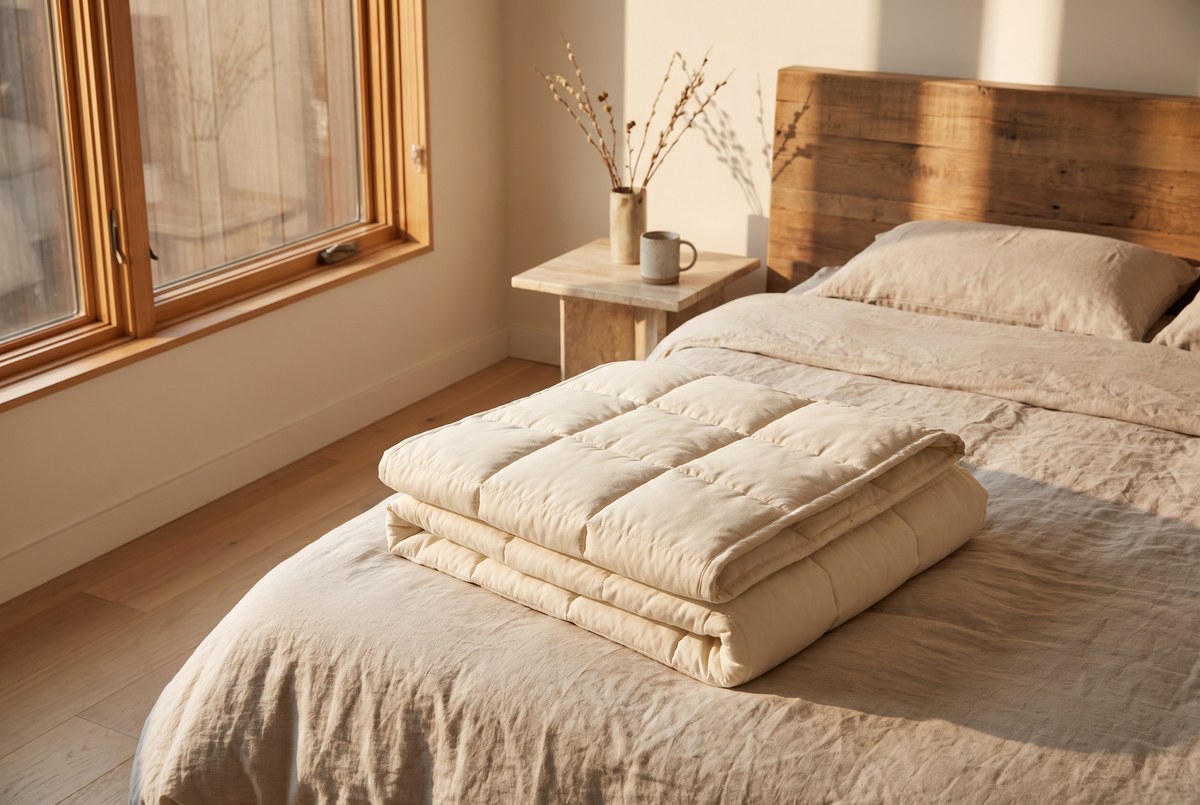
The blanket is folded to a precise weight — about ten percent of the body that will lie beneath it — and inside its quilted channels the glass beads shift and settle with a sound like distant rain. In the sleep laboratory the protocol is exact. Saliva is collected at timed intervals before lights-out, each tube labeled, spun, frozen for the melatonin assay. The blanket goes over the subject. The technicians keep their voices low. On the bench, the little tubes wait to testify about what pressure does to a nervous system preparing for sleep.
The intervention under study is deep pressure stimulation — firm, evenly distributed tactile input, comparable to a hug or to swaddling, delivered by pellets, beads or metal chains sewn into an ordinary-looking blanket. The hypothesis is physiological: the pressure shifts autonomic balance toward the parasympathetic side, quieting the body into sleep. The question the laboratory exists to answer is whether a heavier blanket is medicine or merely comfort — and what the difference is worth.
The defensible answer from the trial literature: modest, real benefits for anxiety and self-reported insomnia, especially in adults with psychiatric conditions; safety that is essentially unblemished; and a mechanism that remains, on the best evidence, unconfirmed.
Where the trials are strongest
The flagship evidence is in psychiatric populations. One well-designed randomized trial in adults with psychiatric conditions — recorded in the Journal of Clinical Sleep Medicine in 2020 — reported a large effect on insomnia severity, maintained at twelve-month follow-up. A 2024 pilot randomized controlled trial in BMC Psychiatry found improved sleep quality in adults with clinical insomnia. The meta-analytic layer points the same direction: a 2024 meta-analysis in Complementary Therapies in Medicine on safety and effectiveness in mental disorders, a 2024 systematic review in the Journal of Psychiatric Research spanning inpatient and outpatient psychiatric settings, and a 2024 randomized crossover multicentre trial in the Journal of Sleep Research testing ball blankets against insomnia in depression. Across randomized trials and meta-analyses, the most consistent findings are modest reductions in anxiety and in self-reported insomnia severity — and no serious adverse events reported anywhere.
Where the evidence thins
Two populations complicate the story. For objectively measured sleep — what the instruments record rather than what sleepers report — the evidence is weaker and more mixed. And for children with autism, where weighted blankets are perhaps most lovingly purchased, a major pediatric trial and an American Academy of Neurology guideline found no clear benefit for sleep duration. A placebo component likely contributes to perceived improvement in everyone: you cannot blind a blanket, and the sleeper always knows its weight.
The complication: the mechanism that wasn't
The laboratory study that gives the modality its scientific glamour found a larger pre-sleep rise in salivary melatonin under the weighted blanket — a real, measured effect. But the hypothesized calming pathway through oxytocin and cortisol was not confirmed. The pressure does something; the field cannot yet say precisely what. This body of evidence describes deep-pressure stimulation as a general modality, not any specific commercial blanket.
Practical meaning
For an adult whose insomnia travels with anxiety — especially alongside a psychiatric condition — a weighted blanket at roughly ten percent of body weight is among the lowest-risk, best-supported comfort aids available. Expect modest relief, not rebuilt sleep architecture. For a child with autism, the honest answer is that the trials have not shown what parents hope.
Back in the laboratory, the morning shift catalogs the frozen tubes. The melatonin numbers came out higher; the cortisol story did not hold; the subjects, mostly, said they slept better. The blanket asks so little and risks so little that the science can afford its honesty: pressure comforts, comfort helps, and help is not the same as cure.
Educational, not medical advice.
The takeaway
Weighted blankets are a safe, low-risk comfort aid with modest trial support for anxiety and insomnia severity — one well-designed trial in psychiatric patients showed a large, 12-month-durable effect — but evidence is mixed for objectively measured sleep, absent for sleep duration in children with autism, and the hypothesized oxytocin-cortisol calming pathway was not confirmed.
References
5 peer-reviewed sources, published 2020–2024, across 5 journals. 2 of them have a full Magellan study write-up linked below.
- J Clin Sleep Med · 2020 · PMID 32536366 · DOI 10.5664/jcsm.8636Weighted blankets effectively reduce insomnia and improve daytime symptoms and activity in individuals with certain psychiatric disorders. Read our full write-up →
- Complement Ther Med · 2024 · PMID 39447684 · DOI 10.1016/j.ctim.2024.103104Weighted blankets appear to be a safe and potentially effective complementary treatment for anxiety, insomnia, depression, and fatigue in people with mental disorders, but more robust research is needed. Read our full write-up →
- BMC Psychiatry · 2024 · PMID 39501163 · DOI 10.1186/s12888-024-06218-9
- J Psychiatr Res · 2024 · PMID 39341068 · DOI 10.1016/j.jpsychires.2024.09.027
- J Sleep Res · 2024 · PMID 38740439 · DOI 10.1111/jsr.14238
Mechanisms and molecules in this article
Each links to its Magellan monograph — what it is, what it does, and the studies behind it.
Related reading
The spiked mat is wellness social media's favorite torture device. The underlying technique — acupressure —…
Breathing is the last thing most people think to train — until a climbing blood-pressure reading makes the…
Small studies in selected mouth-breathers do not justify universal taping, especially when nasal obstruction…
All Magellan articles → · More on Recovery, Sauna & Light Therapy →
Prefer the interactive version? Open this article inside the Magellan app →