The Air in Your Living Room Is Not Nothing
HEPA filtration demonstrably cuts indoor PM2.5 and nudges blood pressure down by a few millimeters of mercury in randomized trials — while the activated-carbon stage that traps gases rests almost entirely on exposure-reduction logic, not human-outcome trials.
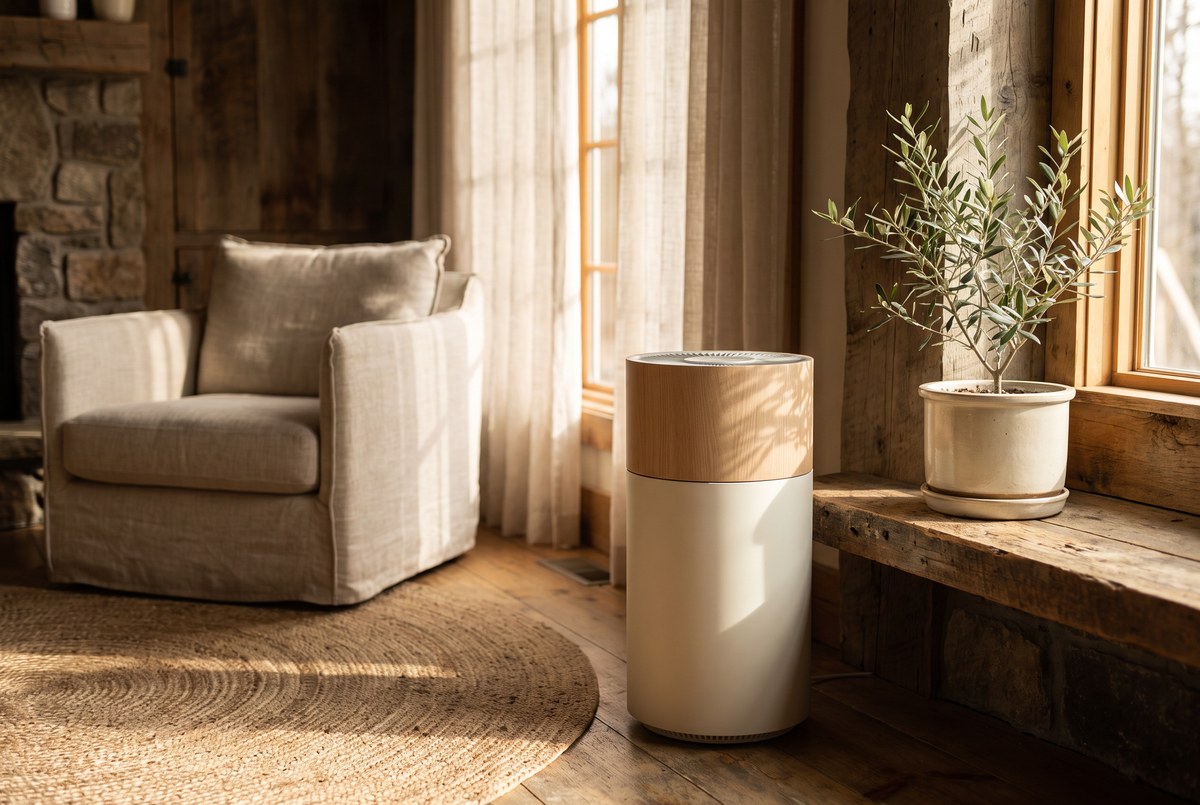
Okay so here's a thing most of us do, or anyway a thing I do, which is to spend roughly all of our time indoors — cooking things, spraying things, sitting on furnishings that are quietly off-gassing their various chemicals into the room — while rarely if ever considering that the air in said room is a substance, an actual mixture, that we are inhaling continuously, all day and all night, without ever once auditing its contents — and that whatever is in that mixture, particles from traffic, volatile compounds from the cleaning spray, formaldehyde from the pressed-wood whatever, is now, in a very literal sense, part of us.
Which is the whole premise of the air purifier industry, and also — this is the part that makes it interesting rather than just alarming — a premise that has been tested in actual randomized trials.
The question: does cleaning indoor air measurably change human physiology? The most defensible answer: yes for particles, modestly — a few points of blood pressure, mostly — and not-yet-tested for gases, where the argument rests on exposure logic rather than outcomes.
What filtration demonstrably does
Start with the exposure itself, because the trials do. In one senior-housing study, running HEPA filtration cut personal PM2.5 from 15.5 to 7.4 micrograms per cubic meter — roughly half — and after just three days blood pressure sat about 3 mm Hg lower. That is not a rounding error of design; it is a randomized result. Pooled analyses tell the same story at lower volume: a 2021 systematic review and meta-analysis of randomized trials in Science of the Total Environment, a 2020 systematic review in Hypertension, and a 2025 pragmatic randomized crossover trial in the Journal of the American College of Cardiology converge on systolic reductions of roughly 2 to 4 mm Hg, with some trials also improving heart-rate variability, oxidative-stress markers and respiratory symptoms. Benefits are clearest in people with elevated blood pressure, older adults, and those with COPD or asthma.
Why anyone bothers
The stakes come from the observational literature, and it is worth being precise about that word — observational. A 2022 EBioMedicine study linked long-term ambient pollution exposure to the trajectory of cardiometabolic multimorbidity, and a 2023 register-based study of the entire Scottish population tied long-term exposure to mortality. These are associations across huge populations, consistent and worrying, but they cannot prove cause, and they describe outdoor pollution over years — not what one machine in one room will do for one person.
The part nobody wants to underline
Now the caveats, which are load-bearing. A 12-month trial of HEPA cleaners in children's bedrooms missed its primary asthma-control endpoint; benefits appeared only in secondary analyses. Several trials found no change in blood pressure or inflammatory markers at all. Reviewers rate the overall certainty of the evidence as low. And then there is the carbon. A deep bed of activated carbon genuinely adsorbs the things particle filters miss — VOCs, formaldehyde, odors, the gaseous fraction of wildfire smoke — by trapping them on a hugely porous surface. That is solid adsorption chemistry. But human-outcome trials isolating the carbon stage are essentially absent. The gas-phase claims rest on a chain of reasoning: less exposure should mean less harm. Reasonable, plausible, unproven at the outcome level.
What this means for an actual room
For someone with hypertension, COPD or asthma — or a home near traffic or wildfire country — a particle-filtering purifier is among the few consumer health devices with randomized-trial support, however modest. Expect cleaner air and possibly a couple of points of blood pressure, not a transformation. And know that this evidence concerns filtration and pollutants generally, not any specific commercial unit humming in the corner.
Which returns us to the living room, and the thousands of daily liters, and the machine's low fan working through them one at a time — a small, mechanical, honestly partial answer to a question most of us never thought to ask. Educational, not medical advice.
The takeaway
Indoor HEPA filtration produces real exposure reductions and modest, low-certainty cardiovascular benefits — about 2–4 mm Hg systolic — while gas-phase carbon filtration, though mechanistically sound, lacks human-outcome trials of its own.
References
5 peer-reviewed sources, published 2020–2025, across 5 journals. 2 of them have a full Magellan study write-up linked below.
- EBioMedicine · 2022 · PMID 36174399 · DOI 10.1016/j.ebiom.2022.104282Long-term exposure to air pollution increases the risk of developing cardiometabolic diseases, progressing to multimorbidity, and all-cause mortality, especially in certain vulnerable groups. Read our full write-up →
- Environ Res · 2023 · PMID 37793592 · DOI 10.1016/j.envres.2023.117223Long-term exposure to common air pollutants is linked to increased mortality from various physical and mental health conditions. Read our full write-up →
- Effect of HEPA Filtration Air Purifiers on Blood Pressure: A Pragmatic Randomized Crossover Trial. ↗J Am Coll Cardiol · 2025 · PMID 40767818 · DOI 10.1016/j.jacc.2025.06.037
- Sci Total Environ · 2021 · PMID 34058577 · DOI 10.1016/j.scitotenv.2021.147882
- Hypertension · 2020 · PMID 32475316 · DOI 10.1161/HYPERTENSIONAHA.119.14456
Mechanisms and molecules in this article
Each links to its Magellan monograph — what it is, what it does, and the studies behind it.
Related reading
Ambulatory blood pressure — especially nighttime and 24-hour averages — predicts death and cardiovascular…
Nighttime traffic noise is a documented cardiovascular risk factor, and white-noise masking genuinely helps…
Grip strength — a few seconds of squeezing a handle — predicts death, disability, and cognitive decline…
All Magellan articles → · More on Air, Water & Sleep Systems →
Prefer the interactive version? Open this article inside the Magellan app →