What Your Handshake Already Knows About You
Grip strength — a few seconds of squeezing a handle — predicts death, disability, and cognitive decline across millions of study participants, in one landmark 17-country cohort better than blood pressure. It is a window into aging, not yet a proven lever on it.
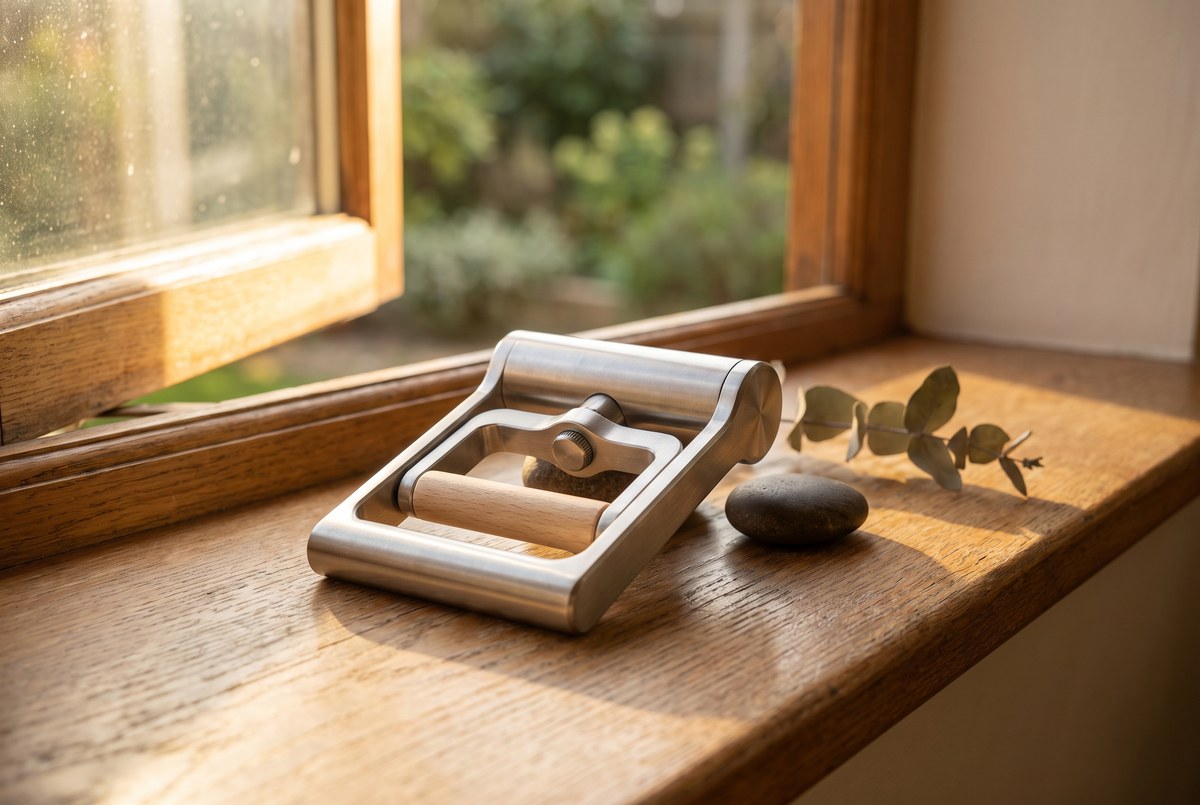
There is a moment, in a certain kind of doctor's office and in a great deal of aging research, when a person is handed a small device and asked to squeeze it as hard as possible. It takes seconds. It feels like a formality, almost a party trick. And yet the number that comes out of that squeeze carries a strange weight — because across some of the largest health studies ever assembled, the strength of a hand has tracked, quietly and consistently, with how much time its owner has left.
That is the psychological stake of the hand-grip dynamometer: a measurement simple enough to feel trivial, attached to findings large enough to be frightening. The fear of frailty — of becoming someone who cannot open the jar, rise from the chair, recover from the fall — turns out to have a number, and the number can be read in a hallway in under a minute.
The precise question is what that number means. The most defensible answer: grip strength is an exceptionally well-documented marker of risk — of death, disability, cognitive decline, sarcopenia, and frailty — and it is a marker, not a proven causal lever.
The number that outperformed blood pressure
The landmark is the PURE study, reported in The Lancet in 2015: a prospective cohort spanning 17 countries, in which grip strength predicted death — and did so better than systolic blood pressure. A 2022 nationally longitudinal cohort study in China, published in the Journal of Science and Medicine in Sport, found its own association between handgrip strength and all-cause mortality; a 2018 record in the BMJ examined muscular strength in the same frame. These are not fringe observations. They are convergent findings from populations that differ in nearly everything except the hand that was asked to squeeze.
Millions of hands
The largest pool comes from a 2018 systematic review and meta-analysis in Archives of Physical Medicine and Rehabilitation, drawing on data from approximately two million men and women: higher muscular strength was linked to roughly 31% lower all-cause mortality. The measurement itself has been standardized with unusual rigor — weakness cut-points such as the FNIH thresholds of under 26 kg for men and under 16 kg for women, normative reference data from more than 125,000 adults in 21 countries, and very high reproducibility. Clinical literature in nutritional assessment, including a 2019 record in the Journal of Renal Nutrition, treats the dynamometer as a core status tool. Grip strength is a core component of standard sarcopenia and frailty assessments precisely because it is cheap, quick, noninvasive, and integrative — a single readout of the musculoskeletal, neurological, and endocrine systems working together.
A marker, not a lever
The honest complication matters as much as the findings. Grip strength is largely a risk marker, and whether raising it lowers mortality remains unproven — association, however consistent, is not causation. The reading itself is sensitive to protocol: body position, elbow angle, and the number of trials materially change the number, which means an unstandardized squeeze on a consumer device can mislead. What is proven is the other direction of effort: resistance training reliably improves measured strength. The dynamometer can tell you where you stand; the training, not the device, is the intervention.
For a reader, the practical meaning is to treat the reading like a vital sign — measured the same way each time, tracked as a trend, and answered with strength training rather than worry. The fear in the hallway is real. So is the finding behind it: the hand, asked to squeeze, keeps reporting on the whole body — and the body, trained, keeps answering back.
Educational, not medical advice.
The takeaway
Low grip strength is one of the most robust and reproducible risk markers in aging research; whether raising it lowers mortality is unproven, although resistance training reliably raises the number itself.
Train the numbers: Stronger for Longer
A free 12-week walking, strength and balance program for adults 50 and over, measured with five validated self-tests at weeks 0, 6 and 12. No supplements, nothing to buy.
References
5 peer-reviewed sources, published 2015–2022, across 5 journals. 3 of them have a full Magellan study write-up linked below.
- J Ren Nutr · 2019 · PMID 30827839 · DOI 10.1053/j.jrn.2019.01.002Lower handgrip strength is linked to a higher risk of death in dialysis patients. Read our full write-up →
- J Sci Med Sport · 2022 · PMID 36064503 · DOI 10.1016/j.jsams.2022.08.005Stronger handgrip strength is linked to a lower risk of death from all causes in middle-aged and older Chinese adults, especially in younger men. Read our full write-up →
- Lancet · 2015 · PMID 25982160 · DOI 10.1016/S0140-6736(14)62000-6
- BMJ · 2018 · PMID 29739772 · DOI 10.1136/bmj.k1651Lower grip strength is associated with increased risk of mortality and various diseases, and can improve the accuracy of health risk predictions. Read our full write-up →
- Arch Phys Med Rehabil · 2018 · PMID 29425700 · DOI 10.1016/j.apmr.2018.01.008
Mechanisms and molecules in this article
Each links to its Magellan monograph — what it is, what it does, and the studies behind it.
Related reading
Reverse osmosis strips 90–99% of water's natural minerals. Remineralization drops put magnesium and calcium…
Ambulatory blood pressure — especially nighttime and 24-hour averages — predicts death and cardiovascular…
HEPA filtration demonstrably cuts indoor PM2.5 and nudges blood pressure down by a few millimeters of…
All Magellan articles → · More on Air, Water & Sleep Systems →
Prefer the interactive version? Open this article inside the Magellan app →