Cold Plunge and Red Light Near Saratoga Springs
Verbatim local searches for cold plunge, red light, hyperbaric oxygen and PEMF, answered with the trials that exist — what was measured, in whom, over how many sessions, and where the evidence stops. Not a directory: no venue is named, ranked or recommended, and no prices are quoted.
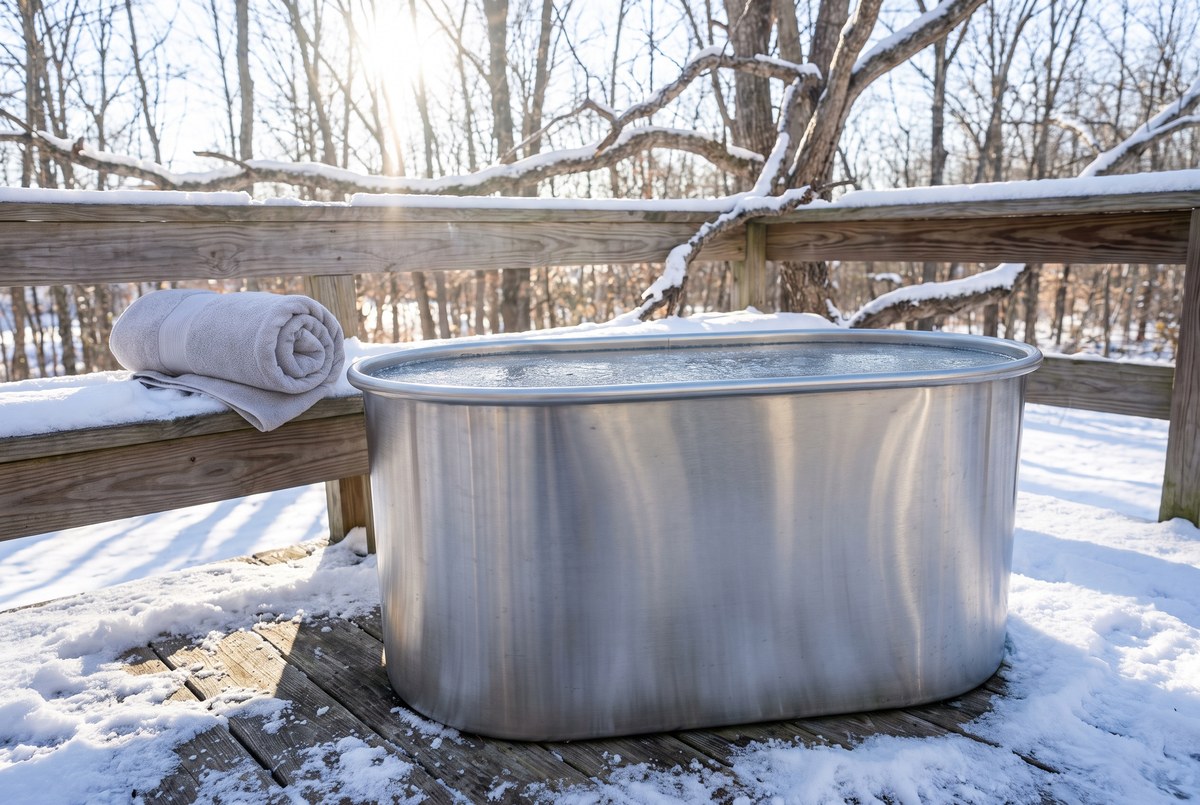
Ten minutes in water at ten degrees. Not a mood — a protocol, with a stopwatch and a thermometer. Twenty-one physically active men strength trained twice a week for twelve weeks, finishing each session in cold water for ten minutes or in active recovery. Sixteen others trained seven weeks, finishing at 10°C for fifteen minutes or sitting in water at 23°C — a control group, when nobody can be blinded. Then the biopsy needle.
The light is smaller than the marketing: a desktop unit emitting 650 nanometres at roughly 1600 lux and 0.29 milliwatts through a four-millimetre pupil, three minutes, twice a day, five days a week, in children aged eight to thirteen. The hyperbaric protocol was sixty daily sessions; thirteen men in a companion study gave skin biopsies after three months of nothing, then three months of daily sessions. The machinery hums. The data is quieter.
Winters here are long and the summers short — a fair argument for a warm room, a poor one for anything more specific. What changed is availability: cold plunge tubs, red-light panels, infrared cabins, hyperbaric chambers, PEMF mats, vibration plates and compression boots are now widely sold. Here is what each has been tested to do — in whom, for how long, at what effect size — and what it has not. This page is not a directory: it names no clinic, studio, spa or practice, and it does not rank or recommend local providers. What a reader can carry into a consultation is not a list of venues but the questions that separate a defensible service from a sales pitch.
What is actually for sale
- Cold water immersion — a chilled tub; trials used 10°C for ten to fifteen minutes.
- Red light and photobiomodulation — panels, beds, masks, handhelds, one desktop medical device. Red is roughly 630 to 700 nm, penetrating 2 to 3 mm of tissue; near-infrared 800 to 1200 nm, 5 to 10 mm.
- Infrared sauna — a cabin heating the body with infrared emitters rather than hot air.
- Hyperbaric oxygen — a pressurised chamber, oxygen, daily sessions over weeks.
- PEMF — mats, coils, loops and wands applying pulsed electromagnetic fields.
- Whole-body vibration — a platform delivering vertical accelerations through the feet.
- Compression — boots inflating around the legs in sequence, typically 20 to 30 minutes at about 80 mmHg.
Cold water immersion
A meta-analysis of cold-water immersion against other recovery modalities pooled 28 studies in physically active participants: cold water was superior for muscle soreness and similar for power and flexibility, outperforming active recovery, contrast water therapy and warm-water immersion — while air cryotherapy beat it for strength and immediate power recovery at one hour. A meta-analysis of cold water immersion and fatigue recovery across 20 studies found reduced soreness and perceived exertion immediately post-exercise, lower creatine kinase at 24 hours, lower lactate at 24 and 48 hours, no evidence of any effect on C-reactive protein or interleukin-6 across 48 hours, and countermovement jump significantly reduced immediately after immersion.
None of it is sham-controlled, because there is no sham for cold water. Soreness and perceived exertion are self-reported; creatine kinase and lactate are objective, and are markers rather than performance.
Verdict: cold water immersion is genuinely effective for short-term recovery of self-reported soreness and fatigue in physically active people, and blunted muscle-fibre growth in two small trials of men training for hypertrophy.
Red light and photobiomodulation
Two products share the name, and the strongest data belongs to a desktop device children look into twice a day to slow myopia, not a panel bought for skin. The multicentre randomised trial of repeated low-level red-light therapy enrolled 264 children aged 8 to 13 with myopia of −1.00 to −5.00 dioptres. At 12 months, adjusted axial elongation was 0.13 mm against 0.38 mm with spectacles alone, a difference of 0.26 mm (95% CI 0.20 to 0.31), and a spherical equivalent difference of −0.59 D. Machine-measured and large — also single-blind, since a child knows whether the light is on, and axial elongation is a surrogate. A two-year post-trial follow-up, in which children chose whether to continue and 57% of those eligible were analysed, found the benefit sustained in children who continued and a modest rebound in those who stopped: axial length grew 0.42 mm in year two after stopping, against 0.12 mm on continued treatment.
The safety literature gets equal space. A review across 20 studies and 2,380 participants aged 3 to 18 found no permanent vision loss, a temporary afterimage resolving within six minutes as the commonest symptom, and side-effect incidence of 0.088 per 100 patient-years — alongside two case reports of one patient with reversible visual-acuity decline and OCT abnormalities resolving four months after stopping, and a number-needed-to-harm exceeding number-needed-to-treat by 12.7 to 21.4 for a child with −3D to −8D myopia. Its recommendation was fundus photography and OCT before and during therapy plus home monitoring. A 2025 cohort measuring cone photoreceptor density in 52 treated and 47 untreated children found reduced density in the paracentral fovea — at 0.3 mm temporal eccentricity, −2.1 × 10³ cells/mm² (95% CI −3.68 to −0.59) — and 11 eyes with abnormal signals, odds ratio 7.23 (95% CI 1.15 to 303.45). Retrospective; it cannot show cause.
For the products most people buy, a randomised trial of photobiomodulation for diabetic foot ulcers assigned volunteers aged 30 to 65 with grade I or II ulcers to red LED, infrared LED, both, or control, treated daily at home for 12 weeks. At 90 days the light groups showed large clinical effect sizes against control (Cohen's d of 1.7 and 1.6) and, in the authors' wording, a tendency toward faster healing. A foot ulcer is not a wrinkle, and clearance is not evidence: low-level light therapy holds United States clearance for cosmetic improvement of ageing or sun-damaged skin, while the review of wound phototherapy notes there are few adequately powered double-blind trials of dose-response by wavelength.
Verdict: red light has consistent single-blind randomised evidence over 12 months for slowing axial elongation — a surrogate — in myopic children, a device that should be used with retinal monitoring rather than casually, and, for skin and wound claims, mechanistic plausibility plus small trials that fall well short of the marketing.
Infrared sauna, and why the Finnish cohort does not transfer
The famous sauna longevity numbers are observational, Finnish, and about traditional hot-air sauna. The headline is a cohort of 2,315 middle-aged Finnish men followed a median of 20.7 years, with 190 sudden cardiac deaths and 929 deaths from all causes. Against men reporting one session a week, men reporting four to seven had an adjusted hazard ratio for sudden cardiac death of 0.37 (95% CI 0.18 to 0.75), with similar patterns for coronary, cardiovascular and all-cause mortality; sessions over 19 minutes carried a hazard ratio of 0.48 against sessions under 11 minutes. Associations: men who can sit in a hot room seven times a week may differ in ways adjustment cannot be assumed to remove.
The randomised evidence is more sobering. An eight-week trial of sauna bathing and vascular health in 41 adults with stable coronary artery disease — four sessions a week, 20 to 30 minutes, 79°C — produced heat acclimation (core temperature down 0.27°C, sweat rate up 0.3 L/h) and no improvement in flow-mediated dilation, arterial stiffness or blood pressure. A meta-analysis of passive heating interventions across 20 randomised trials of two to fifteen weeks found no significant pooled effects on flow-mediated dilation, pulse wave velocity, resting heart rate, heart rate variability, fasting glucose, HbA1c, cholesterol, triglycerides or C-reactive protein. Systolic pressure was the one thing that moved, and its pooled estimate of −2.46 mmHg did not reach significance; only in subgroups — whole-body heating at −4.11 mmHg, coronary risk or disease at −2.52 mmHg — did it separate from zero, with high heterogeneity throughout.
The most useful positive trial is a multi-arm study of sauna in conjunction with exercise in 47 sedentary adults with a cardiovascular risk factor. Over eight weeks, adding a 15-minute post-exercise sauna to guideline-based exercise produced greater fitness gains than exercise alone (+2.7 mL/kg/min, 95% CI 0.2 to 5.3), lower systolic pressure (−8.0 mmHg, 95% CI −14.6 to −1.4) and lower total cholesterol — while exercise alone against control produced +6.2 mL/kg/min. An addition, not a substitute, in an unblinded trial. All of it was hot air or hot water, and carrying that 0.37 across to an infrared cabin takes two unearned leaps: association to causation, and one heating modality to another.
Verdict: frequent traditional sauna is associated with lower cardiovascular and all-cause mortality among middle-aged Finnish men in one prospective cohort, randomised trials of passive heating found no significant pooled effect on systolic blood pressure or most cardiometabolic markers, and none of it has been demonstrated for a consumer infrared cabin.
Hyperbaric oxygen
Hyperbaric oxygen has established medical indications nobody disputes; the longevity claim is separate, and the trial everyone cites is small and uncontrolled. In a prospective study of telomere length and immunosenescence, 35 healthy adults aged 64 and older received 60 daily sessions. Telomere length in T helper, cytotoxic T, natural killer and B cells rose by over 20%, with B cells up 37.63% (± 52.73) after the final session, while senescent T helper cells fell 37.30% (± 33.04) and senescent cytotoxic T cells 10.96% (± 12.59). Read the standard deviations before the means. The companion study of skin ageing took biopsies from thirteen men, mean age 68, using a three-month no-treatment period as each man's own control: increases in collagen density, elastic fibre length and blood vessel number, fewer tissue senescent cells, no change in elastic fibre density.
Both are single-arm or self-controlled: no sham chamber, no randomisation, no blinding of someone who knows they are spending an hour a day in a pressure vessel. Telomere length and senescent cell fraction are biomarkers, not outcomes.
Verdict: hyperbaric oxygen has documented effects on blood-cell and skin-biopsy ageing biomarkers in small uncontrolled trials of adults over 64, on a 60-session protocol, and no controlled evidence of any clinical longevity benefit.
PEMF
PEMF can be sham-controlled — an identical coil, current off — and has been, in essentially one condition: osteoarthritis, mostly of the knee. The poolings disagree. A meta-analysis of PEMF versus sham in osteoarthritis pooled twelve trials and found significant pain relief in knee osteoarthritis (SMD −0.54, 95% CI −1.04 to −0.04) and in hand osteoarthritis (SMD −2.85, from the single hand trial, which its authors caution against over-reading), but not in cervical osteoarthritis; function improved in knee and hand, not neck; three trials reported adverse events with no difference from sham. A meta-analysis of placebo-controlled trials reported a large pooled pain effect (SMD 1.06, 95% CI 0.61 to 1.51), with smaller effects on stiffness and function, explicitly limited to the short term. The most recent synthesis, nine randomised trials in 457 patients with knee osteoarthritis, found no significant improvement in VAS pain or total WOMAC at one month, a WOMAC-pain benefit at 18 to 21 days (MD −1.63, 95% CI −2.43 to −0.82) gone by one month, stiffness and daily-activity gains only at one month, no improvement in objective function, high risk of bias, and the authors' note that the gains may not reach clinical meaningfulness. Two further poolings sit on the null side of the same question: a meta-analysis of eight randomised trials in 421 patients with knee osteoarthritis found no advantage over placebo on WOMAC total score, WOMAC pain, visual analogue pain or stiffness, while reporting a benefit on physical function, and an earlier meta-analysis of nine studies in 483 patients with knee osteoarthritis found no significant difference from placebo for pain or stiffness, while reporting a benefit on activities of daily living. Nothing there is about sleep, energy or a healthy person's baseline anything.
Verdict: PEMF has genuine sham-controlled evidence for short-term symptom scores in knee osteoarthritis, plus a single-trial hand-osteoarthritis signal the review's own authors call uncertain, with effects of uncertain clinical size and no agreed dose — and no evidence for any of the general wellness claims made for it.
Whole-body vibration
The outcome studied at scale is bone mineral density. A review of vibration and bone density in postmenopausal women covering 23 studies found significant effects at lumbar spine and trochanter across several configurations, but only two reached high-quality evidence by GRADE, giving a recommendation of roughly 30 Hz, 0.3 g and 7,000 cumulative minutes for lumbar spine density — over a hundred hours on the plate. A meta-analysis of vibration training in older adults pooling seven studies and 202 participants aged 55 and over found a small effect at the total femur (Hedges' g = 0.28, p = 0.04) and trivial, non-significant effects at the femoral neck (g = 0.15) and lumbar spine (g = 0.13), rated low certainty. A network meta-analysis of exercise types and bone density across 49 papers and 3,360 people put that in context: at the femoral neck, combined aerobic plus resistance exercise ranked first by a wide margin, vibration significant but well behind; at the lumbar spine vibration did not appear among modalities with significant effects.
Verdict: whole-body vibration produces small, parameter-sensitive gains in bone mineral density — a surrogate for fracture risk, not fracture — in older and postmenopausal adults at high cumulative doses, and is outperformed by combined aerobic and resistance exercise for the same outcome.
Compression
In a double-blinded randomised crossover study of the hemodynamic effects of intermittent pneumatic compression, 22 athletes underwent 15-minute protocols at 80 mmHg and 200 mmHg. Systolic and end-diastolic peak blood velocities rose significantly during compression, more at the higher pressure, and returned close to baseline within two minutes of it ending; heart rate did not change. Note what "double-blinded" meant: two pressures against each other, not an inert boot. Recovery is weaker. A meta-analysis of lower-limb intermittent pneumatic compression across 17 studies and 319 participants found trivial-to-small benefits for muscular function, trivial-to-moderate effects on pain and soreness, and highly variable effects on muscle damage markers. A critically appraised topic on compression in endurance athletes reviewed two randomised trials and a crossover study; all three concluded compression was not effective against exercise-induced muscle damage, allowing only short-term soreness relief.
Verdict: compression boots transiently increased limb blood flow in athletes at rest and produce small, mostly perceptual reductions in soreness, with no convincing effect on markers of muscle damage.
| Modality | What was actually measured | Verdict |
|---|---|---|
| Cold water immersion | Soreness, perceived exertion, creatine kinase, lactate; fibre size | Works between efforts; blunts fibre growth after lifting; no sham possible |
| Red light (myopia device) | 12-month axial elongation in myopic children; cone density | Strongest efficacy here, on a surrogate; needs retinal monitoring; rebounds on stopping |
| Red light (skin panels) | Foot ulcer area over 12 weeks | One small trial, a tendency toward faster healing; cosmetic claims outrun it |
| Infrared sauna | Not tested here; the mortality data are hot-air sauna | Borrows an observational result from another modality; not established |
| Hyperbaric oxygen | Telomere length, senescent cells, skin histology, over 60 sessions | Biomarkers moved, uncontrolled; no clinical outcome |
| PEMF | Pain, stiffness, function in knee and hand osteoarthritis | Sham-controlled but short-term; poolings conflict; no agreed dose |
| Whole-body vibration | Bone density at spine, total femur, femoral neck | Small effect on a surrogate at high dose; loaded exercise does more |
| Compression | Peak blood velocities during; soreness and damage markers after | Transient hemodynamic effect; soreness relief small and self-reported |
What to ask before you buy or book
Portable, aimed at nobody, boring on purpose.
- What outcome are you promising, and was it ever measured? "Reduces inflammation" is a claim; "lowered creatine kinase at 24 hours" is an outcome. "Reverses ageing" is a claim; "raised telomere length in blood cells, uncontrolled" is an outcome. Ask which is being sold.
- Was it sham-controlled, and if it could not be, what objective measure moved? PEMF can be and has been. Cold water, sauna and compression cannot be, which does not disqualify them but does mean discounting self-reported outcomes. The 2026 PEMF pooling is the cautionary case: subjective scores improved, objective function did not.
- Who was in the trials, and am I that person? The populations here are myopic children, diabetic adults with foot ulcers, middle-aged Finnish men, adults over 64, postmenopausal women, arthritic knees, athletes. A device tested for a narrow problem you do not have is not partially useful to you; it is untested in you.
- How many sessions, and what happens if it does not work? Sixty consecutive daily hyperbaric sessions; roughly 7,000 cumulative minutes on a vibration plate; for myopia, years of it, with axial length growing 0.42 mm in the year after stopping against 0.12 mm on continued treatment. The red-light safety review recommended imaging before and during therapy. Ask what is measured at baseline, what is re-measured, and when a non-response is declared.
What a session is actually buying you
No prices appear here. There is no pricing data in the evidence reviewed and this page does not survey local rates; nothing below is a quote. What can be stated is what the trials delivered, over how many sessions.
One cold immersion of ten to fifteen minutes bought less self-reported soreness, lower creatine kinase at 24 hours and lower lactate at 24 and 48 hours — and a countermovement jump temporarily worse on getting out. The myopia result cost three minutes twice a day, five days a week, for twelve months, for a 0.26 mm difference in axial elongation, with a rebound on stopping. The hyperbaric biomarker results took 60 daily sessions and produced no clinical endpoint; the vibration recommendation runs to roughly 7,000 cumulative minutes, and a separate pooling put the total-femur effect at g = 0.28. Eight weeks of sauna four times a week in coronary patients bought heat acclimation and no vascular change; compression bought elevated blood velocity for as long as the boots were inflated. Against all that, hold the sauna-plus-exercise numbers: exercise alone raised fitness by 6.2 mL/kg/min, and sauna added 2.7 on top of it.
The one that can work against you
Cold water after lifting is the only item here with a documented downside for the person likeliest to buy it. In the trial of cold water immersion and strength training adaptations, 21 physically active men trained twice a week for 12 weeks with either 10 minutes of cold water immersion or active recovery after each session. Strength and muscle mass increased more in the active recovery group; isokinetic work rose 19%, type II fibre cross-sectional area 17% and myonuclei per fibre 26% in that group, and not in the cold group. A second study in the same paper found satellite cell numbers and anabolic signalling blunted after cold immersion, and the authors concluded that regular post-exercise cold water immersion should be reconsidered.
The second trial sharpens it. In cold water immersion after resistance training, sixteen men trained seven weeks with either 15 minutes at 10°C or passive recovery at 23°C. Improvements in one-repetition maximum leg press were similar between groups — strength preserved — while the increase in type II fibre cross-sectional area was attenuated in the cold group. The authors state the rule plainly: post-exercise cold water immersion should be avoided if muscle hypertrophy is the goal.
Two small trials of young men training for hypertrophy, with strength gains preserved in one. That is the whole claim and it should not be inflated. A review of cold-water immersion and adaptive responses adds the boundary: the pattern does not clearly apply to endurance training. If tomorrow's session matters more than this month's adaptation, cold water buys something measurable. If you are lifting to grow, you pay for the plunge and then pay again.
Questions people actually ask
cold plunge saratoga springs ny This page ranks and recommends no local provider, and names none. Pooled across 28 studies in physically active people, cold water beat other recovery methods for soreness; a separate pooling of 20 studies found lower creatine kinase at 24 hours — none of it sham-controlled.
cold plunge near me No provider is ranked or recommended here. Trials ran at 10°C for ten to fifteen minutes, in physically active people.
cold plunge albany ny No rankings, no recommendations. The studied population was physically active people recovering between efforts; routine use after training for growth blunted type II fibre growth in two small trials. Whether you match that is the question.
red light therapy saratoga springs ny No provider is named or recommended. The evidence splits by product: a desktop myopia device with a randomised trial showing 0.13 mm versus 0.38 mm of axial elongation at 12 months, and, for skin, one small foot-ulcer trial plus clearance — not a body of double-blind trials.
red light therapy near me Again no rankings. The strongest randomised data belongs to a children's myopia device used with retinal monitoring, not a walk-in panel.
pemf therapy near me No provider is ranked or recommended here. The literature is almost entirely knee osteoarthritis: the poolings disagree on whether there is a pain benefit at all, and the 2026 pooling found no improvement in objective function.
hyperbaric oxygen therapy near me No rankings or recommendations here. On the longevity claim, the evidence is 35 adults aged 64 and older, uncontrolled, 60 daily sessions, telomere length in isolated blood cells up over 20% — biomarkers, no control group, no clinical outcome.
how much does pemf therapy cost Not a price quote; this page carries no pricing data. The trials bought short-term symptom scores in an arthritic knee, at settings varying so much that nobody can state the dose — and the most recent pooling notes the improvements may not reach clinical meaningfulness.
hyperbaric oxygen therapy cost Again, not a price quote. The published protocol runs 60 consecutive daily sessions, and what it delivered was movement in blood-cell and skin-biopsy biomarkers, uncontrolled, with no clinical endpoint.
infrared sauna benefits and disadvantages The benefits usually cited belong to something else: a Finnish observational cohort of hot-air sauna, where four to seven sessions a week carried a hazard ratio of 0.37 for sudden cardiac death against one a week. Randomised passive-heating trials moved almost nothing, systolic pressure overall included. No trial here tested a consumer infrared cabin; the main disadvantage is believing you bought the Finnish result.
can infrared saunas be bad for you With no trial of a consumer infrared cabin here, this page cannot tell you about its harms either; the absence runs both ways. What can be said is that the eight-week randomised sauna trial in coronary patients produced heat acclimation and no vascular improvement.
Related on Magellan: Do longevity devices really work? · Zone 2 training · What prevents falls after 65.
Educational, not medical advice.
The takeaway
Availability has outrun evidence, and the two are easy to confuse. Cold water immersion, pooled across 28 studies in physically active people, beat other methods for soreness; a separate pooling of 20 studies found lower creatine kinase at 24 hours, with no sham possible — and after lifting it blunted type II fibre growth in two small trials of young men, with 1RM leg press preserved in one. Red light's strongest data is a children's myopia device: 0.13 mm versus 0.38 mm of axial elongation at 12 months, a surrogate, single-blind, with a safety review recommending fundus photography and OCT and a cohort reporting reduced cone density that cannot show cause. Sauna's 0.37 hazard ratio for sudden cardiac death is observational, Finnish, hot-air; randomised passive heating moved nothing significant, systolic pressure overall included, and no trial here tested an infrared cabin. Hyperbaric oxygen raised telomere length in isolated blood cells over 20% in 35 uncontrolled adults over 64 across 60 daily sessions. Vibration gave g = 0.28 at the total femur in adults over 55, on low-certainty evidence. This page names, ranks and recommends no provider, and quotes no prices.
References
28 peer-reviewed sources, published 2009–2026, across 24 journals. 7 of them have a full Magellan study write-up linked below.
- Sports Med · 2023 · PMID 36527593 · DOI 10.1007/s40279-022-01800-1
- Front Physiol · 2023 · PMID 36744038 · DOI 10.3389/fphys.2023.1006512
- J Physiol · 2015 · PMID 26174323 · DOI 10.1113/JP270570
- J Appl Physiol (1985) · 2019 · PMID 31513450 · DOI 10.1152/japplphysiol.00127.2019
- Sports Med · 2018 · PMID 29627884 · DOI 10.1007/s40279-018-0910-8
- Ophthalmology · 2022 · PMID 34863776 · DOI 10.1016/j.ophtha.2021.11.023Repeated low-level red-light therapy significantly slows myopia progression in children with no observed adverse effects. Read our full write-up →
- Clin Exp Ophthalmol · 2022 · PMID 36054314 · DOI 10.1111/ceo.14149
- Asia Pac J Ophthalmol (Phila) · 2024 · PMID 39672511 · DOI 10.1016/j.apjo.2024.100124
- JAMA Ophthalmol · 2025 · PMID 40272813 · DOI 10.1001/jamaophthalmol.2025.0835
- Lasers Med Sci · 2024 · PMID 39382587 · DOI 10.1007/s10103-024-04199-5
- Wounds · 2020 · PMID 33166263
- JAMA Intern Med · 2015 · PMID 25705824 · DOI 10.1001/jamainternmed.2014.8187More frequent and longer sauna bathing sessions are associated with a lower risk of cardiovascular and all-cause mortality in middle-aged men. Read our full write-up →
- J Appl Physiol (1985) · 2023 · PMID 37650138 · DOI 10.1152/japplphysiol.00322.2023
- Am J Prev Cardiol · 2025 · PMID 41049507 · DOI 10.1016/j.ajpc.2025.101082
- Am J Physiol Regul Integr Comp Physiol · 2022 · PMID 35785965 · DOI 10.1152/ajpregu.00076.2022
- Aging (Albany NY) · 2020 · PMID 33206062 · DOI 10.18632/aging.202188Hyperbaric oxygen therapy significantly increased telomere length and reduced senescent cell percentages in various immune cells in healthy older adults. Read our full write-up →
- Aging (Albany NY) · 2021 · PMID 34784294 · DOI 10.18632/aging.203701
- Medicina (Kaunas) · 2026 · PMID 42075549 · DOI 10.3390/medicina62040677
- BMJ Open · 2018 · PMID 30552258 · DOI 10.1136/bmjopen-2018-022879
- Phys Ther · 2020 · PMID 32251502 · DOI 10.1093/ptj/pzaa054Pulsed electromagnetic field therapy significantly reduces pain, stiffness, and improves physical function in osteoarthritis patients in the short term. Read our full write-up →
- J Rehabil Med · 2019 · PMID 31583420 · DOI 10.2340/16501977-2613Pulsed electromagnetic field therapy may improve physical function in knee osteoarthritis but does not significantly reduce pain or stiffness. Read our full write-up →
- J Rehabil Med · 2009 · PMID 19479151 · DOI 10.2340/16501977-0374
- Osteoporos Int · 2023 · PMID 36282343 · DOI 10.1007/s00198-022-06556-y
- PeerJ · 2025 · PMID 40391029 · DOI 10.7717/peerj.19230
- Sci Rep · 2025 · PMID 40188285 · DOI 10.1038/s41598-025-94510-3
- Int J Sports Physiol Perform · 2024 · PMID 39043362 · DOI 10.1123/ijspp.2024-0017
- Biol Sport · 2024 · PMID 39416507 · DOI 10.5114/biolsport.2024.133665Intermittent pneumatic compression on lower limbs may help reduce perceived muscle soreness after exercise, with 20-30 minute sessions at 80 mmHg being common protocols. Read our full write-up →
- J Sport Rehabil · 2021 · PMID 33418535 · DOI 10.1123/jsr.2020-0364Intermittent pneumatic compression offers only short-term relief for muscle soreness and does not effectively reduce overall exercise-induced muscle damage in endurance athletes. Read our full write-up →
Mechanisms and molecules in this article
Each links to its Magellan monograph — what it is, what it does, and the studies behind it.
Related reading
PEMF, red light, cold plunges, infrared saunas, hyperbaric oxygen, vibration plates, compression boots and…
A small uncontrolled telomere study and a healthy-aging cognitive trial are intriguing. Neither proves…
Pulsed electromagnetic field therapy is real, regulated medicine in one narrow orthopedic niche — fracture…
All Magellan articles → · More on Recovery, Sauna & Light Therapy →
Prefer the interactive version? Open this article inside the Magellan app →