Does NAD+ Really Decline With Age? What Human Measurements Actually Show
Nearly every NAD+ supplement starts from the same premise: levels fall as we age. In small studies of human skin, brain, muscle and liver, the premise mostly holds. In blood, the largest rigorously validated analysis found no age decline at all. What the measurements show, where the claim overreaches, and why health status may matter more than birthdays.
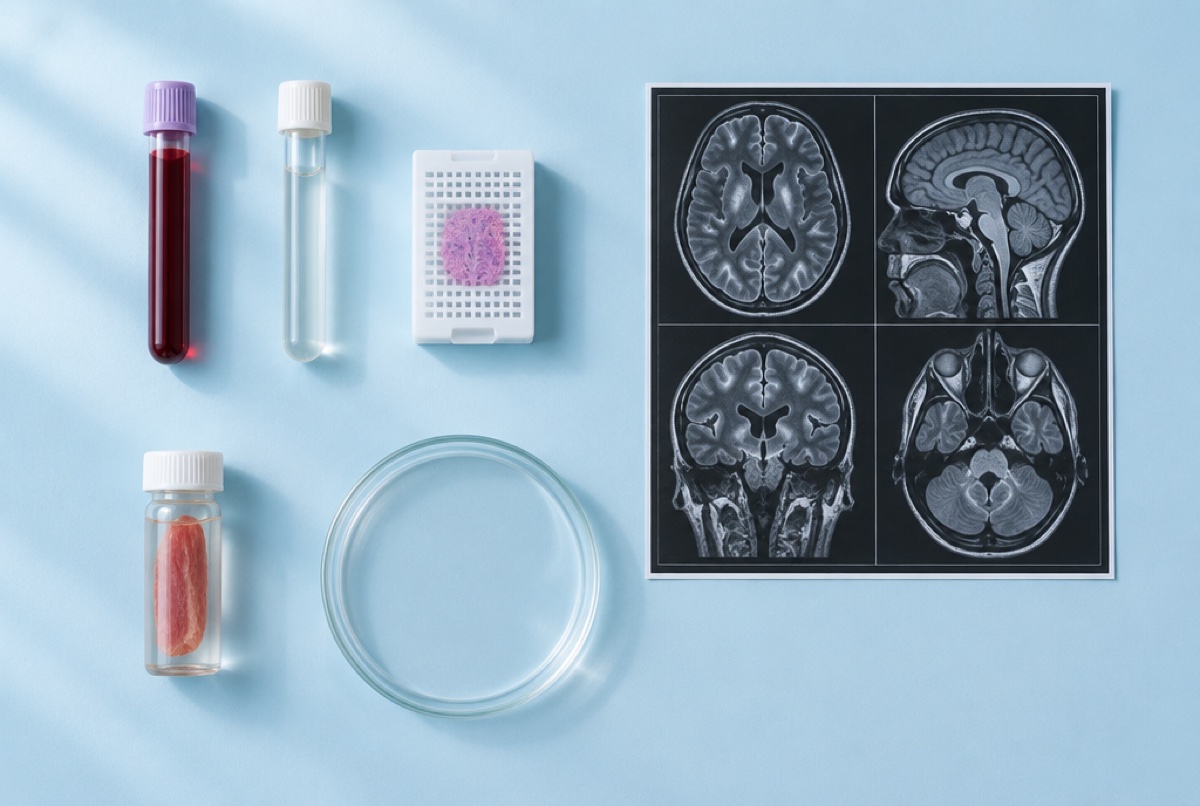
Here is roughly what the human case for “NAD+ declines with age” is built from. Pelvic skin from 49 people, newborns and patients aged 15 to 77, taken during operations scheduled for unrelated reasons. Cerebrospinal fluid from patients aged 24 to 91 who were already having a spinal tap to receive anesthesia. A single cube of occipital lobe, read without a needle by a 7-tesla scanner in 16 healthy volunteers. Thigh-muscle samples from young adults and from older adults sorted by whether they trained, simply got by, or were physically impaired. Plasma from healthy adults aged 20 to 87. And, most recently, whole blood from seven separate cohorts, run through a mass-spectrometry method validated against its own error.
That inventory is smaller than the sentence it supports. “NAD+ falls with age” appears on supplement labels, on IV-clinic menus and in the opening paragraph of a great many scientific reviews, usually as settled background. We have already examined whether NAD+ boosters raise the molecule and whether that changes anything that matters. This piece goes one step earlier and asks whether the premise itself holds up.
The precise question: do NAD+ levels actually fall as human beings age, and if so, where, by how much, and because of what? The most defensible answer in 2026 is that the decline is real but conditional. Small, mostly cross-sectional human studies find lower NAD+ in older skin, brain, muscle and liver. The gap appears closely tied to inactivity, inflammation and disease, not just the calendar. And in whole blood, the only compartment an at-home test can sample, the most rigorous analysis to date found no decline with age at all. Calling it a myth would be wrong. Calling it a universal law would be wrong, too.
Where the idea came from
NAD+ (nicotinamide adenine dinucleotide) is a coenzyme every cell uses to move electrons during energy production. It is also spent, not just recycled, by enzymes involved in DNA repair, signaling and stress responses: the PARPs, the sirtuins and an enzyme called CD38. That double role is what made the idea of an age-related shortage so compelling. If the supply runs low, both energy metabolism and maintenance work could suffer at once.
Most of the mechanistic story comes from mice. A 2016 Cell Metabolism study found that CD38 expression and activity rise with age in mice and that CD38 was required for the age-related NAD+ decline and the mitochondrial dysfunction that accompanied it. A 2021 isotope-tracing study in Cell Systems then measured how fast aged mice actually make and spend NAD+. It found a modest tissue decline, a median of about 30 percent, with production intact. The smaller pool was simply turning over faster, consistent with more active NAD-consuming enzymes. Calorie restriction partly blunted the decline by reducing consumption. The authors' own summary is worth keeping in view: the decline with normal aging “is relatively subtle and occurs despite maintained NAD+ production, likely due to increased consumption.”
So even in the animal that launched the idea, the picture is not an empty tank. It is a somewhat lower level in a system that is still producing at full speed and spending more.
The human tissue evidence, sample by sample
Skin. The 2012 pelvic-skin study in PLoS One remains one of the clearest human signals. NAD+ correlated strongly and negatively with age in both men (r = −0.706) and women (r = −0.537). In men, activity of the DNA-repair enzyme PARP rose with age and tracked inversely with NAD+, which fits the idea that accumulated DNA damage drives NAD+ consumption. The limits are real: one tissue site, surgical patients, 49 people, one point in time each.
Brain. Two magnetic resonance studies measured NAD in living human brains rather than in removed tissue. A 2015 PNAS study reported age-dependent reductions in NAD+ and total NAD, a rise in NADH, and a falling NAD+/NADH ratio in healthy volunteers. A 2019 study at 7 tesla, in 16 healthy adults aged 26 to 78, found an age-dependent decline in occipital-lobe NAD+ of about 1.24 micromolar per year, with repeat-scan variability of around 6 percent. These are direct, noninvasive measurements, which makes them unusually valuable. They are also tiny samples from one region of the brain.
Spinal fluid. A 2014 study of cerebrospinal fluid from donors aged 24 to 91 found lower NAD(H), a combined measure of NAD+ and NADH, in people older than 45, alongside higher markers of lipid oxidation and inflammation. The NAD(H) difference sat right at the edge of statistical significance (p = 0.05). People who drank more than one alcoholic drink a day also had lower levels, an early hint that exposures, not only years, move the number.
Liver. A 2016 study in the British Journal of Pharmacology reported lower hepatic NAD+ in aged mice and in older human patients, with the NAMPT-driven recycling pathway, rather than synthesis from tryptophan, appearing compromised. Most of that paper's experimental work, including the treatment arm, was done in mice.
Muscle. This is where the evidence becomes most interesting. A 2022 Nature Aging study compared the muscle metabolome of young adults with three groups of older adults: exercise-trained, normally active and physically impaired. NAD+ was one of the most prominent metabolites lower in older adults. But the gap was largest in the impaired group, and the trained older adults had NAD+ levels closer to those of the young. NAD+ also correlated with average daily steps and with mitochondrial and muscle function. A 2019 Nature Communications study of 119 older men in Singapore, the UK and Jamaica found low muscle NAD+ and disrupted NAD+ synthesis and recycling in people with sarcopenia compared with age-matched controls. Same age, different NAD+, depending on muscle health.
A third muscle study measured the machinery rather than the molecule. In 57 people, levels of NAMPT, the rate-limiting enzyme in NAD+ recycling, fell with age, and aerobic fitness was the best predictor of NAMPT. Twelve weeks of training raised it in older adults by 28 percent with aerobic exercise and 30 percent with resistance exercise. That study did not measure NAD+ itself, so it supports plausibility, not proof.
Blood: the compartment that won't cooperate
Blood is where the premise runs into trouble, and blood is what a consumer NAD+ test measures. The results have pointed in different directions for years. A 2018 study of plasma from healthy adults aged 20 to 87 reported significant age-related declines in NAD+, NADP+ and a related precursor, alongside rises in NADH, nicotinamide and NAD+ breakdown products. A 2016 PNAS metabolomics study comparing 15 young adults with 15 adults averaging 81 years old listed NAD+ and NADP+ among 14 blood compounds that differed by age. But a 2020 study of whole blood from 151 healthy donors aged 19 to 68 found no significant correlation between NAD+ and age overall, only a trend toward decline in men. The clearly lower values in that study came from 19 patients aged 75 to 101 who were hospitalized for heart failure, whose mean was 20.7 micromoles per liter versus 23.4 in healthy donors, roughly 12 percent lower. That is a sick-versus-healthy comparison as much as an old-versus-young one.
Then came the most careful attempt yet. A 2026 study in Nature Metabolism built an ultra-high-performance liquid chromatography and high-resolution mass spectrometry method explicitly designed to account for real-world analytical variability, and applied it to seven independent human cohorts. Those included young-versus-old comparisons, athletes, and people in exercise, diet and multimodal lifestyle programs. Whole-blood NAD+ “remain remarkably stable with age and across lifestyle interventions.” It did rise with nicotinamide riboside supplementation, which shows the assay could detect a change when one occurred. The authors concluded that their results “challenge the utility of blood NAD+ levels as a biomarker of ageing or lifestyle factors.”
Why might blood behave differently from muscle or brain? Several reasons are plausible. Whole blood is dominated by red blood cells, which have no nucleus and no mitochondria and therefore very different NAD+ demands from a working muscle fiber or a neuron. Plasma holds only trace extracellular amounts. NAD+ is chemically fragile, so sample handling and extraction can shift results, a point the 2026 authors emphasized. And studies do not always measure the same thing: NAD+, NADH, total NAD(H) and the NAD+/NADH ratio are different quantities that are easy to blur in a headline.
The confounder hiding inside “age”
A 2022 review in Nutrients went through the NAD+ and aging literature across yeast, worms, rodents, monkeys and humans and asked, in its title, whether the decline is a universal truth or a confounded consensus. Its conclusion was blunt: despite systematic claims of overall decline, the evidence is “very limited and often restricted to a single tissue or cell type,” and “this is particularly true in humans.” The authors called for much larger, preferably longitudinal, studies across tissues.
That last word matters. Every human study above is cross-sectional: it compares different people of different ages at one moment rather than following the same people as they grow older. Older groups also carry more inflammation, more inactivity, more chronic disease and more accumulated DNA damage, and each of those has its own link to NAD+. Inflammation and DNA damage both switch on NAD+-consuming enzymes. The muscle studies show NAD+ tracking function and activity within the same age band. The lowest blood values came from hospitalized patients. Drinking tracked with lower spinal-fluid NAD(H).
None of this proves that age itself is irrelevant. It does suggest that “age” in these studies partly stands in for the wear and illness that tend to accompany it. And a cross-sectional design cannot tell us which way the arrow points: whether low NAD+ helps cause frailty, or whether inactivity and disease lower NAD+.
Myth or fact? A scorecard
Supported: In small human studies, older people have lower NAD+ in skin, brain, muscle and liver than younger people. The brain magnetic resonance studies and the skin study show consistent negative correlations with age.
Overstated: That the decline is universal, body-wide, steep or easy to measure in blood. The mouse decline that anchors the theory is modest, and the most rigorous human blood analysis found no age effect.
Unproven: That lower NAD+ causes human aging, or that restoring it slows or reverses aging. Oral precursors reliably raise blood NAD+, but as we have reviewed for NMN and NR, raising the number has not yet translated into consistent functional or clinical benefit in people.
What this means for a reader
First, treat a blood NAD+ result with caution. The best current evidence says whole-blood NAD+ does not change with age or lifestyle, so a “low” or “youthful” reading is not a validated measure of how old your tissues are. A higher reading after a supplement shows the supplement was absorbed. It does not show that you were deficient, or that your muscle or brain changed.
Second, the most consistent human pattern links higher muscle NAD+ with being active and physically capable. Trained older adults looked more like young adults, and training raised the key recycling enzyme. That is association plus mechanism, not proof that exercise works through NAD+. But exercise does not need NAD+ to justify itself; its benefits for function and survival rest on outcome evidence of their own, which you can read about in our pieces on Zone 2 training and aerobic fitness after 50.
Third, know what would settle the question: large studies that follow the same people for years, sample more than one tissue, use standardized and validated assays, and separate the effects of age from those of activity, inflammation and disease. Until those exist, “NAD+ declines with age” is best read as a reasonable hypothesis with uneven human support, not as a diagnosis waiting for a product.
Go back to the inventory: the skin sample, the spinal fluid, the scanner's single cube of brain, the thigh biopsies, the tubes of blood. Each answered a slightly different question. Together they say the supply does run lower in some of the body's working tissues, in some older people, especially those who are less active or less well. And the tube of blood, the sample most likely to be sold back to you as an aging score, is the one place the most careful measurement has not found the decline at all. Educational, not medical advice.
The takeaway
NAD+ decline with age is not a myth, but it is not the universal, body-wide fact it is sold as. Small cross-sectional studies find lower NAD+ in older human skin, brain, muscle and liver, and in muscle the gap tracks physical function and activity as much as age. In whole blood, the compartment consumer tests sample, the most rigorous current method found no age effect. Whether lower tissue NAD+ causes human aging, or whether raising it reverses anything, remains unproven.
References
15 peer-reviewed sources, published 2012–2026, across 13 journals. Every citation links to its PubMed record.
- Nature Metabolism · 2026 · PMID 42135539 · DOI 10.1038/s42255-026-01537-5
- Nutrients · 2022 · PMID 35010977 · DOI 10.3390/nu14010101
- PLoS One · 2012 · PMID 22848760 · DOI 10.1371/journal.pone.0042357
- Proceedings of the National Academy of Sciences of the United States of America · 2015 · PMID 25730862 · DOI 10.1073/pnas.1417921112
- Magnetic Resonance in Medicine · 2019 · PMID 31502710 · DOI 10.1002/mrm.27971
- PLoS One · 2014 · PMID 24454842 · DOI 10.1371/journal.pone.0085335
- Hepatic NAD(+) deficiency as a therapeutic target for non-alcoholic fatty liver disease in ageing. ↗British Journal of Pharmacology · 2016 · PMID 27174364 · DOI 10.1111/bph.13513
- Nature Aging · 2022 · PMID 37118369 · DOI 10.1038/s43587-022-00174-3
- Nature Communications · 2019 · PMID 31862890 · DOI 10.1038/s41467-019-13694-1
- Physiological Reports · 2019 · PMID 31207144 · DOI 10.14814/phy2.14139
- Rejuvenation Research · 2018 · PMID 30124109 · DOI 10.1089/rej.2018.2077
- Proceedings of the National Academy of Sciences of the United States of America · 2016 · PMID 27036001 · DOI 10.1073/pnas.1603023113
- Experimental Gerontology · 2020 · PMID 32783906 · DOI 10.1016/j.exger.2020.111051
- Cell Systems · 2021 · PMID 34559996 · DOI 10.1016/j.cels.2021.09.001
- Cell Metabolism · 2016 · PMID 27304511 · DOI 10.1016/j.cmet.2016.05.006
Mechanisms and molecules in this article
Each links to its Magellan monograph — what it is, what it does, and the studies behind it.
Related reading
Rentosertib has renewed the debate over biological age. A randomized human experiment offers an important…
Apigenin inhibits CD38, the enzyme that drains NAD+ as tissues age — a beautiful mechanism demonstrated in…
In April 2026 a glaucoma patient in Glendale, California received an injection of ER-100 — three of the four…
Prefer the interactive version? Open this article inside the Magellan app →