The Yellow Powder and the Ache That Sends People Looking
Curcumin, the pigment of turmeric, reliably lowers some inflammatory markers in meta-analyses and shows real symptomatic benefit in osteoarthritis — but results are inconsistent, trials are small, and the very formulations that make it absorbable have been linked to liver injury.
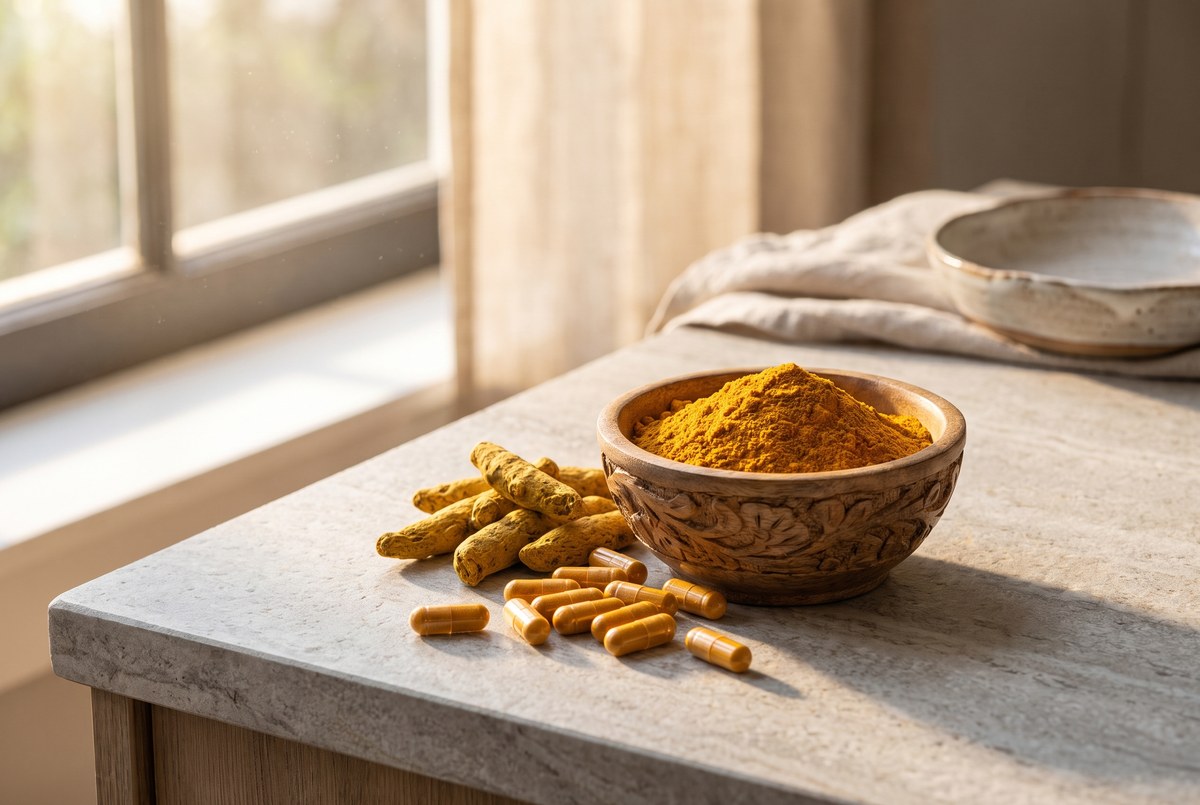
Nobody buys curcumin because of a signaling pathway. They buy it because of a knee that announces itself on the stairs, a hand that has stopped closing fully around a jar, a body that has begun to keep its own ledger of years. The purchase is small — a bottle, a capsule, a month's supply — but the hope folded into it is large: that inflammation, the word that now explains everything from arthritis to aging itself, might be turned down like a dial. Getting that hope wrong costs more than money. It costs the months a person spends swallowing a pigment while a joint quietly worsens, or the trust they lose in evidence altogether when the promise outruns the data.
So it matters, genuinely, what the human evidence actually says about curcumin — the principal curcuminoid and yellow pigment of turmeric, a rhizome long used as a culinary spice and in traditional medicine.
The most defensible answer is neither the enthusiast's nor the skeptic's. Meta-analyses of randomized controlled trials generally find that curcumin supplementation lowers circulating inflammatory mediators — C-reactive protein, interleukin-6, tumor necrosis factor-alpha — and improves oxidative-stress markers. But effects on individual cytokines are inconsistent across populations, several analyses report null results, and the trials underneath the averages are often small, short and heterogeneous in formulation. The signal is real and the noise is real.
What the meta-analyses agree on
The mechanistic story is coherent: curcumin acts on signaling pathways such as nuclear factor-kappaB, and a 2021 review in Nutrition Reviews and a 2023 meta-analysis of randomized trials in Cytokine both document anti-inflammatory and antioxidant effects in adults. A 2023 umbrella meta-analysis — an analysis of the analyses — profiled inflammatory biomarkers following supplementation and broadly confirmed the pattern. When three layers of aggregation point the same direction, the direction is probably true: on average, curcumin moves inflammatory blood markers downward. Whether moving those markers changes how anyone feels or fares is a separate question.
Where it touches symptoms: the joints
The strongest case for felt benefit is osteoarthritis. A 2024 meta-analysis of meta-analyses in Phytotherapy Research examined curcumin's efficacy in relieving the condition, and a 2024 Bayesian network meta-analysis in the Journal of Ethnopharmacology compared curcumin therapy for knee osteoarthritis against alternatives on efficacy and safety. Symptomatic benefits have been reported in osteoarthritis and rheumatoid arthritis, alongside modest LDL-cholesterol and triglyceride reductions in cardiometabolic populations and adjunctive antidepressant effects. These are averages over small trials — meaningful for a population, no guarantee for a person.
The complication: absorption cuts both ways
Native curcumin is poorly water-soluble, rapidly metabolized and poorly absorbed, which is why the shelf now offers high-bioavailability versions: piperine co-administration, nanoparticles, lipid and phospholipid carriers. Nanocurcumin and similar formulations appear to enhance some effects — one small 18-month trial of a bioavailable formulation even reported improved verbal memory and reduced brain amyloid and tau signal on PET imaging in non-demented adults, a finding as intriguing as it is preliminary. But the same absorption-boosting property, often piperine's inhibition of hepatic metabolism, has been linked to a growing case series of immune-mediated liver injury. The fix for curcumin's weakness may be the source of its risk. Prolonged use warrants caution, and anyone with liver concerns belongs in a clinician's office, not a supplement aisle.
What a reader can honestly take
For the person on the stairs, the evidence permits a measured hope: this is a compound with reproducible anti-inflammatory effects in blood markers and symptomatic support in joint disease, studied as itself — not as any specific commercial product. What it does not permit is certainty. The averages hide nulls, the trials are short, and the formulations differ enough that one bottle is not another. The ache that sends people looking deserves that honesty. Educational, not medical advice.
The takeaway
Curcumin supplementation lowers CRP, IL-6 and TNF-alpha on average and eases osteoarthritis symptoms in meta-analyses, but the evidence is heterogeneous, some analyses are null, and high-bioavailability formulations carry a documented liver-injury caution.
References
5 peer-reviewed sources, published 2021–2024, across 5 journals. 3 of them have a full Magellan study write-up linked below.
- Nutr Rev · 2021 · PMID 34378053 · DOI 10.1093/nutrit/nuaa114Curcumin supplementation can reduce several markers of inflammation in humans, but more research is needed to determine optimal usage. Read our full write-up →
- Cytokine · 2023 · PMID 36804260 · DOI 10.1016/j.cyto.2023.156144Turmeric/curcumin supplementation can reduce inflammation and improve antioxidant status in adults. Read our full write-up →
- Evid Based Complement Alternat Med · 2023 · PMID 36700039 · DOI 10.1155/2023/4875636Curcumin supplementation significantly reduces key inflammatory biomarkers like CRP, IL-6, and TNF-. Read our full write-up →
- Phytotherapy Research · 2024 · PMID 38576215 · DOI 10.1002/ptr.8153
- Journal of Ethnopharmacology · 2024 · PMID 38036015 · DOI 10.1016/j.jep.2023.117493
Mechanisms and molecules in this article
Each links to its Magellan monograph — what it is, what it does, and the studies behind it.
Related reading
Transcranial photobiomodulation has small cognitive trials and a growing systematic review literature.…
The spiked mat is wellness social media's favorite torture device. The underlying technique — acupressure —…
Evidence shows balance and strength training improves key healthspan markers in older adults.
All Magellan articles → · More on Recovery, Sauna & Light Therapy →
Prefer the interactive version? Open this article inside the Magellan app →