The Flavone in the Celery, and the Fear It Answers
Luteolin reliably calms inflammatory signaling in rodent brains and cultured cells, and small human trials — mostly of luteolin combined with other agents — report intriguing benefits. But the one placebo-controlled trial of luteolin alone came back negative, and nothing yet establishes it as an anti-aging supplement.
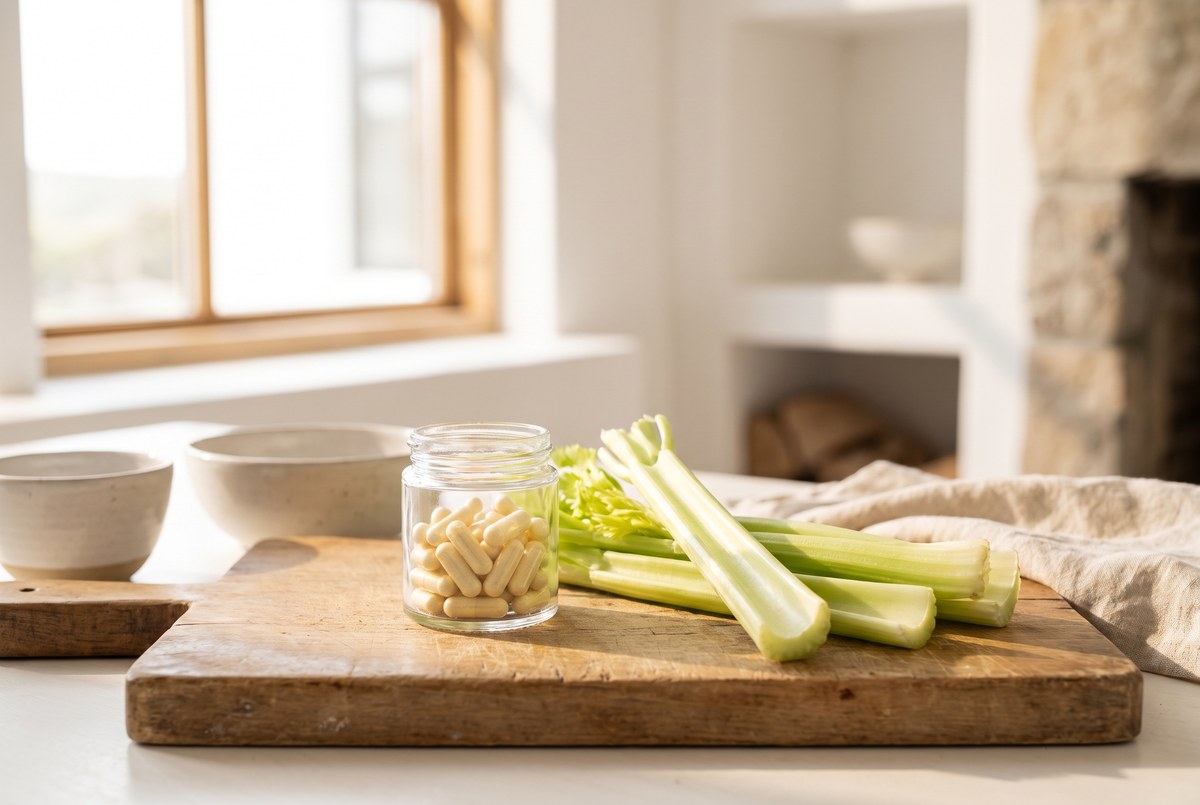
There is a particular dread reserved for the mind's own decline — the word that will not come, the face without a name, the suspicion that the self might outlast the machinery that runs it. People do not talk about this fear easily, but they shop for it. And into that quiet marketplace steps a small yellow flavone from celery, parsley, green pepper and chamomile, sold in capsules and traded as hope in the forums: luteolin, the anti-inflammatory flavonoid said to calm the inflamed brain.
The fear is universal; the question is specific. Does this molecule — which demonstrably quiets inflammatory signaling in rodent brains and cultured cells — do anything provable in people?
The most defensible answer: the mechanism is real and repeatedly confirmed in preclinical work; the human evidence is promising but indication-specific and usually involves luteolin blended with other agents; and the one placebo-controlled trial of luteolin by itself found it no better than placebo. It is not an established anti-aging supplement.
What the laboratory keeps finding
The preclinical case is genuinely consistent. Luteolin acts as an antioxidant and anti-inflammatory agent, inhibiting microglial and astrocyte activation and the release of pro-inflammatory cytokines including TNF-α, IL-1β and IL-6, while modulating endoplasmic-reticulum stress and pathways such as JNK/AP-1, NF-κB and mTOR — work summarized in Acta Pharmacologica Sinica in 2021 and in a 2020 Biofactors review on neuroinflammation and neurotrauma. In rodent models of Alzheimer's disease, cerebral hypoperfusion and LPS-induced cognitive impairment, it ameliorates memory and learning deficits, a case argued in Neurochemical Research in 2018. In senescent mice, dietary luteolin reduced proinflammatory microglia in the brain — the 2016 Rejuvenation Research study. A 2023 review in Frontiers in Pain Research extended the portfolio to pain in chronic conditions. Rodents and cells, though, are not people; the leap is everything.
Where humans enter the picture — usually in combination
The most striking human data involve palmitoylethanolamide combined with luteolin (PEA-LUT) plus olfactory training after COVID-19: in one multicenter trial about 89% of patients improved their smell versus 37% with training alone, with benefits also reported for subjective cognition. A chlorogenic-acid-plus-luteolin nutraceutical improved weight, glycemic and vascular markers over six months in pre-obesity. Open-label studies of a luteolin-containing formulation in children with autism reported behavioral improvement and lower serum TNF and IL-6 — encouraging, but open-label, which means everyone knew who was taking what.
The complication
Against all of this stands the cleanest test: a placebo-controlled trial in Gulf War Illness found luteolin no better than placebo. The molecule is also poorly water-soluble, with limited oral bioavailability — the reason lipid-based and co-micronized formulations exist — so what works in a dish may never reach a human brain at meaningful concentrations. And because the positive human trials used combinations, they cannot prove luteolin itself did the work. Larger rigorous trials are needed; that phrase is not boilerplate here, it is the finding.
Practical meaning
The promise lives in neuroinflammation; the proof lives in specific indications and combinations; the standalone capsule is, as yet, an extrapolation. Luteolin itself remains a molecule you already eat — in celery, parsley, green pepper and chamomile — in amounts no one has linked to harm or, for that matter, to proven cognitive protection. This evidence describes luteolin and its formulations, not any specific commercial product.
So the yellow powder waits at the intersection of a real mechanism and an unproven hope. The fear that sells it is old and honest. The science that tests it is young and honest too — and the honest thing to hold is both at once.
Educational, not medical advice.
The takeaway
The defensible bottom line: luteolin has a consistent anti-neuroinflammatory mechanism in preclinical models and promising, indication-specific human signals — most notably for smell recovery after COVID-19 in combination with palmitoylethanolamide — but standalone luteolin failed its placebo-controlled test and remains unproven for human cognitive aging.
References
5 peer-reviewed sources, published 2016–2023, across 5 journals. 3 of them have a full Magellan study write-up linked below.
- Acta Pharmacol Sin · 2021 · PMID 34267346 · DOI 10.1038/s41401-021-00702-8Luteolin improved memory and reduced brain inflammation and cellular stress in a mouse model of Alzheimer's disease. Read our full write-up →
- Rejuvenation Res · 2016 · PMID 26918466 · DOI 10.1089/rej.2015.1708Dietary luteolin reduced age-related proinflammatory microglia activity in the brains of senescent mice. Read our full write-up →
- Biofactors · 2020 · PMID 33098588 · DOI 10.1002/biof.1687Luteolin, a natural compound, shows promise in protecting the brain by reducing inflammation and oxidative stress in various neurological conditions. Read our full write-up →
- Front Pain Res (Lausanne) · 2023 · PMID 36937566 · DOI 10.3389/fpain.2023.1114428
- Neurochem Res · 2018 · PMID 29392519 · DOI 10.1007/s11064-018-2482-2
Mechanisms and molecules in this article
Each links to its Magellan monograph — what it is, what it does, and the studies behind it.
Related reading
The evidence for acetyl-L-carnitine is limited to specific conditions, with no direct support for lifespan…
Apigenin inhibits CD38, the enzyme that drains NAD+ as tissues age — a beautiful mechanism demonstrated in…
Broccoli-sprout sulforaphane flips one of biology's master antioxidant switches. Human trials show modest…
All Magellan articles → · More on Nutraceuticals & Cellular Energizers →
Prefer the interactive version? Open this article inside the Magellan app →