Forty Pulses a Second: An Inventory of What the Massage Gun Does and Does Not Do
Percussive massage guns reliably loosen joints and blunt next-day soreness in controlled trials — and just as reliably fail to boost strength, jump height, or any aging-related outcome. The honest inventory separates the warm-up drawer from the marketing drawer.
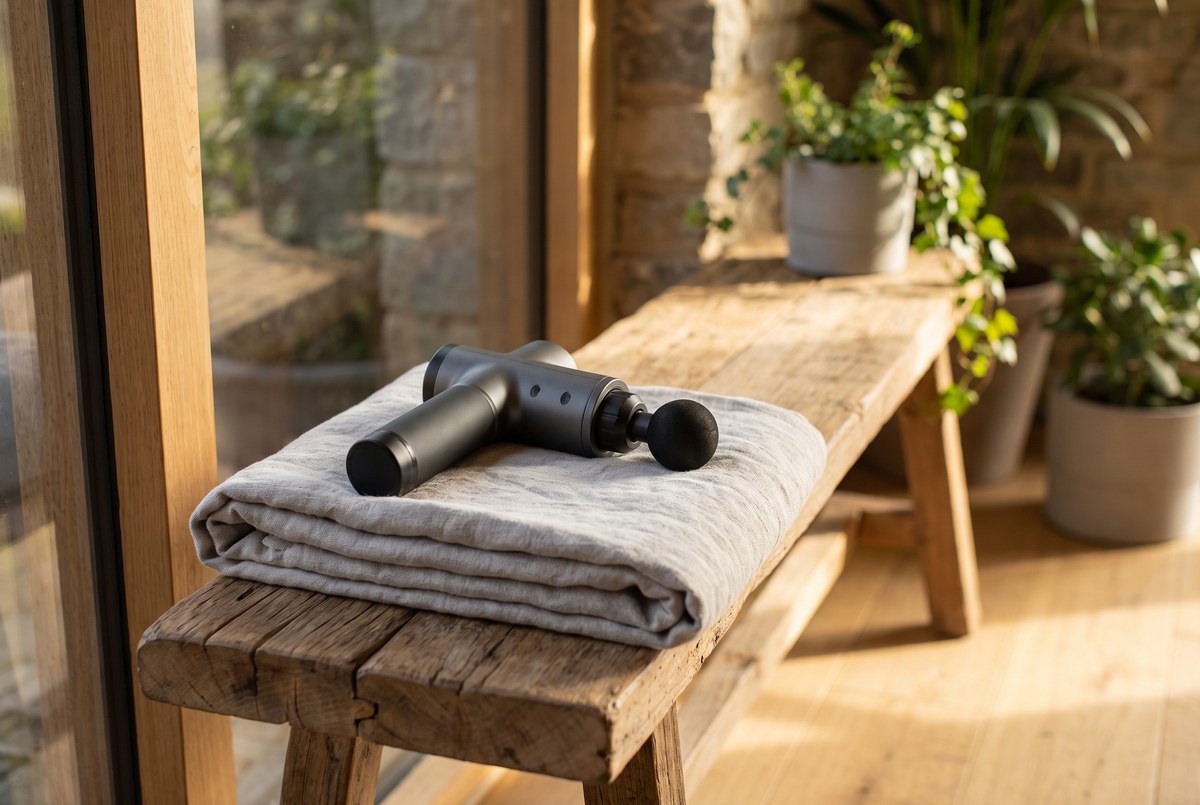
An inventory of what the percussive massage gun promises, in rough order of appearance on the box: rapid pulses, up to about 40 percussions per second, delivered into muscle and fascia; deep-tissue massage without the massage therapist; warmer warm-ups; faster recovery; the end of soreness; the restoration of the athlete. Now an inventory of what the trials actually measured: degrees of joint range of motion; millimeters of thoracolumbar fascia thickness; centimeters of vertical jump; hours until the quadriceps stopped aching; pain scores after ACL reconstruction; bar velocity during resistance training.
The interesting question is where the two inventories overlap — and the answer is: more than the skeptics expected, less than the box says.
The device itself is a simple proposition. A handheld motorized head hammers the tissue, mimicking deep-tissue massage; the proposed mechanisms are increased local blood flow, stimulation of skin and muscle mechanoreceptors and proprioceptors, and neuromuscular modulation that transiently lowers muscle tone and stiffness. Athletes and the physically active use it for warm-up and post-exercise recovery. The defensible summary of the controlled literature: it acutely increases flexibility without costing strength, it reliably dials down soreness, and beyond that the claims outrun the data.
What holds up
Systematic reviews of controlled trials converge on one clean finding: percussive massage acutely increases joint range of motion and flexibility without reducing strength — a genuinely useful warm-up property, since static stretching famously taxes power. Randomized trials report less muscle stiffness and soreness and faster recovery after fatiguing exercise: a 2025 randomized controlled trial in Frontiers in Public Health tested percussion therapy against delayed-onset muscle soreness, a 2026 trial in Frontiers in Sports and Active Living examined fascia-gun relaxation of exercise-induced fatigue in athletes, and the evidence base is catalogued in the Journal of Strength and Conditioning Research. Newer trials extend into clinical populations — less pain and better function after ACL reconstruction, reduced thoracolumbar fascia thickness in chronic low back pain.
What doesn't
In several trials, percussive or vibration therapy was no better than passive rest, stretching, or foam rolling — the cheap controls. Used immediately before activity, it does not improve — and may transiently reduce — maximal strength, balance and explosive performance. The single most instructive trial: a 2025 randomized study in the Clinical Journal of Sport Medicine found percussive massage improved quadriceps pain, fatigue and perceived recovery after habitual running but had no effect on vertical jump — the subjective inventory improved while the objective one shrugged. A 2021 study in the International Journal of Environmental Research and Public Health measured acute effects on movement velocity during resistance training, which is the kind of granular question this literature actually answers.
The complication
The studies are mostly small, short-term, and conducted in young athletic adults. No trial has linked massage-gun use to aging-related outcomes — sarcopenia, mobility in older adults, anything a longevity-minded buyer might actually care about. This evidence concerns percussive and vibration therapy in general, not any specific commercial device.
Practical meaning
File the gun under recovery and mobility, not performance and definitely not longevity: useful before a session for range of motion, useful after one for soreness, best avoided in the minutes immediately before maximal-effort lifting or jumping, and unproven for everything grander.
So the final inventory is short and honest. Range of motion: yes. Soreness: yes, modestly. Strength, jump, aging: no, no, and never tested. Forty pulses a second can buy you a looser hip and a quieter morning after. It cannot buy you back the years — no box has promised that yet, but give the marketing department time.
Educational, not medical advice.
The takeaway
Systematic reviews and randomized trials support percussive massage for acutely increasing range of motion without reducing strength, and for reducing muscle stiffness and soreness after fatiguing exercise — but it is often no better than rest, stretching or foam rolling, it can transiently reduce explosive performance if used right before activity, and nothing links it to aging-related outcomes.
References
5 peer-reviewed sources, published 2021–2026, across 5 journals. 2 of them have a full Magellan study write-up linked below.
- J Strength Cond Res · 2025 · PMID 40293721 · DOI 10.1519/JSC.0000000000005110Percussion massage did not improve recovery from muscle damage caused by intense eccentric exercise. Read our full write-up →
- Front Public Health · 2025 · PMID 40206177 · DOI 10.3389/fpubh.2025.1561970Longer duration percussive massage therapy (40 minutes) is more effective than static stretching or shorter duration percussive massage (25 minutes) for recovering from delayed onset muscle soreness. Read our full write-up →
- Front Sports Act Living · 2026 · PMID 42318302 · DOI 10.3389/fspor.2026.1831667
- Int J Environ Res Public Health · 2021 · PMID 34360032 · DOI 10.3390/ijerph18157726
- Clin J Sport Med · 2025 · PMID 40135996 · DOI 10.1097/JSM.0000000000001355
Mechanisms and molecules in this article
Each links to its Magellan monograph — what it is, what it does, and the studies behind it.
Related reading
Evidence suggests blood flow restriction training effectively increases muscle strength and mass in older…
Neuromuscular electrical stimulation can preserve and rebuild muscle when ordinary training is impossible —…
A look at the evidence for sauna, cold plunge, and red-light therapy in promoting longevity and healthspan.
All Magellan articles → · More on Recovery, Sauna & Light Therapy →
Prefer the interactive version? Open this article inside the Magellan app →