The Soil Molecule That Biohackers Swear Builds New Mitochondria
PQQ is a redox-active compound from soil and natto that grows mitochondria in rodent and cell studies — and a handful of small, short, mostly Japanese and manufacturer-linked human trials report better memory, attention, and LDL. No large independent trial exists. That gap is the whole story.
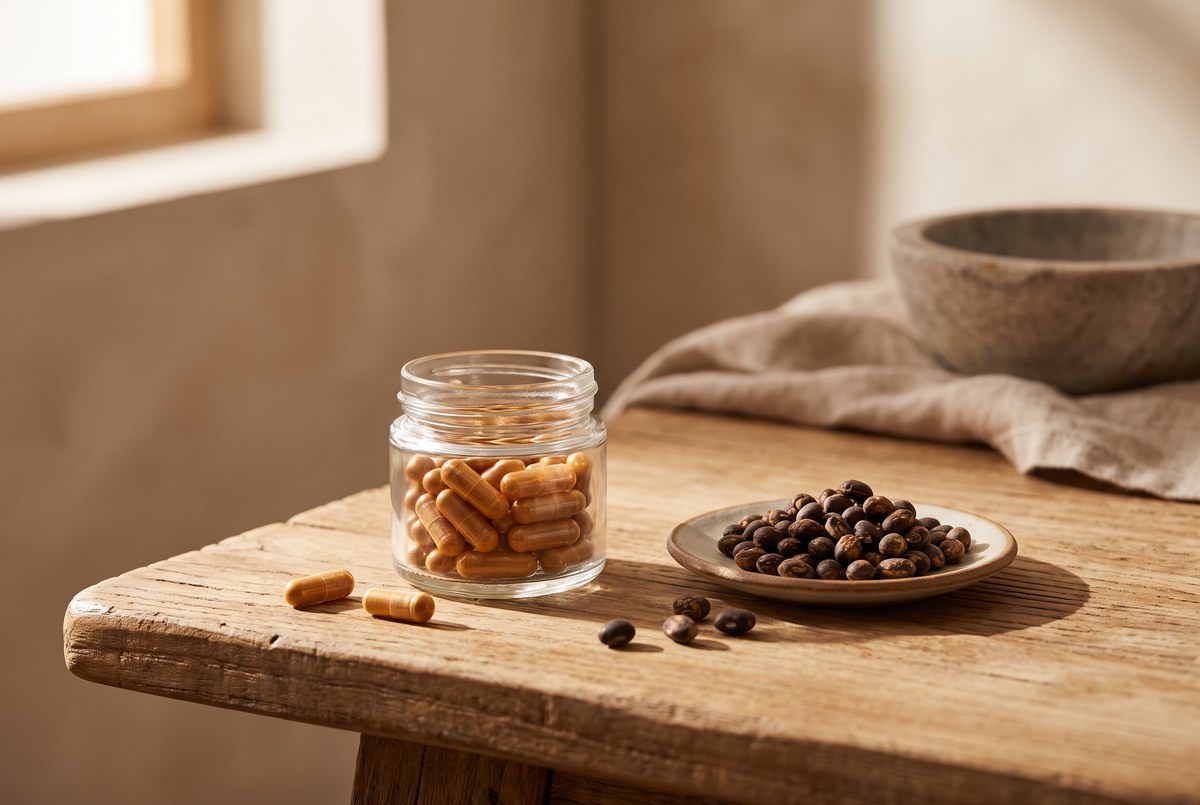
Scroll the forums and the word lands like a drumbeat: biogenesis. Not preserving mitochondria — building new ones. Fresh furnaces in old cells. And the molecule credited with this miracle is PQQ, pyrroloquinoline quinone, a redox compound dug out of soil bacteria, floating in natto and spinach and kiwi and green tea, present in human breast milk, hailed by some researchers as a candidate "longevity vitamin." Twenty milligrams a day. New mitochondria. Whoosh — there goes the supplement budget.
Stop. Breathe. Here is the precise question: what has PQQ actually done in humans, versus in cells and rodents? The defensible answer: a handful of small, short, mostly Japanese, largely manufacturer-linked trials report real but modest cognitive and lipid effects — while the mechanism that made it famous has never been demonstrated to matter in a human body.
The human trials: small, short, and genuinely positive
Credit where the data earn it — the trials exist and several are randomized. The typical scale: roughly thirty to sixty participants, up to twelve weeks, about twenty milligrams per day. A 2021 trial in the Journal of the American Nutrition Association tested dietary PQQ disodium salt on cognitive function in healthy volunteers. A 2023 study in Food & Function reported improved brain function in both younger and older adults. A 2016 paper in Advances in Experimental Medicine and Biology examined the branded BioPQQ supplement's effects on cognitive functions. Across this small literature, the reported outcomes cluster: memory, attention, cognitive flexibility — one trial carrying near-infrared evidence of increased prefrontal blood flow, an actual physiological correlate rather than a questionnaire alone.
The most striking entry is a 2024 randomized controlled trial in the Journal of Nutrition, Health and Aging: six weeks of PQQ in elderly individuals with mild cognitive decline raised serum BDNF — a brain-growth signal — and nudged cerebral oxygen saturation from about 48 percent to 53 percent. A separate trial modestly lowered LDL cholesterol in people whose levels started high-normal. These are real measurements, not vibes.
The complication: the famous mechanism is not human evidence
Now the part the forum posts skip. The mitochondrial-biogenesis claim — the one doing all the marketing work — rests on cell and animal studies showing PQQ activates the CREB, PGC-1α, and SIRT1 signaling pathways. A 2022 paper in Pulmonary Pharmacology & Therapeutics documents this biology. It is lovely biology. It is also, so far, biology that lives in rodent livers and culture dishes. Whether swallowing twenty milligrams of PQQ builds new mitochondria in a human brain is unknown — no trial has measured it, and no trial has run long enough or large enough to show a hard clinical outcome: no dementia prevented, no disease delayed, no lifespan extended.
And the provenance matters. The trials are small, short, largely conducted in Japan, and heavily linked to the compound's manufacturer — the exact profile that demands independent replication before confidence. None of the research tested any specific commercial product beyond its own preparation.
What a reader can actually take from this
If PQQ interests you, the honest reading is: a plausible, antioxidant, possibly cognition-adjacent compound with encouraging early trials and zero confirmation at scale. It is a watch-this-space molecule, not a proven one. The foods that contain it — natto, spinach, kiwi, green pepper, parsley, green tea — deliver it the way human biology has always received it, embedded in diets with their own evidence.
So the drumbeat quiets into something more accurate: not biogenesis in a bottle, but a genuinely interesting molecule waiting for the large, independent, years-long trial that would decide whether the forums were early — or just loud. Until then, the furnaces you have are the ones you keep, and nobody has yet proven a pill can mint new ones in you. Educational, not medical advice.
The takeaway
Small human trials of PQQ (roughly 20 mg/day, up to 12 weeks, a few dozen participants) report improved memory, attention, and cognitive flexibility, with one trial raising BDNF and cerebral oxygen saturation — but the celebrated mitochondrial-biogenesis mechanism is cell-and-rodent work, and no large independent human trial or hard clinical endpoint exists.
References
5 peer-reviewed sources, published 2016–2024, across 5 journals. 2 of them have a full Magellan study write-up linked below.
- Pulm Pharmacol Ther · 2022 · PMID 36030026 · DOI 10.1016/j.pupt.2022.102156PQQ shows promise in preventing and treating pulmonary hypertension by improving mitochondrial function and reducing cellular proliferation and inflammation. Read our full write-up →
- J Am Nutr Assoc · 2021 · PMID 34415830 · DOI 10.1080/07315724.2021.1962770Daily PQQ supplementation improved multiple aspects of cognitive function in healthy middle-aged to elderly individuals over 12 weeks. Read our full write-up →
- J Nutr Health Aging · 2024 · PMID 38908296 · DOI 10.1016/j.jnha.2024.100287
- Food Funct · 2023 · PMID 36807425 · DOI 10.1039/d2fo01515c
- Adv Exp Med Biol · 2016 · PMID 26782228 · DOI 10.1007/978-1-4939-3023-4_40
Mechanisms and molecules in this article
Each links to its Magellan monograph — what it is, what it does, and the studies behind it.
Related reading
The evidence for acetyl-L-carnitine is limited to specific conditions, with no direct support for lifespan…
Apigenin inhibits CD38, the enzyme that drains NAD+ as tissues age — a beautiful mechanism demonstrated in…
Blood ergothioneine falls with age, and low levels track with cognitive decline, cardiovascular disease,…
All Magellan articles → · More on Nutraceuticals & Cellular Energizers →
Prefer the interactive version? Open this article inside the Magellan app →