Seven Ingredients Walk Into a Gummy
A single organ-support gummy packs lutein, zeaxanthin, nattokinase, inulin, apple cider vinegar, rutin and trehalose. The evidence behind those seven compounds ranges from large randomized trials to pure mechanism — and the combination itself has never been tested.
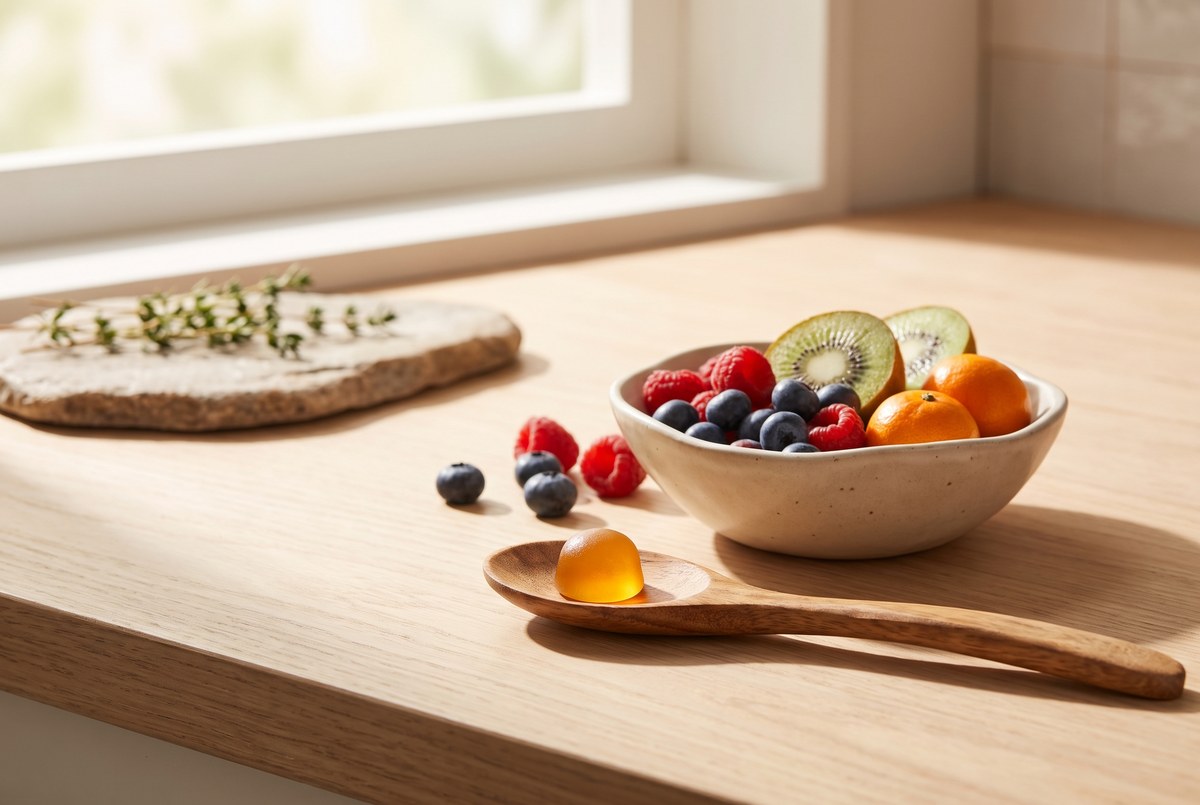
Consider the contents of one strawberry-colored gummy, marketed for whole-body organ support. Item one: lutein, a xanthophyll carotenoid concentrated in the retina and brain. Item two: zeaxanthin, its near-twin. Item three: nattokinase, a fibrinolytic enzyme extracted from natto, the fermented soybean dish. Item four: inulin, a fermentable prebiotic fiber. Item five: apple cider vinegar, a delivery system for acetic acid. Item six: rutin, a flavonoid. Item seven: trehalose, a disaccharide that can induce autophagy — the cell's internal housekeeping — and the formulation's flagship brain-health ingredient. Seven compounds, seven distinct mechanisms, one chewable vehicle, aimed at the eyes, brain, heart, kidneys, liver, muscles and gut: the organs that commonly decline with age.
It is a strange little inventory, and the strangeness is the point. Each item on the list arrives with its own separate dossier of evidence — some thick, some nearly empty — and the product's promise rests on the assumption that seven individual dossiers add up to one combined effect.
So the precise question: does the human evidence support a multi-ingredient gummy for organ health? The most defensible answer is that the ingredients must be judged one at a time, that their support ranges from large randomized trials down to preclinical mechanism, and that no trial has ever tested this exact seven-ingredient combination — meaning any benefit is inferred from each compound separately, at doses a gummy may not reach.
The strongest dossier: the eyes
Lutein and zeaxanthin are the best-supported items on the list, and even their record is mixed. The AREDS2 randomized clinical trial, published in JAMA in 2013, tested lutein plus zeaxanthin for age-related macular degeneration — and its primary AMD endpoint came back null. A separate randomized, double-masked, placebo-controlled trial in the American Journal of Ophthalmology in 2012 found improved retinal function in early macular degeneration after supplementation. Large trials and RCTs link the pair to eye and cognitive health, yet the LIMPIA trial found no change in macular pigment. This is what genuinely studied ingredients look like: real trials, real nulls, signals in some endpoints and silence in others.
The middle shelf: pressure, glucose, fiber
Nattokinase illustrates the gap between small trials and big ones. A 2023 meta-analysis of six randomized trials found a modest blood-pressure reduction — about 3 mmHg systolic — while a large three-year randomized trial found no effect on subclinical atherosclerosis. Apple cider vinegar's acetic acid has trial support for improved post-meal glucose. Inulin carries meta-analytic support for glycemic control in prediabetes and type 2 diabetes. These are real but modest effects, mostly on surrogate markers — blood pressure, post-meal glucose — rather than on clinical outcomes like heart attacks or kidney failure.
The thin folder: mechanism without outcomes
Rutin and trehalose rest mainly on mechanistic and preclinical data — endothelial effects, autophagy induction. Trehalose, the flagship, faced its largest human test in the HEALEY ALS platform trial: it was well tolerated, and it showed no efficacy. A compound can be fascinating in a cell culture and invisible in a patient; the trehalose file is the cautionary exhibit.
The problem the label cannot solve
Even if every ingredient were proven — and none fully is — the combination would remain unstudied. Compounds can interact, compete for absorption, or simply arrive in a gummy at doses below those used in trials. The honest framing is that this evidence describes the underlying compounds and mechanisms, not this specific commercial product. Broader supplementation meta-analyses, such as those examining vitamin D and mortality, underline the general lesson: nutrient-by-nutrient results are hard-won, frequently null, and rarely transferable to blends.
What a reader can take from the inventory: judge such products ingredient by ingredient, discount anything supported only by mechanism, and remember that surrogate markers are not outcomes. The gummy on the counter holds seven dossiers — one thick, three middling, two thin, and one combination trial that does not exist. That is the whole list, and the list is the honest answer. Educational, not medical advice.
The takeaway
The ingredients in multi-organ formulas carry wildly uneven human evidence — strongest for lutein and zeaxanthin, weakest for rutin and trehalose — and no trial has tested the combination, so any benefit is an inference, not a finding.
References
5 peer-reviewed sources, published 2012–2023, across 5 journals. 3 of them have a full Magellan study write-up linked below.
- The Journals of Gerontology: Series A · 2022 · PMID 35975308 · DOI 10.1093/gerona/glac135GlyNAC supplementation in older adults can reverse several age-related health declines, including oxidative stress and mitochondrial dysfunction. Read our full write-up →
- BMJ · 2019 · PMID 31405892 · DOI 10.1136/bmj.l4673Vitamin D supplementation did not reduce overall mortality but was associated with a 16% reduction in cancer-related deaths. Read our full write-up →
- Ageing Res Rev · 2023 · PMID 37004841 · DOI 10.1016/j.arr.2023.101923Daily vitamin D supplementation may reduce cancer mortality, but bolus dosing does not show the same benefit. Read our full write-up →
- JAMA · 2013 · PMID 23644932 · DOI 10.1001/jama.2013.4997
- Am J Ophthalmol · 2012 · PMID 22835510 · DOI 10.1016/j.ajo.2012.04.014
Mechanisms and molecules in this article
Each links to its Magellan monograph — what it is, what it does, and the studies behind it.
Related reading
Behind every beetroot shot is a person watching a blood-pressure reading edge upward with age. The nitrate…
The giant COSMOS trial gave cocoa flavanols the fairest test any supplement has had. The headline outcome…
Glycine is a building block for collagen, glutathione, creatine and heme, and small trials show 3 grams…
All Magellan articles → · More on Nutraceuticals & Cellular Energizers →
Prefer the interactive version? Open this article inside the Magellan app →