Urolithin A (Mitopure) and Muscle: What the Mitophagy Trials Actually Show
A gut-derived metabolite that switches on mitochondrial cleanup has real human data, including trials that missed their main goals.
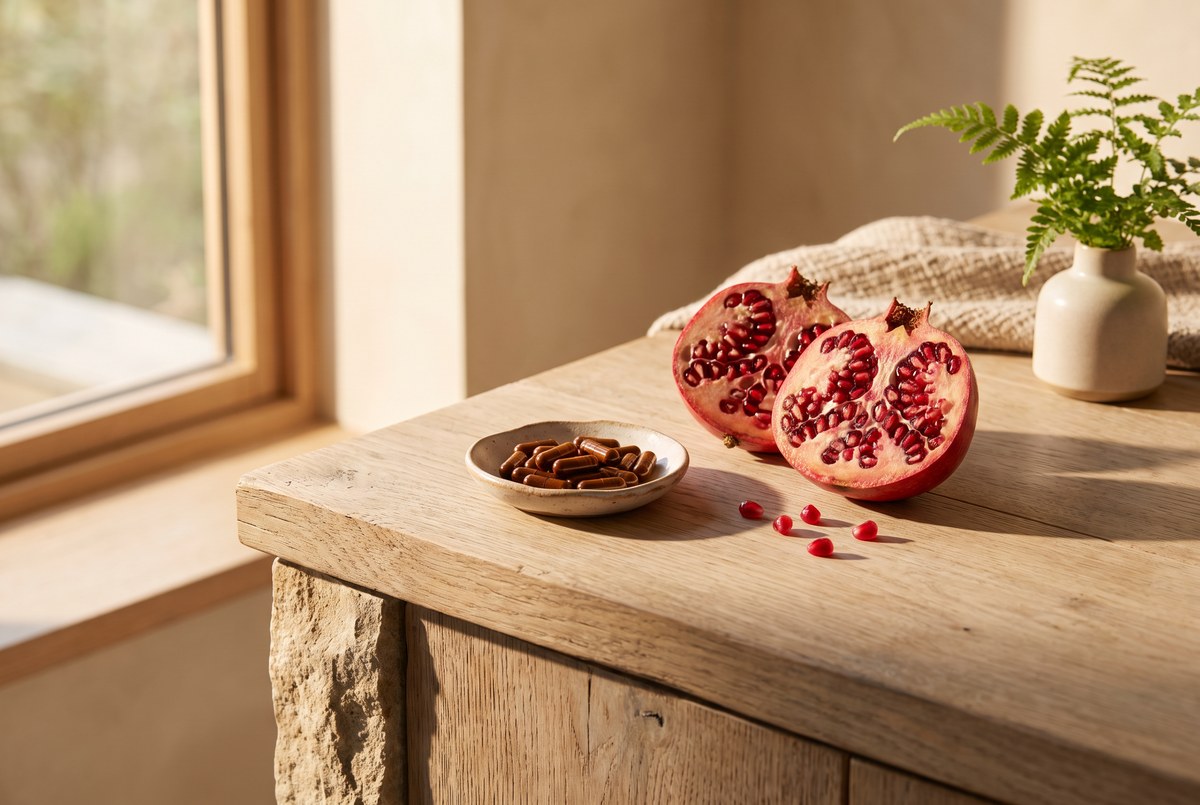
So your gut bacteria make urolithin A from pomegranates and walnuts — except most people’s barely do (the whole pitch for taking Mitopure directly). The question: what did its human trials show? The defensible answer: safe, biomarkers move, function unproven — two trials missed primary endpoints.
Where it comes from and what it does
You cannot get urolithin A directly from food. Your gut bacteria make it from ellagitannins and ellagic acid, compounds found in pomegranates, walnuts, and some berries. Because gut microbiomes differ, only an estimated minority of people produce meaningful amounts on their own, which is part of the rationale for taking it as a direct supplement.
Its proposed mechanism is mitophagy: the cellular recycling process that clears out damaged mitochondria so healthier ones can take their place. Declining mitochondrial quality is a recognized feature of aging muscle, and reviews of sarcopenia list impaired mitophagy among the changes seen in older muscle (Dao and colleagues, Endocrinol Metab, 2020; DOI 10.3803/EnM.2020.405). Urolithin A activates this pathway in laboratory and animal models, which is why it became a candidate for muscle aging.
The human trials, including the misses
The first-in-human study in sedentary older adults (Andreux and colleagues, Nat Metab, 2019) reported that urolithin A was safe, reached the bloodstream, and shifted mitochondrial gene expression and plasma acylcarnitines in a favorable direction. Importantly, that trial measured molecular and safety signals, not strength or performance.
A four-month randomized, placebo-controlled trial in middle-aged adults (Singh and colleagues, Cell Rep Med, 2022) reported about a 12 percent improvement in muscle strength and clinically meaningful gains in aerobic endurance and the six-minute walk test. But it is important to state plainly: the study did not show a significant improvement on its pre-specified primary endpoint, peak power output. Markers of mitochondrial efficiency and inflammation (acylcarnitines, C-reactive protein) did improve.
A separate randomized trial in adults aged 65 to 90 (Liu and colleagues, JAMA Netw Open, 2022) had two primary endpoints: six-minute walk distance and maximal ATP production in hand muscle. Neither reached statistical significance versus placebo. Secondary measures of muscle endurance did improve, and several plasma biomarkers fell, but the headline endpoints were null. The authors concluded urolithin A was safe and may counteract age-related muscle decline, while explicitly stating that future work is needed to confirm it.
In younger, resistance-trained male athletes, an eight-week trial (Zhao and colleagues, J Int Soc Sports Nutr, 2024) found improvements in some endurance and isometric-strength measures but no statistically significant change in one-rep-max bench press or squat, and it actually reported a rise in C-reactive protein within the urolithin A group, which differs from the older-adult data.
Honest limits
Several of these trials were funded or conducted with involvement of the ingredient's manufacturer, which does not invalidate them but is relevant context. Sample sizes were modest. The most consistent and reproducible findings are safety and changes in mitochondrial biomarkers; effects on hard performance outcomes have been mixed, with key primary endpoints missed in two trials. There is no evidence yet that urolithin A extends human lifespan or treats any disease.
The reasonable takeaway is that urolithin A is a biologically plausible, generally well-tolerated compound with suggestive but inconsistent functional benefits, not a proven muscle drug. Educational, not medical advice; talk with a clinician before starting any supplement. Educational, not medical advice.
The takeaway
Urolithin A reliably shifts mitochondrial biomarkers and appears safe, but two of its randomized trials missed their primary strength and walking-distance endpoints, so functional benefits remain unproven.
Train the numbers: Stronger for Longer
A free 12-week walking, strength and balance program for adults 50 and over, measured with five validated self-tests at weeks 0, 6 and 12. No supplements, nothing to buy.
Discussed here: Urolithin A (Mitopure)
Moderate evidenceWhat that grade means: Several human studies point the same way, but with limits — size, duration, funding, or mixed results.
Typical listed price $50.00 — check the live price before buying.
Read the full evidence page → View on Amazon ↗
See every graded product in Nutraceuticals & Cellular Energizers →
References
5 peer-reviewed sources, published 2019–2024, across 5 journals. 2 of them have a full Magellan study write-up linked below.
- Cell Rep Med · 2022 · PMID 35584623 · DOI 10.1016/j.xcrm.2022.100633Urolithin A supplementation improved muscle strength and exercise performance in middle-aged adults, along with markers of mitochondrial health. Read our full write-up →
- JAMA Netw Open · 2022 · PMID 35050355 · DOI 10.1001/jamanetworkopen.2021.44279Daily urolithin A supplementation improved muscle endurance and certain cellular health biomarkers in older adults, but did not significantly impact walking distance or maximal ATP production. Read our full write-up →
- Nat Metab · 2019 · PMID 32694802 · DOI 10.1038/s42255-019-0073-4
- J Int Soc Sports Nutr · 2024 · PMID 39487653 · DOI 10.1080/15502783.2024.2419388
- Endocrinol Metab (Seoul) · 2020 · PMID 33397034 · DOI 10.3803/EnM.2020.405
Mechanisms and molecules in this article
Each links to its Magellan monograph — what it is, what it does, and the studies behind it.
Related reading
Urolithin A — a metabolite some gut microbiomes make from pomegranate ellagitannins — stimulates mitophagy…
L-carnitine ferries fat into mitochondria, and the heart runs on that ferry. Older trials suggest it helps…
Phosphatidylcholine is a structural brick of every cell membrane and the diet's main form of choline — yet…
All Magellan articles → · More on Nutraceuticals & Cellular Energizers →
Prefer the interactive version? Open this article inside the Magellan app →