What a Home Blood Pressure Monitor Must Actually Prove
Home-measured blood pressure predicts cardiovascular events at least as well as office readings, and self-monitoring paired with clinician support lowers pressure modestly for a year or more — but most devices sold online have never passed independent accuracy validation.
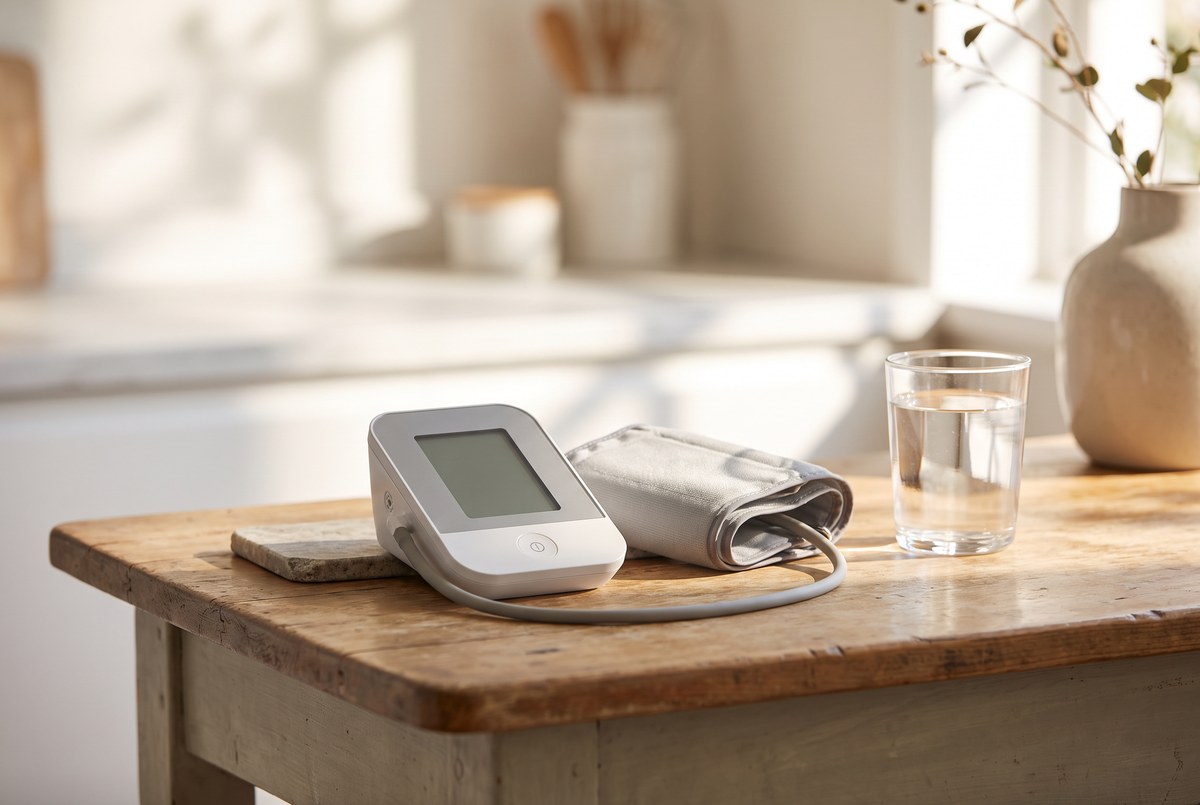
Things a home blood pressure monitor must survive before its numbers deserve trust: an inflatable cuff on the upper arm; an oscillometric sensor translating pressure waves into systolic and diastolic estimates; a recognized accuracy-validation protocol — ISO 81060-2, or the European Society of Hypertension's protocol — with results actually published; and, ideally, a clinician on the other end of the readings who can act on them.
Things the market actually offers: an audit of monitors sold online found that only a small fraction had ever passed independent validation. Cuffless smartwatch readings, whatever the keynote said, are not a validated substitute. The distance between those two inventories is the whole story of this device category.
Why the home number is worth having
Across prospective cohorts and meta-analyses, home and self-measured blood pressure predicts cardiovascular events and mortality at least as well as office measurement — and often independently of it. A 2022 paper in the Journal of Human Hypertension on the prognostic value of home monitoring in patients under antihypertensive treatment belongs to that literature. Home readings capture pressure across many days and settings, and in doing so reveal what a single office reading cannot: white-coat hypertension, high in clinic and normal at home, and masked hypertension, the reverse — the quieter, more dangerous disguise, normal in the office and elevated in life, which only out-of-office measurement can catch.
Monitoring works when it is not alone
The intervention evidence has a clear shape. A 2017 systematic review and individual-patient-data meta-analysis in PLoS Medicine found that self-monitoring paired with support — clinician-guided medication titration, education — produces modest but clinically meaningful blood-pressure reductions sustained for at least a year. Two randomized trials make it concrete: TASMINH4, published in The Lancet in 2018, used self-monitored readings, with or without telemonitoring, to titrate antihypertensive medication; the HOME BP trial, published in the BMJ in 2021, combined home measurement with a digital intervention in poorly controlled hypertension. The same literature carries the counterweight: self-monitoring alone, without such co-interventions, has little effect, and some trials — in pregnancy, for example — found no benefit. TASMINH4 was an unmasked trial, as behavioral interventions usually are, which is worth remembering when weighing its effect sizes.
The accuracy problem is real
None of that literature rescues an inaccurate device. The oscillometric method is sound when validated — a 2001 paper in Blood Pressure Monitoring is part of the technique's foundational literature — but validation is precisely the step most consumer devices skip. 'Validated', in this category, is not an adjective; it is the entry requirement. Validation means the device has been tested against a reference standard under a published protocol; it is a claim with paperwork, and the paperwork is the point. A single reading, meanwhile, is a weather report; a week of readings is climate, and the prognostic literature runs on the second. Cheap accuracy, in other words, is not accuracy — and the category's failure rate is not a footnote but the headline. Buy the protocol, not the promise. Technique matters too: seated, rested, arm supported, measured across days and settings rather than once after climbing the stairs.
For a reader, the practical sequence: choose a validated upper-arm device, build a multi-day record, and bring it into a clinical conversation — because the evidence rewards measurement plus support, not measurement alone. This evidence concerns home blood pressure measurement and the oscillometric method in general, not any specific commercial product.
The cuff inflates, the waves oscillate, the number appears. Whether that number is worth anything was decided earlier — in a validation lab, and in whatever happens after the reading. Educational, not medical advice.
The takeaway
A validated upper-arm cuff used within a supported care program is one of the best-evidenced home-health tools; an unvalidated device, or a lone cuff without any follow-up, is not.
References
5 peer-reviewed sources, published 2001–2022, across 5 journals. 2 of them have a full Magellan study write-up linked below.
- Blood Press Monit · 2001 · PMID 12055415 · DOI 10.1097/00126097-200112000-00016Ambulatory blood pressure monitoring offers more precise cardiovascular risk prediction than traditional office measurements, especially for conditions like white-coat hypertension and gestational hypertension. Read our full write-up →
- J Hum Hypertens · 2022 · PMID 36163509 · DOI 10.1038/s41371-022-00758-xHome blood pressure monitoring independently predicts cardiovascular events in people already being treated for high blood pressure. Read our full write-up →
- PLoS Med · 2017 · PMID 28926573 · DOI 10.1371/journal.pmed.1002389
- Lancet · 2018 · PMID 29499873 · DOI 10.1016/S0140-6736(18)30309-X
- BMJ · 2021 · PMID 33468518 · DOI 10.1136/bmj.m4858
Mechanisms and molecules in this article
Each links to its Magellan monograph — what it is, what it does, and the studies behind it.
Related reading
Ambulatory blood pressure — especially nighttime and 24-hour averages — predicts death and cardiovascular…
HEPA filtration demonstrably cuts indoor PM2.5 and nudges blood pressure down by a few millimeters of…
Nighttime traffic noise is a documented cardiovascular risk factor, and white-noise masking genuinely helps…
All Magellan articles → · More on Air, Water & Sleep Systems →
Prefer the interactive version? Open this article inside the Magellan app →