Two Wavelengths of Light, One Number That Matters at Night
Wrist-worn pulse oximeters can measure blood oxygen with surprising accuracy — one model came within about 1 percent of arterial blood-gas analysis — and the nocturnal hypoxia they track predicts real outcomes. But accuracy varies by device and by skin tone, and the number only matters if someone acts on it.
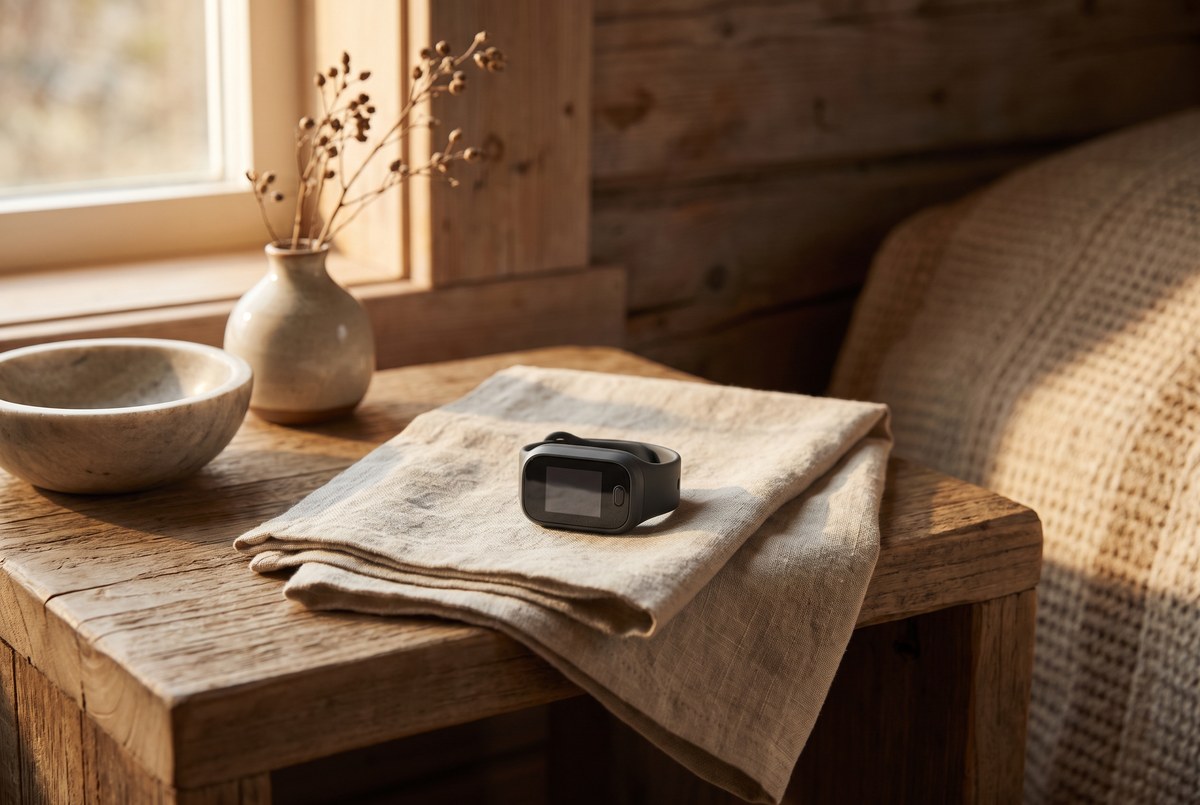
The volunteer breathes, and the air is not quite air. In the validation protocol, the gas mixture is adjusted, oxygen fraction lowered step by step, inducing a controlled hypoxia — the deliberate kind, the kind with an arterial line attached. From the artery, blood is drawn and run through co-oximetry, the reference method, the ground truth. On the wrist, a small device presses light-emitting diodes and a photodetector against the same patch of skin, reading back the pulsatile signal of blood volume: reflective photoplethysmography. Two wavelengths, absorbed differently by oxygenated and deoxygenated hemoglobin, converted by an algorithm into one number — SpO2. The protocol is patient. Step down, stabilize, sample, record. Step down again.
Across that induced descent, one wrist-worn model held a bias of about 1 percent against the arterial standard. Other validation work has been less kind: a 2023 Respiratory Care study compared a smartwatch against a pulse oximeter during pulmonary rehabilitation, where patients actually need the number to be right, and the broader literature finds performance varies — some consumer devices simply fail formal accuracy thresholds.
Which sets up the real question. The device is only a means; the point is the physiology it watches while its owner sleeps. Does overnight oxygen saturation matter enough to measure? The most defensible answer: yes — the nocturnal signal predicts serious outcomes in large cohorts — provided the measurement is accurate, which is not a given.
The signal that predicts
Researchers have learned to quantify how much oxygen a sleeper loses across the night: the sleep apnea-specific hypoxic burden, a measure of the depth and duration of desaturation events. In large cohorts such as the Sleep Heart Health Study and HypnoLaus, greater hypoxic burden tracks with higher risks of hypertension, cardiovascular events, all-cause mortality and cognitive decline. A 2022 study in the American Journal of Respiratory and Critical Care Medicine tied that burden to cardiovascular events and death; a 2023 analysis in the Annals of the American Thoracic Society showed automatically identified desaturations carry the same associations; a 2022 review in Archivos de Bronconeumología lays out where the metric stands and where it is going. These are cohort associations — consistent, prospective, but not proof that fixing the number fixes the risk. And overnight oximetry desaturation indices screen for obstructive sleep apnea with high diagnostic accuracy, which is the actionable part: a bad night curve is a reason to get a formal sleep study, not a diagnosis.
The shadow on the reading
The limitation here is not statistical; it is physical, and it falls unevenly on people. Pulse oximetry is less accurate in darker skin pigmentation. In a large multi-cohort analysis, occult hypoxemia — real hypoxemia hidden behind a reassuring reading — occurred about three times more often in Black than White patients: 11.7 percent versus 3.7 percent of measurements. The bias is more pronounced in reflectance mode, the very mode wrist-worn consumer devices use, and it has prompted updated FDA guidance. A number that is trustworthy for one user can be quietly wrong for another, and a false reassurance is worse than no number at all.
What the wrist can and cannot do
As a screening and trend tool — flagging desaturation patterns worth bringing to a clinician, tracking respiratory status over time — a validated wearable oximeter earns its place. As a verdict, it does not. It remains a monitoring tool: any benefit depends on what the user, and their clinician, do with the data. This evidence concerns SpO2, photoplethysmography and nocturnal hypoxemia as measured phenomena — not this specific commercial product.
In the laboratory, the gas mixture returns to normal, the arterial line comes out, and the device on the wrist keeps glowing against the skin, still reading. It will read all night, in the dark, honestly within its limits — which is exactly why those limits are worth knowing. Educational, not medical advice.
The takeaway
Overnight oxygen desaturation — the 'hypoxic burden' — is a validated predictor of cardiovascular events and mortality, and good wearable oximeters can track it, though some consumer devices fail accuracy thresholds and reflectance readings run less accurate on darker skin.
References
5 peer-reviewed sources, published 2022–2023, across 5 journals. 2 of them have a full Magellan study write-up linked below.
- Front Digit Health · 2023 · PMID 38111608 · DOI 10.3389/fdgth.2023.1258915The EmbracePlus wristband accurately measures blood oxygen levels in healthy adults, including those with darker skin, under controlled conditions. Read our full write-up →
- Respir Care · 2023 · PMID 37193599 · DOI 10.4187/respcare.10760Smartwatches are not accurate enough to monitor oxygen saturation in COPD patients during pulmonary rehabilitation. Read our full write-up →
- Ann Am Thorac Soc · 2023 · PMID 37531573 · DOI 10.1513/AnnalsATS.202303-248OC
- Am J Respir Crit Care Med · 2022 · PMID 34648724 · DOI 10.1164/rccm.202105-1274OC
- Arch Bronconeumol · 2022 · PMID 36115739 · DOI 10.1016/j.arbres.2022.08.005
Mechanisms and molecules in this article
Each links to its Magellan monograph — what it is, what it does, and the studies behind it.
Related reading
Ambulatory blood pressure — especially nighttime and 24-hour averages — predicts death and cardiovascular…
Nighttime traffic noise is a documented cardiovascular risk factor, and white-noise masking genuinely helps…
Evening blue light genuinely suppresses melatonin, but the best-controlled evidence — a Cochrane review of…
All Magellan articles → · More on Air, Water & Sleep Systems →
Prefer the interactive version? Open this article inside the Magellan app →