Stand Still and Shake: The Strange, Partly True Science of Vibration Plates
Whole-body vibration produces real, modest gains in leg strength, balance and everyday function in older and deconditioned adults — but the bone-density picture is genuinely mixed, optimal settings are undefined, and the viral claims about weight loss and 'lymphatic drainage' have no trial support.
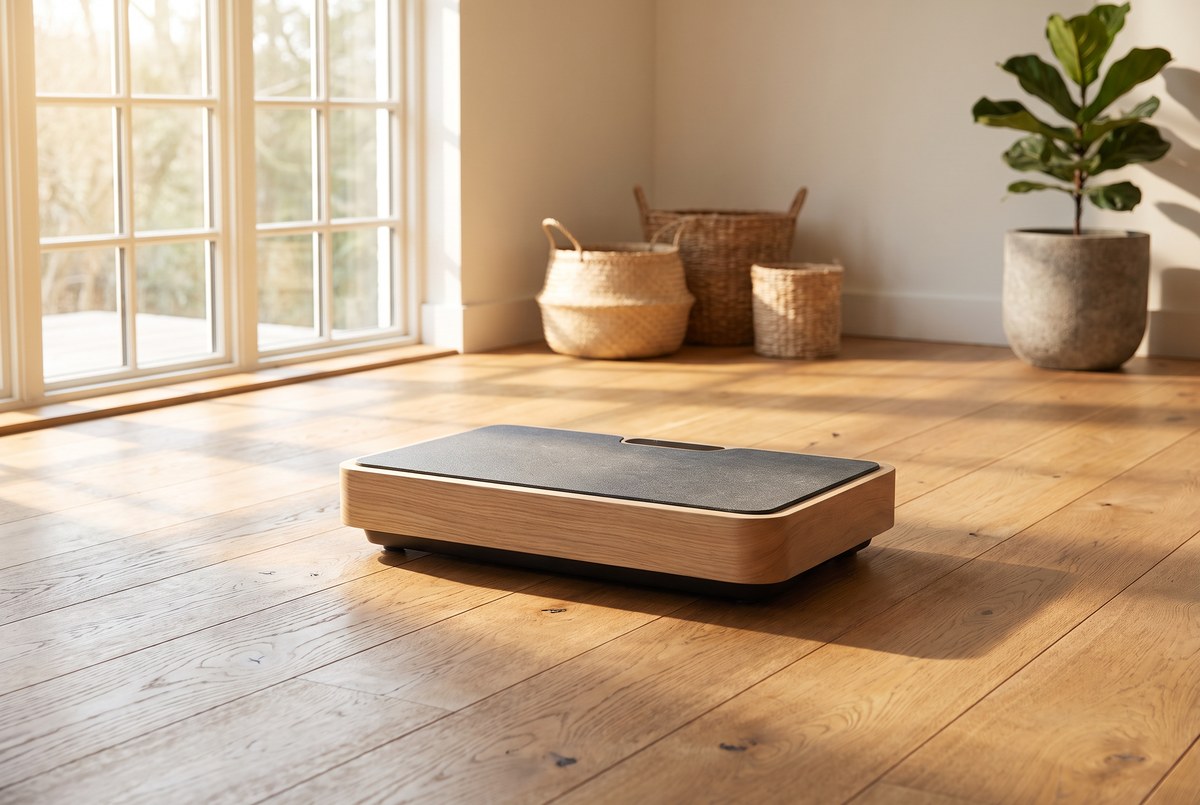
Vrrrm. The platform starts and the whole body hums — calves firing, quads fluttering, teeth very nearly chattering — while the person on top does, essentially, nothing. Stand there. Maybe squat. The machine does the moving. This is the pitch that has launched a thousand late-night ads and a whole subculture of garage gyms and rehab clinics: exercise without the exercising. And here is the wild part — it is not entirely nonsense. It is not entirely true either. The truth is weirder and narrower, and it lives in gerontology journals.
The device itself is simple enough: a motorized plate generates rapid oscillations, transmitted through the feet, provoking largely involuntary muscle contractions through the stretch reflex and loading bone and connective tissue in small cyclic pulses. The claims built on top of it are not simple at all.
So — does shaking make you stronger? The most defensible answer: a little, for some people, especially people who can't train conventionally. Everyone else should keep reading before clearing floor space.
Where the shaking works
The strongest evidence is neuromuscular, and it is mostly in older adults. Meta-analyses of randomized trials find whole-body vibration improves lower-limb strength — one 18-trial analysis put knee-extension gains at a standardized mean difference of about 0.7, a solid moderate effect — plus balance and everyday function: sit-to-stand, walking speed. The sarcopenia trials make the use case concrete. A 2018 BMC Geriatrics randomized trial tested vibration in older people with sarcopenia, measuring muscle mass index, fitness and quality of life; a 2025 Scientific Reports study ran 12 weeks of vibration head-to-head against resistance training in the same population; a 2021 BMC Geriatrics review backs the underlying mechanism of vibration-driven muscle contraction. There are also signals — smaller, protocol-dependent — for glycemic control in type 2 diabetes.
The bone question: a genuinely split verdict
Bone is where the marketing leans hardest and the evidence wobbles. A 2016 stimulus-focused meta-analysis in PLoS One reported that vibration treatments can improve bone mineral density in postmenopausal women, and a 2022 systematic review and meta-analysis in Osteoporosis International found lumbar-spine gains. Then came the correction: a 2025 meta-analysis in older adults found a small benefit only at the total femur — none at the femoral neck, none at the lumbar spine — and rated the certainty of the whole body of evidence low. Many of the trials are small and low quality. Two careful readouts of similar data, two different conclusions: that is what a mixed literature looks like.
The claims with no floor under them
Now the part the ads skip. Optimal settings — frequency, amplitude, duration — are undefined, which means two plates can deliver meaningfully different stimuli and the word 'vibration' on a box tells you almost nothing. Whole-body vibration is not a substitute for weight-bearing and resistance exercise; the trials position it as an adjunct or an option for those who cannot do conventional training. And the trendiest promises — meaningful weight loss, 'lymphatic drainage' — have no trial support at all. None. They are decoration on a machine with a real but narrower resume.
Who this is actually for
The sensible buyer profile emerges straight from the data: older, deconditioned or mobility-limited people who struggle to perform conventional exercise, ideally with a clinician or physiotherapist in the loop. For a healthy 35-year-old, a pair of dumbbells carries more evidence per dollar. This research evaluates vibration as an exposure and its mechanisms — not this specific commercial product.
The motor winds down. The platform stills. What remains is a modest, honest finding hiding inside an immodest industry: shaking is not exercise, but for the right body, at the right moment, it is something. Educational, not medical advice.
The takeaway
Vibration plates are a legitimate low-effort option for improving strength, balance and function in older or mobility-limited people, but they are not a substitute for conventional exercise and most marketing claims outrun the trials.
References
5 peer-reviewed sources, published 2016–2025, across 4 journals. 3 of them have a full Magellan study write-up linked below.
- BMC Geriatr · 2021 · PMID 34911483 · DOI 10.1186/s12877-021-02642-8Resistance and mixed training improve muscle strength and gait speed in older adults with sarcopenia, while all three training types improve TUG times. Read our full write-up →
- Sci Rep · 2025 · PMID 40011687 · DOI 10.1038/s41598-025-91644-2Both whole-body vibration and resistance training improve physical health in older adults with sarcopenia, with resistance training being better for muscle strength. Read our full write-up →
- BMC Geriatr · 2018 · PMID 29343219 · DOI 10.1186/s12877-018-0712-8Whole-body vibration may improve muscle mass, physical function, and quality of life in older adults with sarcopenia in institutional settings. Read our full write-up →
- Osteoporos Int · 2022 · PMID 36282343 · DOI 10.1007/s00198-022-06556-y
- PLoS One · 2016 · PMID 27907000 · DOI 10.1371/journal.pone.0166774
Mechanisms and molecules in this article
Each links to its Magellan monograph — what it is, what it does, and the studies behind it.
Related reading
Evidence suggests blood flow restriction training effectively increases muscle strength and mass in older…
Neuromuscular electrical stimulation can preserve and rebuild muscle when ordinary training is impossible —…
Percussive massage guns reliably loosen joints and blunt next-day soreness in controlled trials — and just…
All Magellan articles → · More on Recovery, Sauna & Light Therapy →
Prefer the interactive version? Open this article inside the Magellan app →