Roasted Beet Hummus with Walnuts
A vivid magenta dip that turns a full serving of nitrate-rich beets into something you will actually finish.
- Mechanism
- Nitric oxide
- Yield
- makes about 2 cups
- Ingredients
- 8
- Steps
- 4
- Cited studies
- 3
- Course
- Dip
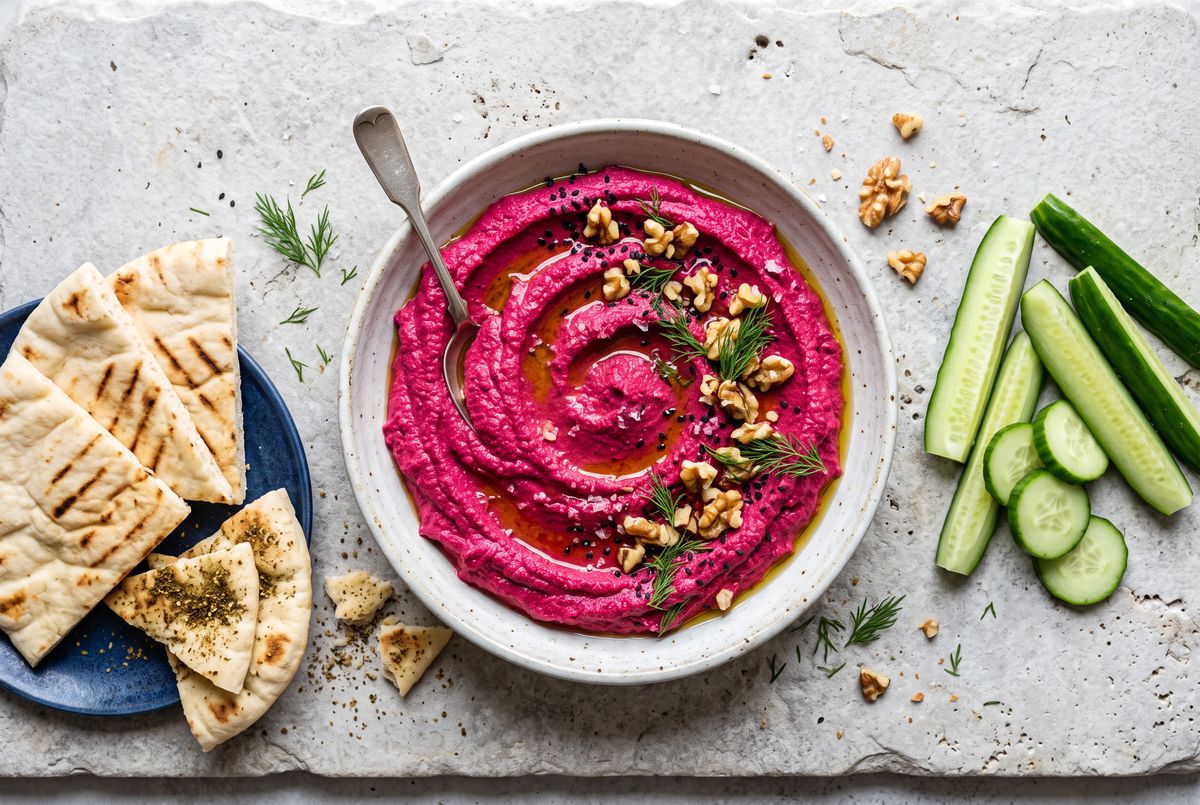
Beets are the most studied whole-food source of dietary nitrate — the raw material your body uses to make nitric oxide, the signal that tells blood vessels to relax. Food-composition work places beets and leafy greens at the top of the dietary nitrate list (American Journal of Clinical Nutrition, 2009), which is why they turn up in almost every nitrate study.
A systematic review and meta-analysis of inorganic nitrate and beetroot juice supplementation found blood-pressure reductions in adults (Journal of Nutrition, 2013). The effect is modest, and it depends on eating beets regularly rather than once. Roasting suits that goal well: it concentrates flavor and, unlike boiling, does not leach the water-soluble nitrate out into a pot you then pour away.
Why this works
The beets carry the nitrate, and the rest of the bowl is there to make a full serving of them easy to eat. Chickpeas and tahini give the dip body, protein and fiber, so it holds together like hummus rather than a thin puree. Lemon juice cuts the earthiness that puts people off beets, and raw garlic sharpens it. The walnuts scattered over the top are the other functional ingredient: they bring ellagitannins, the compounds gut bacteria act on, and research tracking walnut eating in healthy adults has looked at exactly that gut interaction (Nutrients, 2019). Olive oil and dill finish it.
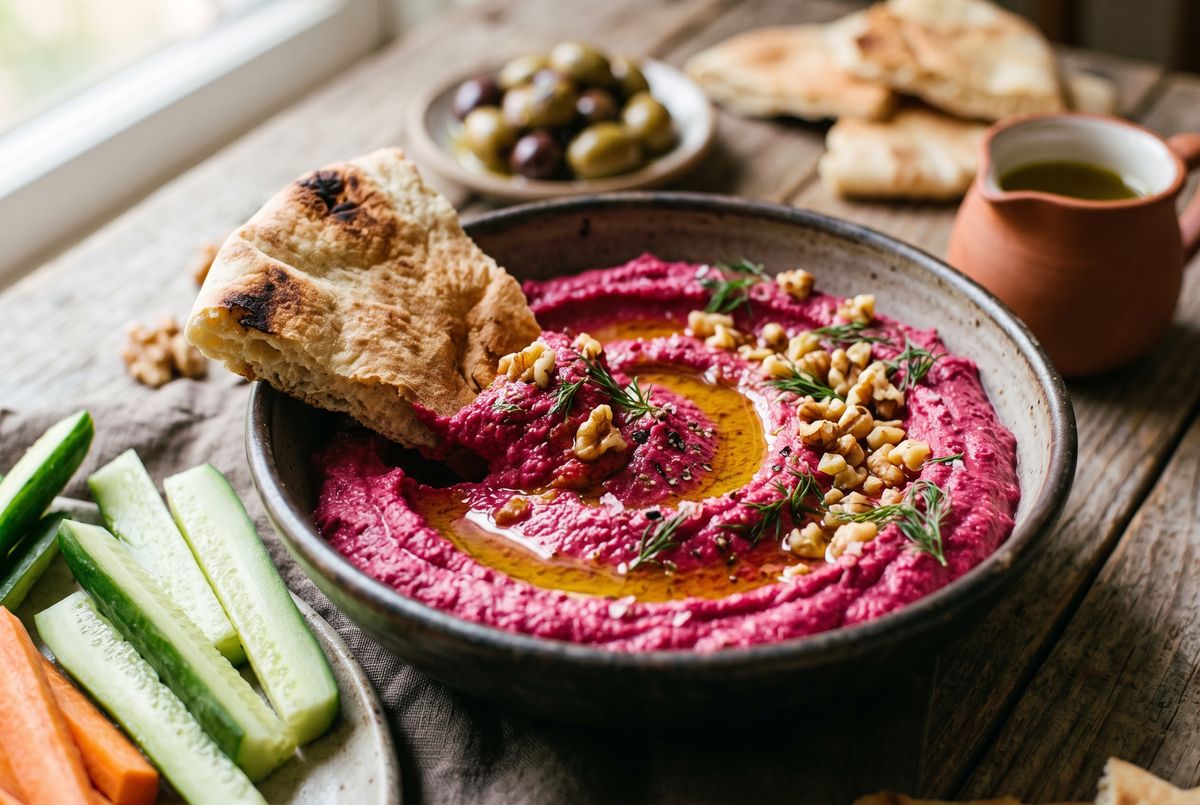
Ingredients · makes about 2 cups
- 2 medium beets (about 12 oz), roasted and peeled
- 1 can (15 oz) chickpeas, drained and rinsed
- ¼ cup tahini
- 1 clove garlic
- Juice of 1 lemon
- 2 tbsp extra-virgin olive oil
- ¼ cup walnuts, toasted and chopped, to finish
- Fresh dill, black sesame seeds
Method
- Wrap the beets in foil and roast at 425°F (220°C) for 45–55 minutes until a knife slides in easily. Cool and slip off the skins.
- Blend the beets, chickpeas, tahini, garlic, lemon juice and olive oil until very smooth, adding a tablespoon of water at a time to loosen.
- Season well, spread into a bowl, and swirl the surface with the back of a spoon.
- Top with toasted walnuts, dill, sesame seeds and a final drizzle of oil.
Getting the most from it
Rinse the canned chickpeas properly under running water — a good share of the canning salt goes down the drain with the liquid, which matters if blood pressure is the reason you are making this. Roast the beets whole in foil rather than boiling them, and cool them before you peel, so the skins slip off with your fingers. Toast the walnuts separately and add them at the end so they stay crisp.
Nutrition Facts
Calculated for one serving from USDA FoodData Central values for the ingredients above. An estimate, not a lab analysis.
How this was calculated. Each ingredient was converted to grams, matched to a food in USDA FoodData Central (SR Legacy, April 2018), summed, and divided by 2 servings. The recipe does not state a yield, so two servings were assumed. Cooking losses, draining and the real size of a handful all move these numbers, so treat them as a good estimate rather than a measurement. Added sugars count honey, maple syrup and table sugar only; sugar from whole fruit is not an added sugar.
- Beets, cooked, boiled, drained
- Chickpeas (garbanzo beans, bengal gram), mature seeds, canned, drained solids
- Seeds, sesame butter, tahini, from roasted and toasted kernels (most common type)
- Garlic, raw
- Lemon juice, raw
- Oil, olive, salad or cooking
- Nuts, walnuts, english
24 PubMed citations
Meta-analyses of randomized trials show that beetroot juice and dietary nitrate lower blood pressure—about 5 mmHg…
20 PubMed citations
In human research, urolithin A supplementation is safe and bioavailable and improves markers of mitochondrial health.…
25 PubMed citations
In human research, the ellagitannin-derived metabolite urolithin A has improved muscle strength, endurance, and…
The research behind this recipe
Primary sources for the claims above. Effects reported in these papers describe the compound or the dietary pattern studied — not this specific dish.
More nitric oxide & blood flow recipes
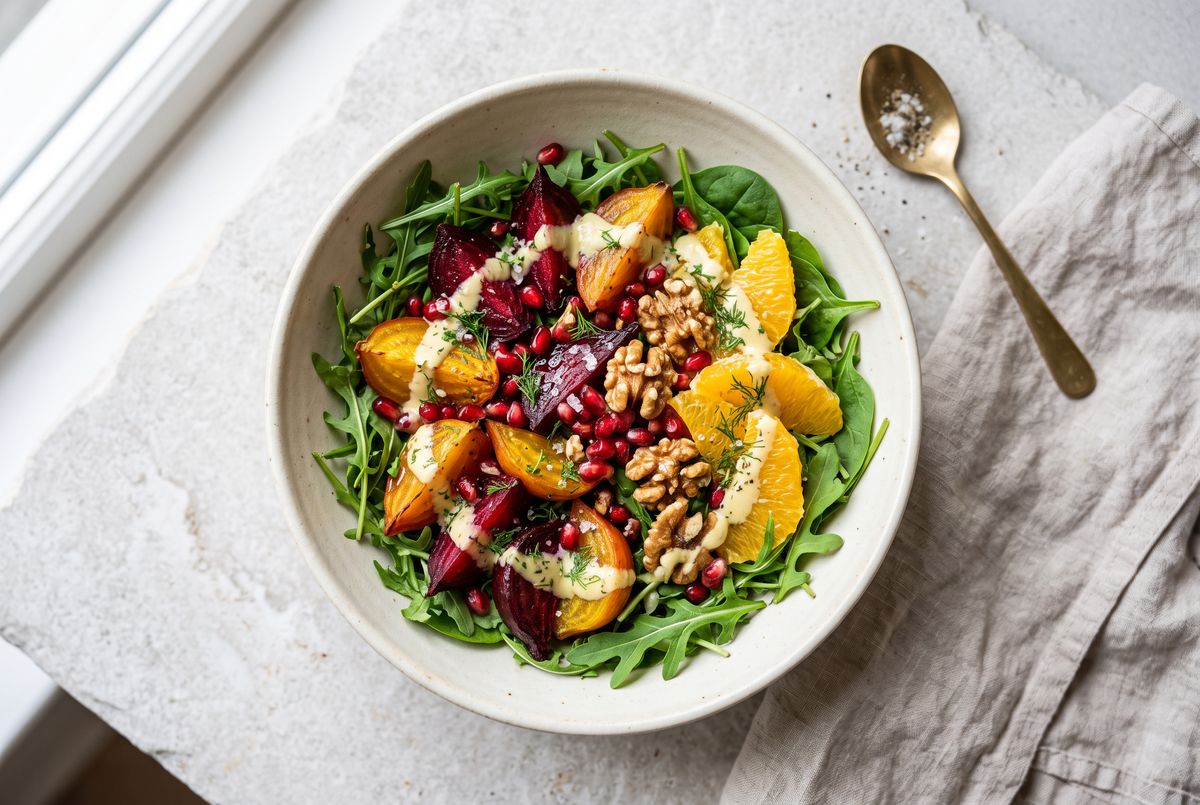 Nitric oxide
Beetroot and arugula are two of the richest dietary sources of nitrate — the raw material your body converts into nitric oxide…
 Nitric oxide
Watermelon is the richest everyday food source of L-citrulline — the amino acid your body converts into L-arginine, the raw…
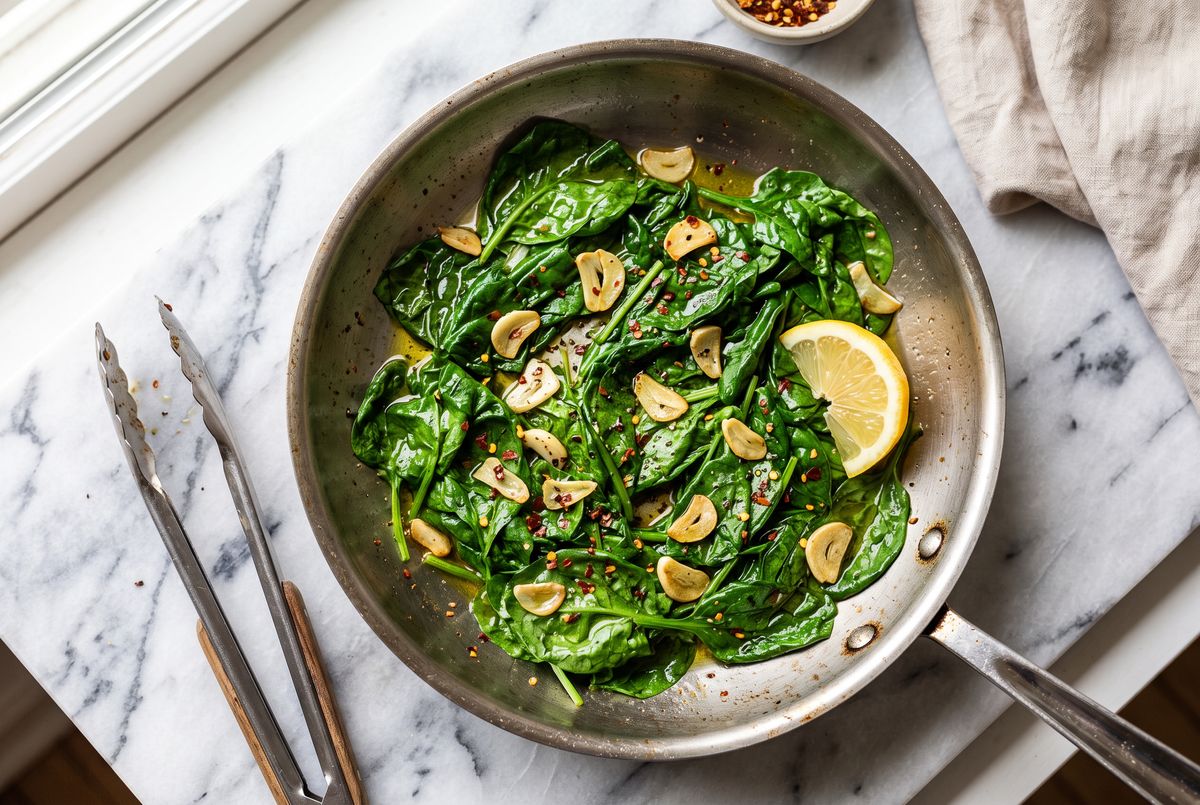 Nitric oxide
Spinach sits alongside arugula and beets at the top of the dietary-nitrate list, and a controlled trial found nitrate-rich…
Keep reading
Nitric oxideBeetroot & dietary nitrateBlood pressureUrolithin AUrolithin A: the evidenceUrolithin A (Mitopure) and MuscleThe supplement guideResearch mapPathway universe