Mail-In Blood Panels: What a Drop of Blood Can and Can't Measure
Mail-In Blood Panels — Magellan evidence grade: Mixed — in the Journal of Clinical Endocrinology and Metabolism, 62 participants from the Melbourne Collaborative Cohort Study gave matched plasma and dried blood spot samples, and LC-MS/MS measurements of 25-hydroxyvitamin D agreed well, with an R-squared of 0.73 regressing plasma on spot. Spot vitamin D did not differ significantly from venous plasma across those conditions.
Source: Am J Clin Pathol 2015, PMID 26572995 ↗ · How Magellan grades evidence · Research map · evidence confidence: high
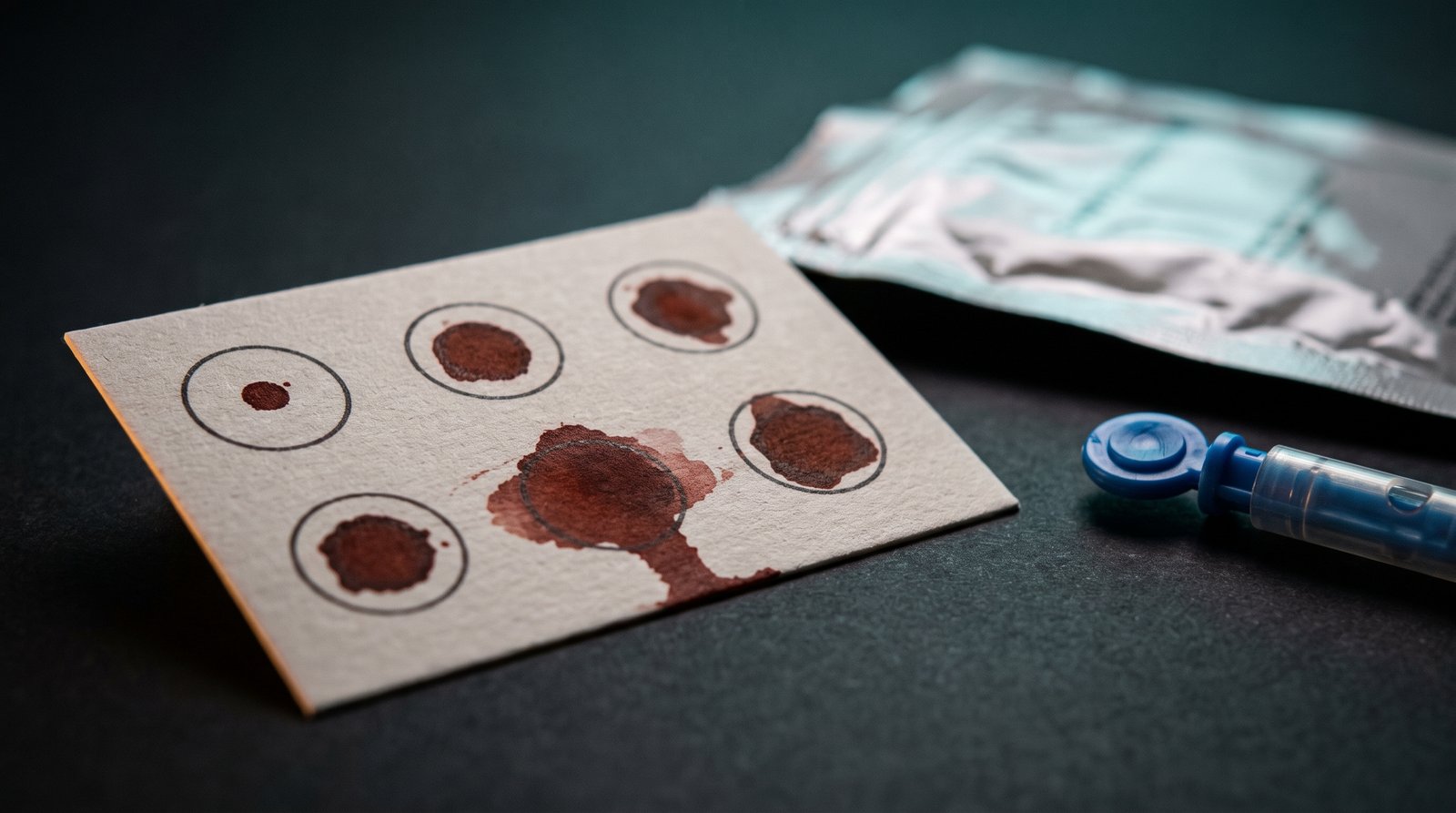
Fingerstick dried blood spots are excellent for some analytes and unreliable for others. The kit box rarely tells you which is which.
The verdict
Agreement with venous blood is strong and replicated for some analytes and formats, notably LC-MS/MS vitamin D and many dried-spot protein assays, and poor for others, notably dried-spot HbA1c and fingerstick cholesterol and glucose.
How to read this grade: Magellan's evidence scale runs 4 = Strong (multiple consistent human studies), 3 = Mixed (human trials that disagree or support only part of the claim), 2 = Early (small, short or uncontrolled human studies), 1 = Preclinical only (animal or laboratory data with no human efficacy result). It grades the strength of the published evidence behind the claim, not the build quality, value or popularity of any product, and it is not a user rating. Grades are set independently of affiliate commissions. How we grade →
Who should buy
A single-analyte mail-in test with a published spot-validated assay, run by a CLIA-certified laboratory.
Who should skip
A sprawling fingerstick wellness panel sold as a replacement for a blood draw.
The bottom line
Whether a mail-in blood test is trustworthy depends on the analyte and the collection format rather than the brand: mass-spectrometry vitamin D from a dried spot agrees well with plasma, dried-spot HbA1c has limits of agreement several times wider than a capillary tube, and fingerstick cholesterol and glucose have agreed poorly with venous reference methods.
What to look for
| Checkpoint | What the evidence says |
|---|---|
| Check the collection format | A volumetric device or capillary tube beats a filter-paper spot |
| Confirm the laboratory is CLIA-certified | That is the floor, not proof of clinical validity |
| Checkpoint 3 | Ask whether dried-spot results are calibrated to plasma-equivalent reference ranges |
| Checkpoint 4 | Check the shipping window and temperature tolerance for your specific analyte |
The full story
The pitch is a laboratory in an envelope. Prick a finger, blot a card, drop it in the post, get a PDF. For some analytes that pitch is entirely true. For others it is a number with error bars wide enough to drive a category change through. The box does not distinguish between the two, because the box is selling a panel while the validation happens one analyte at a time.
That is not a consumer-review complaint, it is what the dried blood spot literature says about itself. A review in Current Environmental Health Reports notes that spots are minimally invasive, cheap to collect, transport and store - and that dried blood spot assays require additional validation for accuracy and reproducibility analyte by analyte. A methods paper in Psychoneuroendocrinology makes the same argument from the other end: the decision to substitute a spot for a venous tube should turn on whether it is analytically sensible and feasible to measure that specific parameter in whole blood from a spot, because spot assays have to be adapted from serum and plasma protocols one analyte at a time.
The specimen is the weakest link
A study in the American Journal of Clinical Pathology took six successive drops from a single fingerprick in 11 donors and compared their variability with venous controls. The coefficient of variation was up to 3.4 times higher for haemoglobin, 5.7 times for total white cells, 7.7 times for granulocytes and 4 times for platelets. Fluctuations only fell within instrument variability once at least 60 to 100 microlitres of fingerprick blood had been pooled. A single drop is not a small sample of your blood. It is a sample of that drop.
Then there is the physics of filter paper. Two reviews - one in Therapeutic Drug Monitoring, one in Current Environmental Health Reports - converge on the haematocrit effect: blood viscosity changes how far a spot spreads across the paper, which changes what a punch of fixed diameter contains. Add spotted volume and punch site, and there are three sources of method uncertainty stacked up before the analyser is switched on. Volumetric microsampling devices are designed to collect a fixed dried volume and sidestep exactly this, but clinical implementation is progressing slowly and more analytical and clinical evaluation is needed.
What survives the post
Vitamin D is the success story of this field. In the Journal of Clinical Endocrinology and Metabolism, 62 participants from the Melbourne Collaborative Cohort Study gave matched plasma and dried blood spot samples, and LC-MS/MS measurements of 25-hydroxyvitamin D agreed well, with an R-squared of 0.73 regressing plasma on spot. Across 500 replicates, within-batch and between-batch intraclass correlations were 0.82 and 0.73. One detail from that paper deserves more attention than it gets: a calibration model was required to convert spot values into plasma-equivalent numbers comparable with clinical reference ranges. That conversion is invisible to the customer and essential to the result.
Vitamin D also survives the logistics. In Annals of Clinical Biochemistry, 40 outpatients with a median age of 78 gave paired capillary spot cards and venous samples that were then put through storage conditions mimicking shipment. Spot vitamin D did not differ significantly from venous plasma across those conditions; correlation was best at 21C or 35C for four days, at 0.906 and 0.903, and freeze-thaw had no significant effect.
Proteins do better than you would guess. Multiple-reaction-monitoring mass spectrometry assays for spots, reported in Molecular and Cellular Proteomics, achieved a median total coefficient of variation of 18% at the lower limit of quantification across 245 proteins and a median inter-day coefficient of variation of 8% over four days. Concentrations stayed stable at ambient laboratory temperature for up to two months for 190 of those proteins, which means cold-chain shipping can be dropped for that set. Note the two figures: 18% at the bottom of the measurable range, 8% day to day in the middle of it.
What does not travel
HbA1c is the cleanest demonstration that format beats analyte. A systematic review in Diabetic Medicine collated 30 studies of postable self-collected capillary samples against venous blood. Capillary micro or capillary tubes gave mean differences of minus 0.4 to 1.4 mmol/mol, with limits-of-agreement widths of 2.4 to 6 mmol/mol. Dried blood spots, for the same analyte through the same post, gave mean differences of minus 4.3 to 7.2 mmol/mol with limits of agreement 11.7 to 16.8 mmol/mol wide. Same molecule, same courier, agreement several times worse depending only on what the kit asked you to bleed onto. Users were content either way - 83% to 96% reported satisfaction with self-collection - which tells you that satisfaction and analytical agreement are unrelated variables.
Fingerstick point-of-care chemistry is similarly uneven within a single panel. A diagnostic-accuracy study in Cien Saude Colet compared fingertip point-of-care measurement with venipuncture laboratory reference methods in Brazilian quilombola adults. Agreement was substantial for triglycerides, poor for total cholesterol and glucose, and the Bland-Altman analysis concluded the fingertip method did not produce good measures. Three analytes, one drop of blood, one panel, one that held up.
What the evidence does not show
It does not show that mail-in testing is junk. Vitamin D by mass spectrometry from a spot is a genuinely good measurement, spot protein assays are reproducible, and capillary-tube HbA1c lands close to venous. What the evidence also cannot show is that any panel is trustworthy in general, because "in general" is not how validation works here - and nothing in this evidence base validates a bundled consumer panel as a unit. Every analyte on the requisition is a separate claim.
The regulatory floor is lower than the marketing implies, too. CMS regulates all laboratory testing except research performed on humans in the United States through the Clinical Laboratory Improvement Amendments, covering approximately 320,000 laboratory entities, and certification is required for a lab to receive Medicare or Medicaid payment. That is a statement about how a laboratory operates, not evidence that a given test predicts anything about you. The FDA reviews direct-to-consumer tests intended for moderate-to-high-risk medical purposes for analytical and clinical validity, but states that in general direct-to-consumer tests for non-medical, general wellness or low-risk medical purposes are not reviewed before they are offered, and that such tests are not a substitute for a traditional health care evaluation. A review in EJIFCC names the gap directly: advertising claims of medical usefulness and quality regulations are tightly controlled inside healthcare and essentially absent in direct-to-consumer testing, and results arrive without medical interpretation - a risk for the consumer and for the clinician later handed the printout.
Order of operations
- Pick the analyte first, then check the format. A capillary tube or a volumetric microsampling device is a different specimen from a classic filter-paper spot, and for HbA1c the difference was several-fold in limits of agreement.
- Ask whether spot results are calibrated to plasma equivalents. Without that conversion step, a spot number and a clinical reference range are two different scales.
- Ask whether that specific analyte has a validated spot assay. Not the panel. The analyte.
- Read the shipping window. Vitamin D tolerated four days at 21C or 35C and shrugged off freeze-thaw. That tolerance was demonstrated for vitamin D, not for whatever else is on your card.
- Anchor anything consequential to a venous draw. Mail-in kits are strongest as repeat measurements of analytes with validated spot assays, weakest as the only measurement of something you intend to act on.
The useful mental model is not "home tests versus real tests." It is that a blood test is a chain - specimen, volume, transport, assay, calibration, reference range - and mail-in kits swap out three links of that chain at once. For vitamin D, somebody has done the work of proving the swap holds. For a lot of what gets bundled onto a wellness panel, nobody has, and the PDF looks identical either way. Read the kit as a set of separate tests that happen to share an envelope, and you will get roughly the right amount of confidence out of each one.
The gear in this story
Inclusion means the story discusses it — read the verdict and the checklist above before buying. Product pages carry the full citation list and the evidence grade, and grades are set before any affiliate relationship is considered.
Questions this story answers
Are mail-in blood panels worth it?
A single-analyte mail-in test with a published spot-validated assay, run by a CLIA-certified laboratory.
Who should skip it?
A sprawling fingerstick wellness panel sold as a replacement for a blood draw.
How strong is the evidence?
Mixed evidence. Agreement with venous blood is strong and replicated for some analytes and formats, notably LC-MS/MS vitamin D and many dried-spot protein assays, and poor for others, notably dried-spot HbA1c and fingerstick cholesterol and glucose.
What is the bottom line?
Whether a mail-in blood test is trustworthy depends on the analyte and the collection format rather than the brand: mass-spectrometry vitamin D from a dried spot agrees well with plasma, dried-spot HbA1c has limits of agreement several times wider than a capillary tube, and fingerstick cholesterol and glucose have agreed poorly with venous reference methods.
Sources
10 peer-reviewed papers plus 2 regulatory, guideline or trade documents. Every claim above traces to this list.
- Drop-to-drop variation in the cellular components of fingerprick blood: implications for point-of-care diagnostic developmentAm J Clin Pathol 2015 · PubMed · PMID 26572995 ↗ · doi:10.1309/AJCP1L7DKMPCHPEH ↗
- Home monitoring of haemoglobin A(1c) in diabetes: A systematic review and narrative synthesis on accuracy, reliability and patient acceptabilityDiabet Med 2023 · PubMed · PMID 36562666 ↗ · doi:10.1111/dme.15033 ↗
- Alternative Sampling Devices to Collect Dried Blood Microsamples: State-of-the-ArtTher Drug Monit 2021 · PubMed · PMID 33470777 ↗ · doi:10.1097/FTD.0000000000000864 ↗
- Little to Give, Much to Gain-What Can You Do With a Dried Blood Spot?Curr Environ Health Rep 2020 · PubMed · PMID 32851603 ↗ · doi:10.1007/s40572-020-00289-y ↗
- Measurements of 25-hydroxyvitamin D concentrations in archived dried blood spots are reliable and accurately reflect those in plasmaJ Clin Endocrinol Metab 2014 · PubMed · PMID 24885629 ↗ · doi:10.1210/jc.2014-1269 ↗
- Measurement of vitamin D in dried blood spots stored under different temperature conditionsAnn Clin Biochem 2021 · PubMed · PMID 33874736 ↗ · doi:10.1177/00045632211013870 ↗
- Concentration Determination of >200 Proteins in Dried Blood Spots for Biomarker Discovery and ValidationMol Cell Proteomics 2020 · PubMed · PMID 31896676 ↗ · doi:10.1074/mcp.TIR119.001820 ↗
- The sensitivity, specificity, and agreement of a point of care method: an assessment of the diagnostic accuracyCien Saude Colet 2019 · PubMed · PMID 31664401 ↗ · doi:10.1590/1413-812320182411.01012018 ↗
- Direct to Consumer Laboratory Testing (DTCT) - Opportunities and ConcernsEJIFCC 2021 · PubMed · PMID 34421490 ↗
- How and when to use dried blood spots in psychoneuroendocrinological researchPsychoneuroendocrinology 2019 · PubMed · PMID 31239081 ↗ · doi:10.1016/j.psyneuen.2019.06.011 ↗
Regulatory, guideline and trade sources
- Clinical Laboratory Improvement Amendments (CLIA)Centers for Medicare & Medicaid Services · 2026 · Read the source ↗
- Direct-to-Consumer TestsU.S. Food and Drug Administration · 2026 · Read the source ↗
Related on Magellan
More from the Home Lab & Diagnostics beat, and from the rest of the tech desk.
One particle, one measurement, and a cleaner line to risk than the LDL-C most labs report by default.
It is genetically fixed, it raises risk, nothing on the shelf lowers it meaningfully — and the drugs that do are in phase 3.
Send the same blood twice and a first-generation methylation clock can hand back ages years apart. The fix exists; it isn't…
Consumer sleep trackers are good at telling sleep from wake and mediocre at staging it. The validation studies are unusually…
Photobiomodulation has decent randomised evidence for skin and pain, a biphasic dose curve, and a marketing layer far ahead of…
Molecule and marker monographs: Lipid panel · hs-CRP · Homocysteine · ApoB testing
Long reads: ApoB home test kits, reviewed
Evidence guides: The longevity supplement guide · Longevity research map