Cuffless Blood Pressure Is the Holy Grail of Wearables. It Isn't Here Yet.
Cuffless Blood Pressure Is the Holy Grail of Wearables — Magellan evidence grade: Mixed — an individual-patient-data meta-analysis in PLoS Medicine pooled 25 randomised trials of self-monitoring and found that self-monitoring on its own did not lower blood pressure at all: minus 1.0 mmHg systolic, with a confidence interval running from minus 3.3 to plus 1.2. Adjust for the office reading and it only fell to 1.21.
Source: Hypertension 2020, PMID 32275193 ↗ · validated upper-arm home blood pressure monitor · How Magellan grades evidence · Research map · evidence confidence: high
Home blood pressure is one of the few numbers that changes outcomes. Which is exactly why the device you use has to be a validated one.
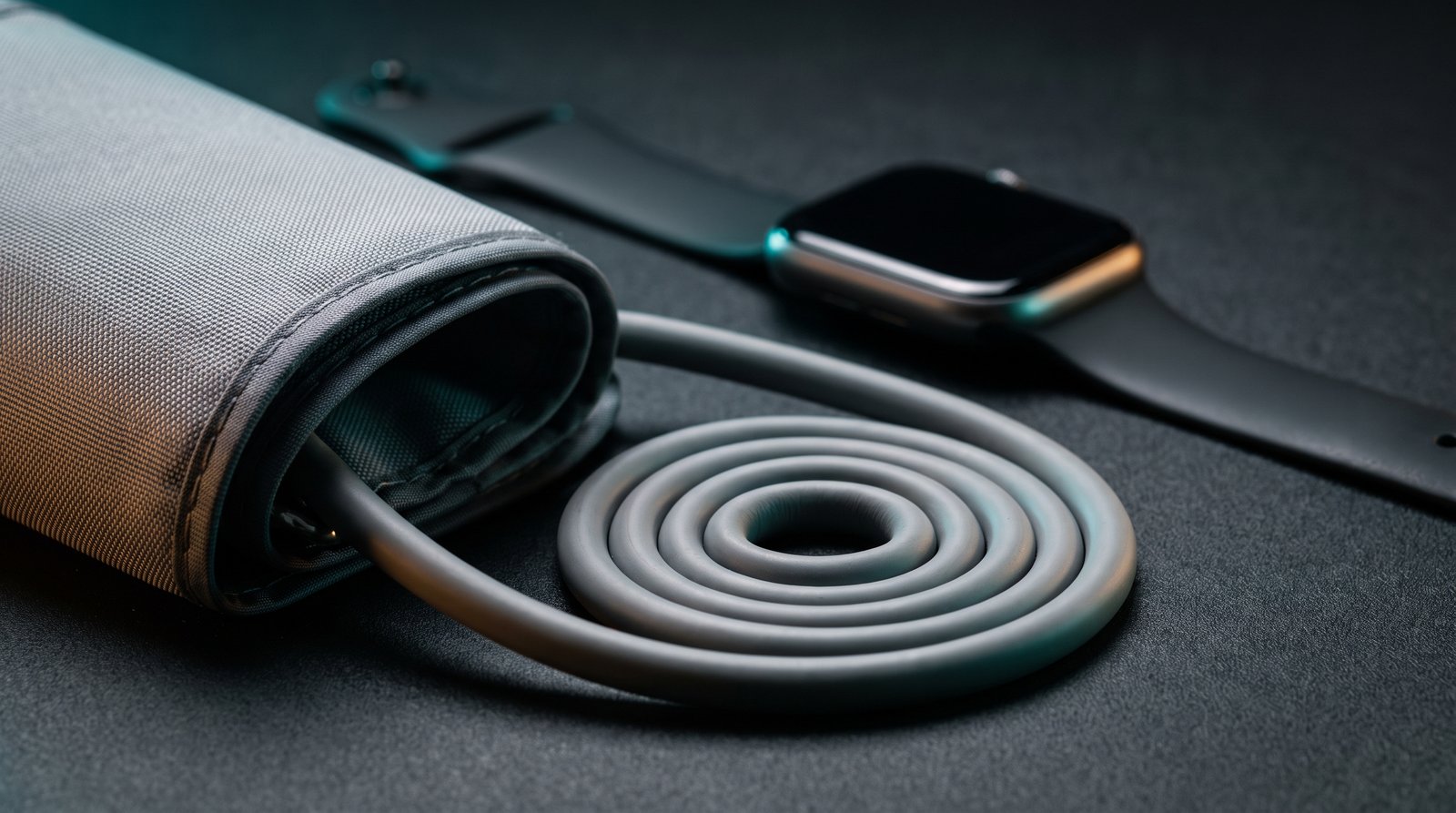
The verdict
Cohort and meta-analytic evidence for out-of-office measurement with validated cuffs is strong, while cuffless estimation still has no accepted validation protocol and professional bodies advise against clinical use.
How to read this grade: Magellan's evidence scale runs 4 = Strong (multiple consistent human studies), 3 = Mixed (human trials that disagree or support only part of the claim), 2 = Early (small, short or uncontrolled human studies), 1 = Preclinical only (animal or laboratory data with no human efficacy result). It grades the strength of the published evidence behind the claim, not the build quality, value or popularity of any product, and it is not a user rating. Grades are set independently of affiliate commissions. How we grade →
Who should buy
A validated upper-arm cuff, chosen from the validated-device list first and the price second.
Who should skip
Any cuffless wristband or watch sold as a blood pressure monitor.
The bottom line
Out-of-office blood pressure carries prognostic information that clinic readings do not, but only a minority of home cuffs sold online has ever passed a validation protocol - and cuffless devices have no generally accepted protocol to pass. Look the model up in a validated-device database before you look at the price.
What to look for
| Checkpoint | What the evidence says |
|---|---|
| Upper-arm cuff | Not a wrist cuff or a wristband |
| Checkpoint 2 | Model number listed in the STRIDE BP validated-device database |
| Checkpoint 3 | Validation study within the last 10 years using ISO 81060-2:2018, ANSI/AAMI/ISO 2013 or 2009, or ESH-IP 2010 |
| Checkpoint 4 | Read home readings against home thresholds (about 133/82), not the clinic 140/90 |
The full story
Blood pressure is one of the very few numbers in consumer health with a hard outcome attached to it, and the strongest evidence is for measuring it away from the clinic. A meta-analysis of nine cohorts in the Journal of Hypertension, covering 9299 participants and 881 events, found that each 10 mmHg of additional 24-hour ambulatory systolic pressure carried a hazard ratio of 1.27 for combined cardiovascular events. Adjust for the office reading and it only fell to 1.21. That second figure is the one that matters: out-of-office pressure is not a convenient stand-in for the cuff in the exam room. It knows things the exam room does not.
Which makes the hardware question unusually consequential, and explains why the wearable industry's most seductive promise - a watch or a ring that reports your pressure continuously, no squeezing, no interruption - keeps hitting the same wall. In December 2025, releasing a scientific statement on cuffless devices, the American Heart Association put it about as bluntly as a professional body ever does.
Cuffless blood pressure devices "should not be used at this time to diagnose, track or treat high blood pressure."
Home numbers are not clinic numbers
If you are going to measure at home, the goalposts move. An international pooling study in Hypertension followed 6470 participants from five population cohorts for a median of 8.3 years, accrued 716 cardiovascular endpoints, and then worked backwards to ask which home reading carries the same ten-year risk as a clinic 140/90 mmHg. The answer was 133.4/82.2 mmHg overall, and 131.9/82.4 mmHg among the 5018 participants who were not on treatment. Home pressure runs lower for the same amount of risk, which means holding your morning readings up against a clinic threshold is a small, systematic act of self-flattery.
The second thing worth knowing before you buy is that the device is not the intervention. An individual-patient-data meta-analysis in PLoS Medicine pooled 25 randomised trials of self-monitoring and found that self-monitoring on its own did not lower blood pressure at all: minus 1.0 mmHg systolic, with a confidence interval running from minus 3.3 to plus 1.2. Combined with intensive support, the same behaviour came with a 6.1 mmHg reduction in clinic systolic pressure at twelve months. Measurement plus a plan does something. Measurement alone is data collection.
Most of the cuffs for sale have never been tested
A survey published in Hypertension catalogued 972 unique home blood pressure devices offered by 59 online businesses in Australia and checked each one against published validation studies. Only 18.3% of the 278 upper-arm cuff devices were validated. Wrist cuffs: 8.0% of 162. Wrist-band wearables: none of 532. International e-commerce platforms stocked 92.4% of everything on offer, and just 5.5% of those were validated. Validated cuffs also cost more - a median of A$101.1 against A$67.4 - which is an unglamorous way of saying that the cheapest result on the page is a coin flip you never see land.
This is not a quirk of one marketplace. A national survey in Hypertension examined 3230 electronic sphygmomanometers actually in use across 58 Chinese cities and found that the weighted proportion of accuracy-validated devices was 23.0% in households and 33.9% in health care institutions. The professionals do better, but not by much, and 8.8% of the devices in secondary hospitals were wrist-type. Writing in the Journal of Hypertension, the Lancet Commission on Hypertension group counted over 3000 commercially available devices, many with no published accuracy testing against established scientific standards, and blamed weak or absent regulation. Its primary recommendation: mandatory independent validation to the ISO standard.
What is actually known about cuffless
Less than the marketing implies. A systematic review and meta-analysis in European Heart Journal - Digital Health screened 430 studies of wearable cuffless monitors and found only 16 that reported validation at all, covering 15 devices and 974 participants. Photoplethysmography - the optical trick your watch uses for heart rate - accounted for 81.3%. Eight of the 15 had a mean bias under 5 mmHg. The pooled mean difference against a reference was 3.42 mmHg systolic, but with a confidence interval from minus 2.17 to 9.01 and heterogeneity of 95.4%, which is statistical language for "these devices do not behave alike." The review also flagged its own limitation: its definition of validity excluded measurement precision, the standard deviation of the differences, which the ISO criteria require.
Underneath the accuracy problem sits a standards problem. A 2021 review in Hypertension noted that the 2018 AAMI/ESH/ISO Universal Standard - the protocol that validates ordinary cuffs - is inappropriate for validating cuffless devices, and that the 2021 European Society of Hypertension guidelines do not recommend cuffless devices for clinical use. By 2023, when the ESH published its own validation recommendations in the Journal of Hypertension, there were still no generally accepted protocols. The ESH proposed six separate tests for intermittent cuffless devices: static accuracy, device position to probe hydrostatic pressure, treatment, awake and asleep, exercise, and a recalibration test assessing whether cuff calibration holds over time. That last one exists because a cuffless reading is usually a model anchored to a cuff measurement, and models drift.
What the evidence does not show
It does not show that cuffless estimation is hopeless. Eight of fifteen devices reaching a mean bias under 5 mmHg is not nothing - it is simply the wrong metric on its own, because a device that reads 15 too high half the time and 15 too low the rest has an immaculate mean bias and no clinical use. The AHA statement is careful here too: international accuracy standards exist for some but not all of these devices, they do not assess typical real-world use, and several currently available devices have been cleared by the FDA and are in clinical use - and the AHA still concludes they may be inappropriate for it. Clearance is a regulatory status, not an accuracy result.
Nor does any of this show that a validated cuff will improve your health by itself; the self-monitoring trials say the opposite. The wrist question also stays open: validated wrist-cuff devices exist, they are simply far rarer, and nothing here compares wrist against upper arm head to head.
What to buy, and in what order
- Start with the list, not the listing. STRIDE BP - a joint initiative with the European Society of Hypertension, the International Society of Hypertension and the World Hypertension League - publishes a searchable database of 591 validated monitors. Look up the model number there before the retailer's star rating.
- Prefer an upper-arm cuff. STRIDE BP's stated preference is upper-arm cuff devices with at least one approved validation study published in the last ten years using a recent protocol: the AAMI/ESH/ISO Universal Standard ISO 81060-2:2018, the 2013 or 2009 ANSI/AAMI/ISO standards, or ESH-IP 2010. Its listings cover upper-arm, wrist-cuff and wrist-watch cuff devices only. No cuffless device appears on it.
- Expect to pay a little more. In the Australian survey the validated cuffs were the pricier ones; cheapness is informative here, and not in your favour.
- Read your readings against home thresholds. The outcome-driven equivalents of a clinic 140/90 were roughly 133/82 at home. Using the clinic cut-off on home numbers is comparing two different scales.
- Already own a cuffless wearable? The AHA's position is that it should not be used to diagnose, track or treat blood pressure, and that a validated arm cuff is what to use instead. It should not be the number you quote to a clinician.
The mildly deflating conclusion is that the state of the art here is the boring inflatable thing - and it is genuinely good, provided it is one of the minority that has been checked. Cuffless will probably arrive; the ESH has already written the exam it will have to sit, complete with a drift test. Until a device passes something like that, an unvalidated reading is not a lower-quality number, it is an unknown one. Unknown numbers are worse than no number at all, because you will act on them anyway.
The gear in this story
Inclusion means the story discusses it — read the verdict and the checklist above before buying. Product pages carry the full citation list and the evidence grade, and grades are set before any affiliate relationship is considered.
Questions this story answers
Which home blood pressure monitor is worth buying?
A validated upper-arm cuff, chosen from the validated-device list first and the price second.
Who should skip it?
Any cuffless wristband or watch sold as a blood pressure monitor.
How strong is the evidence?
Mixed evidence. Cohort and meta-analytic evidence for out-of-office measurement with validated cuffs is strong, while cuffless estimation still has no accepted validation protocol and professional bodies advise against clinical use.
What is the bottom line?
Out-of-office blood pressure carries prognostic information that clinic readings do not, but only a minority of home cuffs sold online has ever passed a validation protocol - and cuffless devices have no generally accepted protocol to pass. Look the model up in a validated-device database before you look at the price.
Sources
10 peer-reviewed papers plus 2 regulatory, guideline or trade documents. Every claim above traces to this list.
- Nonvalidated Home Blood Pressure Devices Dominate the Online Marketplace in Australia: Major Implications for Cardiovascular Risk ManagementHypertension 2020 · PubMed · PMID 32275193 ↗ · doi:10.1161/HYPERTENSIONAHA.120.14719 ↗
- Cuffless Devices for the Measurement of Blood Pressure: A Scientific Statement From the American Heart AssociationHypertension 2026 · PubMed · PMID 41376592 ↗ · doi:10.1161/HYP.0000000000000254 ↗
- Evaluation of the Accuracy of Cuffless Blood Pressure Measurement Devices: Challenges and ProposalsHypertension 2021 · PubMed · PMID 34510915 ↗ · doi:10.1161/HYPERTENSIONAHA.121.17747 ↗
- European Society of Hypertension recommendations for the validation of cuffless blood pressure measuring devices: European Society of Hypertension Working Group on Blood Pressure Monitoring and Cardiovascular VariabilityJ Hypertens 2023 · PubMed · PMID 37303198 ↗ · doi:10.1097/HJH.0000000000003483 ↗
- Wearable cuffless blood pressure monitoring devices: a systematic review and meta-analysisEur Heart J Digit Health 2022 · PubMed · PMID 36713001 ↗ · doi:10.1093/ehjdh/ztac021 ↗
- Lancet Commission on Hypertension group position statement on the global improvement of accuracy standards for devices that measure blood pressureJ Hypertens 2020 · PubMed · PMID 31790375 ↗ · doi:10.1097/HJH.0000000000002246 ↗
- Validation Status of Electronic Sphygmomanometers in China: A National SurveyHypertension 2025 · PubMed · PMID 39807594 ↗ · doi:10.1161/HYPERTENSIONAHA.124.24203 ↗
- Outcome-driven thresholds for home blood pressure measurement: international database of home blood pressure in relation to cardiovascular outcomeHypertension 2013 · PubMed · PMID 23129700 ↗ · doi:10.1161/HYPERTENSIONAHA.111.00100 ↗
- Noninvasive 24-h ambulatory blood pressure and cardiovascular disease: a systematic review and meta-analysisJ Hypertens 2008 · PubMed · PMID 18550999 ↗ · doi:10.1097/HJH.0b013e3282f97854 ↗
- Self-monitoring of blood pressure in hypertension: A systematic review and individual patient data meta-analysisPLoS Med 2017 · PubMed · PMID 28926573 ↗ · doi:10.1371/journal.pmed.1002389 ↗
Regulatory, guideline and trade sources
- STRIDE BP validated blood pressure monitors databaseSTRIDE BP (joint initiative with the European Society of Hypertension, International Society of Hypertension and World Hypertension League) · 2026 · Read the source ↗
- Cuffless blood pressure technologies in wearable devices show promise to transform careAmerican Heart Association Newsroom · 2025 · Read the source ↗
Related on Magellan
More from the Wearables & Sensors beat, and from the rest of the tech desk.
Consumer sleep trackers are good at telling sleep from wake and mediocre at staging it. The validation studies are unusually…
Heart-rate variability is genuinely linked to mortality. Your overnight RMSSD is still mostly telling you about last night's…
The sensors are accurate enough. The interpretation — spikes, variability, 'personalised nutrition' — is where the evidence gets…
One particle, one measurement, and a cleaner line to risk than the LDL-C most labs report by default.
Photobiomodulation has decent randomised evidence for skin and pain, a biphasic dose curve, and a marketing layer far ahead of…
Molecule and marker monographs: Blood pressure · Arterial stiffness · Nitric oxide
Evidence guides: The longevity supplement guide · Longevity research map