Neurotech for Aging Brains: Implants, Ultrasound, and a Lot of Electrodes
Neurotech for Aging Brains — Magellan evidence grade: Mixed — four of the six showed a mean amyloid decrease of 14.9 Centiloids. Alzforum also records that several studies failed to replicate the original mouse findings - one reporting plaque growth, another finding that native gamma oscillation entrainment, amyloid lowering and microglial activation were not replicated.
Source: Neurology 2023, PMID 36639237 ↗ · How Magellan grades evidence · Research map · evidence confidence: high
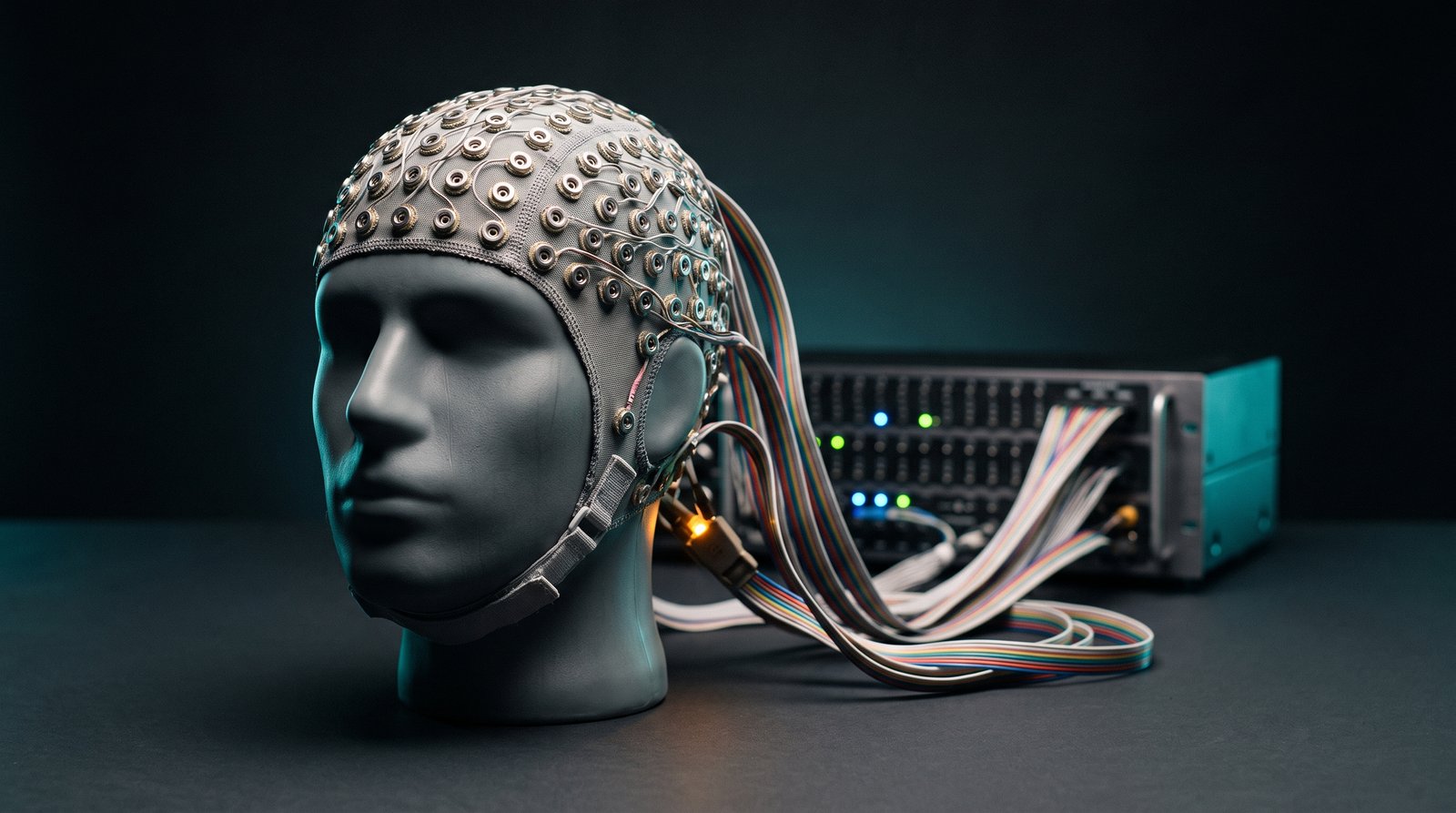
Brain-computer interfaces are real and are not for aging. The non-invasive stimulation aisle is where the aging claims live, and it is noisy.
The verdict
A meta-analysis of 24 sham-controlled tDCS trials found real episodic-memory gains in older adults, while the flagship gamma-stimulation trial missed all three prespecified primary outcomes and the underlying mouse work has failed independent replication.
How to read this grade: Magellan's evidence scale runs 4 = Strong (multiple consistent human studies), 3 = Mixed (human trials that disagree or support only part of the claim), 2 = Early (small, short or uncontrolled human studies), 1 = Preclinical only (animal or laboratory data with no human efficacy result). It grades the strength of the published evidence behind the claim, not the build quality, value or popularity of any product, and it is not a user rating. Grades are set independently of affiliate commissions. How we grade →
What is worth buying
Nothing you can buy - no consumer headset has been tested, blinded, against a cognitive outcome in older adults.
Who should skip
Skip devices citing the 40 Hz mouse paper; the human trial built to test cognition missed all three primary endpoints.
The bottom line
Implanted brain-computer interfaces are extraordinary and are being tested in paralysis, not aging. On the aging side, sham-controlled tDCS has a positive pooled effect on episodic memory, while the 40 Hz gamma trial that tested cognition missed all three of its primary endpoints.
How to judge a claim in this field
| Checkpoint | What a credible claim shows |
|---|---|
| A sham arm | Not a waitlist or an open-label comparison |
| Checkpoint 2 | A cognitive primary endpoint that was prespecified on a registry and actually met |
| Checkpoint 3 | Independent replication outside the manufacturer's own author list |
| Checkpoint 4 | Stimulation frequency and scalp site matching the trial the claim is based on |
The full story
A man with ALS and severe dysarthria was implanted with four microelectrode arrays and hit 99.6% accuracy on a 50-word vocabulary on his first day, then held 97.5% accuracy at roughly 32 words per minute over 8.4 months. That was reported in 2024 in N Engl J Med, and it is one of the most remarkable things medicine has done this decade. It is also a case report in a single participant with paralysis, and it has nothing to do with aging.
That gap is the whole story of neurotech for aging brains. The implants are astonishing and aimed at people who cannot move or speak. The devices marketed at aging cognition are non-invasive, cheaper, and rest on evidence ranging from a genuinely positive meta-analysis to a company trial that missed all three of its primary endpoints. Sorting one from the other is not hard once you know which questions to ask.
What implants have actually done, and for whom
The largest and longest-running implanted brain-computer interface programme reported its interim safety profile in 2023 in Neurology, and the design line matters: prospective, open-label and nonrandomized. Fourteen adults implanted between 2004 and 2021 accrued 12,203 device-days, with 68 device-related adverse events including six device-related serious adverse events - and no explantations, no intracranial infections and no device-related deaths.
Every participant had quadriparesis from spinal cord injury, brainstem stroke or motor neuron disease. Not one had age-related cognitive decline. The registry entry is equally plain: a single-group open-label study with no masking, whose primary endpoint is the safety of the system at one year post-implant, with completion estimated in 2038. This is an early feasibility programme for tetraplegia - the honest baseline against which every consumer claim about aging brains should be read.
Focused ultrasound: opening a barrier is not treating a disease
Focused ultrasound can transiently open the blood-brain barrier - a real capability. A single-arm, non-randomized phase 1 study in five patients with Parkinson's disease dementia, reported in 2021 in Nat Commun, achieved reversible opening in eight of ten treatments with no serious clinical or radiological side effects. It also found no major changes in amyloid or fluorodeoxyglucose PET, and reported mild cognitive improvement in a descriptive manner only - the authors' phrase, and the right one for five unblinded patients.
An open-label prospective study in 2025 in J Neurosurg gave six Alzheimer's patients three bilateral frontal sessions at two-month intervals. Four of the six showed a mean amyloid decrease of 14.9 Centiloids. The other two showed increased amyloid. Neither group showed a significant change on the Korean Mini-Mental State Examination. In six open-label patients, a four-versus-two split in opposite directions is noise until a controlled trial says otherwise.
The 40 Hz story is one mouse paper and a trial that missed everything
The entire consumer gamma-stimulation category descends from a single 2016 mouse paper in Nature: driving fast-spiking parvalbumin interneurons at 40 Hz optogenetically, and then with non-invasive light flicker, reduced amyloid-beta isoforms in pre-depositing mice and mitigated plaque load in aged depositing mice, with microglial morphological change. It is a beautiful experiment. It is one experiment, in mice.
The human trials are where it gets uncomfortable. A 2021 report in Front Syst Neurosci described a very small randomized cohort with unbalanced allocation - 22 participants, 14 active and eight sham - given an hour of daily 40 Hz audiovisual stimulation over six months, with reduced night-time activity on actigraphy and maintained daily-function scores against decline in sham. It is company-authored, and reports sleep and daily-function measures rather than the trial's cognitive primary endpoints.
Then there is the trial built to test cognition. Cognito Therapeutics' 74-participant Overture study prespecified the Alzheimer's Disease Assessment Scale-Cognitive Subscale as its primary outcome, assessed quarterly over six months - confirmed by the registry, independent of any company statement. According to Alzforum's therapeutics database, Overture missed all three of its primary outcomes: ADAS-Cog, CDR-SB and MADCOMS. The widely circulated 84% and 83% slowing figures on daily function and MMSE were secondary outcomes. The device received FDA breakthrough status in January 2021, and a 345-participant phase 3 began in December 2022 at 38 US sites, which is the correct next step and not a result. Alzforum also records that several studies failed to replicate the original mouse findings - one reporting plaque growth, another finding that native gamma oscillation entrainment, amyloid lowering and microglial activation were not replicated.
A 2024 company-authored MRI analysis in J Alzheimers Dis reported reduced white-matter atrophy and myelin-content loss with active stimulation versus sham, covering 38 participants for white-matter volume and 36 for myelin content out of that same 74-participant study - a subset imaging analysis inside a trial whose prespecified cognitive primary endpoints were not met. That is a hypothesis for the phase 3, not a rescue of the phase 2.
Electrodes on the scalp, and the result nobody sells
The most encouraging non-invasive evidence is also the least glamorous. A 2021 meta-analysis in J Gerontol B Psychol Sci Soc Sci pooled 24 sham-controlled anodal transcranial direct-current stimulation trials in 566 participants over 60 and found episodic-memory improvement immediately after stimulation, Hedges' g of 0.625, and at long-term follow-up, g of 0.404. Its authors note that disagreement exists in the literature and that well-designed randomized trials are still needed to establish optimal protocols. A sham-controlled meta-analysis with a moderate effect and a caveat about protocol heterogeneity is roughly the most honest thing in this article.
The most striking single result is a 2022 study in Nat Neurosci in adults aged 65 to 88: four days of repetitive transcranial alternating current stimulation produced frequency- and site-dissociable gains, low-frequency parietal stimulation improving working memory and high-frequency prefrontal stimulation improving long-term memory, persisting a month, with the largest benefits in participants who started with the lowest cognitive function. The effect depends on exact spatiospectral parameters - which frequency, at which site - that no consumer headset reproduces. A 2023 review in Tzu Chi Med J notes that tDCS and TMS are less ideal with respect to localization. If the mechanism is where and at what frequency, a device controlling neither is not delivering the intervention.
What the evidence does not show
No neurotechnology has been shown to prevent dementia, slow cognitive aging, or improve cognition durably in healthy older adults. The focused-ultrasound work opens a barrier without yet changing a clinical outcome. Gamma stimulation has one mouse paper, replication failures against it, and a trial that missed all three primary endpoints. The tDCS meta-analysis is genuinely positive on episodic memory in sham-controlled trials, and its own authors say the protocols are unsettled. Nowhere in any of this is a headset you can buy that has been tested, blinded, against the outcome you care about.
How to read the next headline about this
- Check the indication and the population. Brain-computer interface results in paralysis say nothing about memory in a 70-year-old. The transfer is assumed by marketing, never demonstrated.
- Find out whether there was a sham arm. Sham stimulation is the only way to separate a real effect from the considerable expectation effect of wearing a device on your head.
- Ask whether the primary endpoint was cognitive - and whether it was met. Imaging subsets, sleep measures and daily-function scales are secondary. A missed cognitive primary is not redeemed by a favourable MRI substudy.
- Look for replication by someone else. One mouse paper plus company-authored human reports is a programme, not a body of evidence, especially when independent groups report failures to replicate.
- Match the parameters. If a trial specifies a frequency and a scalp site, and the consumer device controls neither, it is not the same intervention.
There is real science in this aisle, unevenly distributed. Sham-controlled tDCS for episodic memory in older adults has a positive pooled effect and honest caveats attached by the people who found it. Precisely targeted alternating-current stimulation produced a month-long, dissociable benefit in a single laboratory, and deserves independent replication rather than a retail launch. Gamma stimulation has a phase 3 running, which is exactly what should follow a phase 2 that misses its primaries - and its outcome is genuinely unknown, a more interesting position than either the marketing or the cynicism allows. What none of it supports is buying a headset today on the strength of a mouse.
Questions this story answers
Are consumer neurotech headsets worth it?
Nothing you can buy - no consumer headset has been tested, blinded, against a cognitive outcome in older adults.
Who should skip it?
Skip devices citing the 40 Hz mouse paper; the human trial built to test cognition missed all three primary endpoints.
How strong is the evidence?
Mixed evidence. A meta-analysis of 24 sham-controlled tDCS trials found real episodic-memory gains in older adults, while the flagship gamma-stimulation trial missed all three prespecified primary outcomes and the underlying mouse work has failed independent replication.
What is the bottom line?
Implanted brain-computer interfaces are extraordinary and are being tested in paralysis, not aging. On the aging side, sham-controlled tDCS has a positive pooled effect on episodic memory, while the 40 Hz gamma trial that tested cognition missed all three of its primary endpoints.
Sources
10 peer-reviewed papers plus 3 regulatory, guideline or trade documents. Every claim above traces to this list.
- Interim Safety Profile From the Feasibility Study of the BrainGate Neural Interface SystemNeurology 2023 · PubMed · PMID 36639237 ↗ · doi:10.1212/WNL.0000000000201707 ↗
- An Accurate and Rapidly Calibrating Speech NeuroprosthesisN Engl J Med 2024 · PubMed · PMID 39141853 ↗ · doi:10.1056/NEJMoa2314132 ↗
- Blood-brain barrier opening with focused ultrasound in Parkinson's disease dementiaNat Commun 2021 · PubMed · PMID 33536430 ↗ · doi:10.1038/s41467-021-21022-9 ↗
- Repetitive and extensive focused ultrasound-mediated bilateral frontal blood-brain barrier opening for Alzheimer's diseaseJ Neurosurg 2025 · PubMed · PMID 39793012 ↗ · doi:10.3171/2024.8.JNS24989 ↗
- Gamma frequency entrainment attenuates amyloid load and modifies microgliaNature 2016 · PubMed · PMID 27929004 ↗ · doi:10.1038/nature20587 ↗
- Sensory-Evoked 40-Hz Gamma Oscillation Improves Sleep and Daily Living Activities in Alzheimer's Disease PatientsFront Syst Neurosci 2021 · PubMed · PMID 34630050 ↗ · doi:10.3389/fnsys.2021.746859 ↗
- Noninvasive Gamma Sensory Stimulation May Reduce White Matter and Myelin Loss in Alzheimer's DiseaseJ Alzheimers Dis 2024 · PubMed · PMID 38073386 ↗ · doi:10.3233/JAD-230506 ↗
- Effects of Transcranial Direct Current Stimulation on Episodic Memory in Older Adults: A Meta-analysisJ Gerontol B Psychol Sci Soc Sci 2021 · PubMed · PMID 31782505 ↗ · doi:10.1093/geronb/gbz130 ↗
- Long-lasting, dissociable improvements in working memory and long-term memory in older adults with repetitive neuromodulationNat Neurosci 2022 · PubMed · PMID 35995877 ↗ · doi:10.1038/s41593-022-01132-3 ↗
- Application of transcranial brain stimulation in dementiaTzu Chi Med J 2023 · PubMed · PMID 38035058 ↗ · doi:10.4103/tcmj.tcmj_91_23 ↗
Regulatory, guideline and trade sources
- Sensory Stimulation Systems (Therapeutics database entry)Alzforum · 2023 · Read the source ↗
- Multi-Center Study of Sensory Stimulation to Improve Brain Function (Overture Study), NCT03556280ClinicalTrials.gov (U.S. National Library of Medicine) · 2018 · Read the source ↗
- BrainGate2: Feasibility Study of an Intracortical Neural Interface System for Persons With Tetraplegia, NCT00912041ClinicalTrials.gov (U.S. National Library of Medicine) · 2009 · Read the source ↗
Related on Magellan
More from the Frontier Tech beat, and from the rest of the tech desk.
Turn a cell partway back toward youth and stop before it forgets what it is. Everything hard about this is in the word 'partway'.
Dilute the plasma of an old animal and something improves. Doing it to people is a real trial question with early, small answers.
Dasatinib plus quercetin and fisetin have moved out of mice and into small human studies, with results that are more interesting…
Consumer sleep trackers are good at telling sleep from wake and mediocre at staging it. The validation studies are unusually…
One particle, one measurement, and a cleaner line to risk than the LDL-C most labs report by default.
Molecule and marker monographs: BDNF · Memory · Processing speed · Synapses · Neuroprotection
Long reads: Creatine for muscle and brain
Evidence guides: Creatine · The longevity supplement guide · Longevity research map