Cold Plunges Blunt the Gains You Just Earned. Sometimes That's Fine.
Cold Plunges Blunt the Gains You Just Earned — Magellan evidence grade: Mixed — a 2013 PET study in the Journal of Nuclear Medicine measured activated brown adipose tissue at 32 to 85 grams, a mean of 59.1 grams, in the high-brown-fat group of 25 adults. The mood, immune and brown-fat claims are null or trivially small, so the sensible use is context-dependent rather than daily.
Source: J Physiol 2015, PMID 26174323 ↗ · How Magellan grades evidence · Research map · evidence confidence: high
Cold water immersion reliably makes you feel recovered and can reliably interfere with the adaptation you were training for.
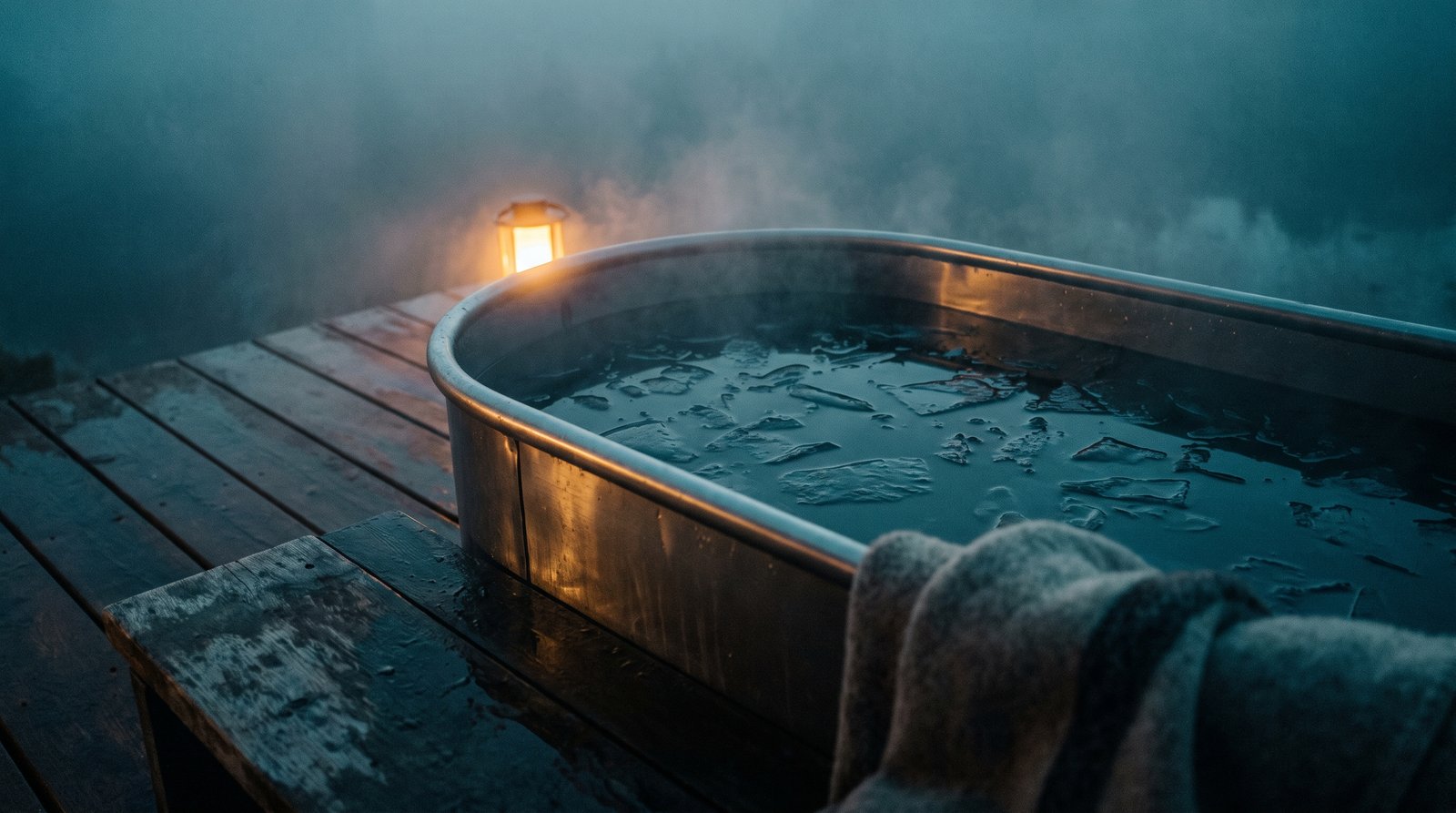
The verdict
Randomised trials consistently show reduced soreness and consistently show blunted muscle-fibre growth after resistance training, while the mood, immune and metabolic claims are null or measured in single-digit calories.
How to read this grade: Magellan's evidence scale runs 4 = Strong (multiple consistent human studies), 3 = Mixed (human trials that disagree or support only part of the claim), 2 = Early (small, short or uncontrolled human studies), 1 = Preclinical only (animal or laboratory data with no human efficacy result). It grades the strength of the published evidence behind the claim, not the build quality, value or popularity of any product, and it is not a user rating. Grades are set independently of affiliate commissions. How we grade →
Who should buy
Buy a tub if soreness and readiness for the next session are what you actually need, in the 10 to 15 minute window at 5 to 15 degrees C.
Who should skip
Skip it after sessions you did for muscle size, and skip it entirely if you are buying it for mood, immunity or fat loss.
The bottom line
Cold water immersion reliably reduces soreness and fatigue, and reliably attenuates type II fibre growth when used after strength training. The mood, immune and brown-fat claims are null or trivially small, so the sensible use is context-dependent rather than daily.
What to look for
| Checkpoint | What the evidence says |
|---|---|
| 10 to 15 minutes at 11 to 15 degrees C was best for soreness | 10 to 15 minutes at 5 to 10 degrees C was best for jump performance and creatine kinase. Colder and longer is not on the curve |
| A waterproof thermometer matters more than chiller wattage | 20 degrees C produced no catecholamine response in the immersion study while 14 degrees C produced a large one |
| Checkpoint 3 | The trials that blunted fibre growth used 10 to 15 minutes immediately after strength training, which is the exposure to move away from lifting days. |
| Checkpoint 4 | Brown fat contributed an estimated 15 to 25 kcal a day of cold-induced thermogenesis, so this is not a metabolism device. |
The full story
Cold water immersion is one of the very few recovery interventions with both a well-documented effect and a well-documented price. The effect is that you feel less sore and less wrecked. The price, if you are lifting to add muscle, is some of the adaptation you just paid for.
What makes this genuinely interesting rather than merely contrarian is that both halves come from randomised trials, and they point in opposite directions. Nearly every argument about cold plunges is really an argument about which half matters to you this month.
Why it feels like it works
Because it does work, for that. A 2012 Cochrane review pooled 17 small trials and 366 participants and found that cold water immersion reduced muscle soreness compared with passive rest or no intervention, with standardised mean differences of -0.55 at 24 hours, -0.66 at 48 hours, -0.93 at 72 hours and -0.58 at 96 hours. Fatigue ratings fell by 1.70 points on a ten-point scale immediately afterwards.
Two caveats sit inside the same review, and they matter. The trials were heterogeneous and of low quality. And there was no detectable difference between cold water immersion and either contrast or warm-water immersion, which quietly suggests that part of what you are buying is immersion, novelty and a decisive end to the training session rather than the specific temperature. Most of those trials also did not actively survey for adverse events.
The cost, measured in muscle fibres
A 2015 trial in the Journal of Physiology is the landmark. Twenty-one physically active men strength-trained twice a week for 12 weeks with either 10 minutes of cold water immersion or active recovery after every session. Strength and muscle mass increased more with active recovery. Isokinetic work rose 19 percent, type II fibre cross-sectional area 17 percent and myonuclei per fibre 26 percent, in the active-recovery group only. A companion study found lower satellite cell numbers and lower p70S6 kinase phosphorylation after exercise with cold immersion, which is the molecular version of the same story.
The authors' stated conclusion: the use of cold water immersion as a regular post-exercise recovery strategy should be reconsidered.
A 2019 trial in the Journal of Applied Physiology adds the nuance that makes this usable. Sixteen men trained three days a week for seven weeks with 15 minutes at 10 degrees C or 15 minutes at 23 degrees C after each session. Leg-press one-repetition maximum improved by a similar amount in both groups, about 130 kg. But type II fibre cross-sectional area gains were attenuated with cold, alongside blunted rps6 phosphorylation at 1 and 48 hours and more FOX-O1 protein. Cold immersion can blunt fibre growth without blunting maximal strength, and the authors advise avoiding it if hypertrophy is the goal.
A 2020 review in the same journal sorts the contexts. For aerobic capacity, lactate threshold, power output and time-trial performance, the effects of regular post-exercise cold immersion are equivocal, and the evidence on muscle angiogenesis and mitochondrial biogenesis is mixed. For strength training, the review describes more consistent evidence that regular cold immersion attenuates gains in muscle mass and strength, attributing it to reduced satellite cell activation, ribosomal biogenesis, anabolic signalling and muscle protein synthesis. If you are training for a time trial, the tradeoff is unresolved. If you are training for size, it is not.
What the evidence does not show
It does not show the mood transformation the category is now sold on. A 2025 meta-analysis in PLoS One pooled 11 randomised studies and 3,177 participants, with water between 7 and 15 degrees C and exposures from 30 seconds to 2 hours. Cold water immersion significantly increased inflammation immediately and again at 1 hour. It reduced stress only at the 12-hour mark, with no significant effect immediately or at 1, 24 or 48 hours. There was no significant effect on immune function and no improvement in mood. Sleep quality and quality of life did improve. The authors flag few randomised trials, small samples and non-diverse populations.
A 2023 study in the Journal of Thermal Biology went after the endorphin story directly. In 16 healthy adults given a single 15-minute immersion at 10 degrees C, positive affect did not change and serum beta-endorphins did not change. Negative affect and cortisol were lower only at 180 minutes afterwards, and the shear-stress changes measured at 30 minutes were, in the authors' own description, minimal.
The famous catecholamine figure is real and routinely misquoted. In a 2000 study in the European Journal of Applied Physiology, one-hour head-out immersion at 14 degrees C raised plasma noradrenaline by 530 percent and dopamine by 250 percent and increased metabolic rate by 350 percent, while adrenaline was unchanged and cortisol tended to fall. Immersion at 20 degrees C produced no such surge despite lowering rectal temperature. That number requires genuinely cold water for a full hour. It is not what happens during three minutes in a tub at a temperature you can chat through.
And the brown fat story has a hard ceiling. A 2013 PET study in the Journal of Nuclear Medicine measured activated brown adipose tissue at 32 to 85 grams, a mean of 59.1 grams, in the high-brown-fat group of 25 adults. Its oxidative metabolism contributed a mean 3.2 kcal a day at rest and 6.3 kcal a day during mild cold, and the authors estimated cold-induced brown-fat thermogenesis at 15 to 25 kcal a day in people with relatively large depots, concluding that brown fat is a minor source of thermogenesis in humans. That is a rounding error against any plausible fat-loss claim.
The dose the trials used, and the part that can hurt you
A 2025 network meta-analysis in Frontiers in Physiology pooled 55 randomised controlled trials and found two dose windows that beat control, both less extreme than the marketing:
- 10 to 15 minutes at 11 to 15 degrees C was best for soreness.
- 10 to 15 minutes at 5 to 10 degrees C was best for jump performance and for creatine kinase.
Nothing in that analysis rewards going colder or staying longer. Which makes a cheap waterproof thermometer a more useful purchase than a bigger chiller, because 20 degrees C and 14 degrees C are physiologically different situations and you cannot reliably tell them apart by feel once you are shivering.
The safety literature deserves a paragraph rather than a footnote. A 2012 review in the Journal of Physiology documents a high incidence of cardiac arrhythmias in healthy volunteers during cold water submersion, because submersion and the release of breath-holding simultaneously activate the sympathetically driven cold shock response, which produces tachycardia, and the parasympathetically mediated diving response, which produces bradycardia. The authors call this autonomic conflict and propose that it explains those arrhythmias and, in vulnerable people, some deaths previously attributed to drowning or hypothermia. Minnesota's Department of Natural Resources describes the first two to three minutes of sudden cold immersion as a period of gasping, hyperventilation and panic. Neither source is describing a supervised tub in a garage, but both are describing the physiology a tub recruits.
The reasonable synthesis is not that cold plunges are a scam. It is that they are a specific tool with a specific cost, and the cost is highest on precisely the days the internet is loudest about using it. If you have a match on Saturday and you lifted on Thursday, the soreness data are on your side. If you are eight weeks into a training block built to add muscle, the fibre data say you are paying real money for a feeling. Buy the tub if you like the tub. Just do not let it audit your training programme.
The gear in this story
Inclusion means the story discusses it — read the verdict and the checklist above before buying. Product pages carry the full citation list and the evidence grade, and grades are set before any affiliate relationship is considered.
Questions this story answers
Is a cold plunge worth it?
Buy a tub if soreness and readiness for the next session are what you actually need, in the 10 to 15 minute window at 5 to 15 degrees C.
Who should skip it?
Skip it after sessions you did for muscle size, and skip it entirely if you are buying it for mood, immunity or fat loss.
How strong is the evidence?
Mixed evidence. Randomised trials consistently show reduced soreness and consistently show blunted muscle-fibre growth after resistance training, while the mood, immune and metabolic claims are null or measured in single-digit calories.
What is the bottom line?
Cold water immersion reliably reduces soreness and fatigue, and reliably attenuates type II fibre growth when used after strength training. The mood, immune and brown-fat claims are null or trivially small, so the sensible use is context-dependent rather than daily.
Sources
10 peer-reviewed papers plus 1 regulatory, guideline or trade document. Every claim above traces to this list.
- Post-exercise cold water immersion attenuates acute anabolic signalling and long-term adaptations in muscle to strength trainingJ Physiol 2015 · PubMed · PMID 26174323 ↗ · doi:10.1113/JP270570 ↗
- Cold water immersion attenuates anabolic signaling and skeletal muscle fiber hypertrophy, but not strength gain, following whole-body resistance trainingJ Appl Physiol (1985) 2019 · PubMed · PMID 31513450 ↗ · doi:10.1152/japplphysiol.00127.2019 ↗
- Combining cooling or heating applications with exercise training to enhance performance and muscle adaptationsJ Appl Physiol (1985) 2020 · PubMed · PMID 32644914 ↗ · doi:10.1152/japplphysiol.00322.2020 ↗
- Cold-water immersion (cryotherapy) for preventing and treating muscle soreness after exerciseCochrane Database Syst Rev 2012 · PubMed · PMID 22336838 ↗ · doi:10.1002/14651858.CD008262.pub2 ↗
- Impact of different doses of cold water immersion (duration and temperature variations) on recovery from acute exercise-induced muscle damage: a network meta-analysisFront Physiol 2025 · PubMed · PMID 40078372 ↗ · doi:10.3389/fphys.2025.1525726 ↗
- Human physiological responses to immersion into water of different temperaturesEur J Appl Physiol 2000 · PubMed · PMID 10751106 ↗ · doi:10.1007/s004210050065 ↗
- 15O PET measurement of blood flow and oxygen consumption in cold-activated human brown fatJ Nucl Med 2013 · PubMed · PMID 23362317 ↗ · doi:10.2967/jnumed.112.111336 ↗
- Effects of cold-water immersion on health and wellbeing: A systematic review and meta-analysisPLoS One 2025 · PubMed · PMID 39879231 ↗ · doi:10.1371/journal.pone.0317615 ↗
- Cardiovascular and mood responses to an acute bout of cold water immersionJ Therm Biol 2023 · PubMed · PMID 37866096 ↗ · doi:10.1016/j.jtherbio.2023.103727 ↗
- 'Autonomic conflict': a different way to die during cold water immersion?J Physiol 2012 · PubMed · PMID 22547634 ↗ · doi:10.1113/jphysiol.2012.229864 ↗
Regulatory, guideline and trade sources
- Cold water dangersMinnesota Department of Natural Resources · 2026 · Read the source ↗
Related on Magellan
More from the Recovery, Light & Heat beat, and from the rest of the tech desk.
Photobiomodulation has decent randomised evidence for skin and pain, a biphasic dose curve, and a marketing layer far ahead of…
The Finnish cohort numbers are striking. They are also observational, and the people who sauna four times a week differ in other…
Intermittent pneumatic compression is mostly a comfort device. Blood flow restriction training has a surprisingly deep trial…
Consumer sleep trackers are good at telling sleep from wake and mediocre at staging it. The validation studies are unusually…
One particle, one measurement, and a cleaner line to risk than the LDL-C most labs report by default.
Molecule and marker monographs: Skeletal muscle · Satellite cells · Exercise
Long reads: Creatine for muscle and brain
Evidence guides: Creatine · The longevity supplement guide · Longevity research map