Compression Boots and Blood Flow Restriction: One Is Better Studied Than You'd Guess
Compression Boots and Blood Flow Restriction — Magellan evidence grade: Mixed — a 2019 meta-analysis in Sports Med covering 11 studies and 238 older adults found that adding restriction to low-load training produced far greater strength gains than the same light training alone, with a pooled effect size of 2.16. Heart rate did not change.
Source: Biol Sport 2024, PMID 39416507 ↗ · pneumatic compression recovery boots · blood flow restriction cuffs · How Magellan grades evidence · Research map · evidence confidence: high
Intermittent pneumatic compression is mostly a comfort device. Blood flow restriction training has a surprisingly deep trial literature.
The verdict
Two devices in one category with opposite profiles: compression has multiple meta-analyses landing on trivial-to-small or frankly null effects, while blood flow restriction has replicated meta-analytic support for strength and hypertrophy alongside a blinded, sham-controlled null in post-surgical rehabilitation.
How to read this grade: Magellan's evidence scale runs 4 = Strong (multiple consistent human studies), 3 = Mixed (human trials that disagree or support only part of the claim), 2 = Early (small, short or uncontrolled human studies), 1 = Preclinical only (animal or laboratory data with no human efficacy result). It grades the strength of the published evidence behind the claim, not the build quality, value or popularity of any product, and it is not a user rating. Grades are set independently of affiliate commissions. How we grade →
Who should buy
Buy the cuffs if you will measure limb occlusion pressure rather than trust a preset, and buy the boots only if you are knowingly buying comfort.
Who should skip
Skip the boots if you expect them to change performance, and skip the cuffs if your plan is to set them to 200 mmHg and hope.
The bottom line
Pneumatic compression reliably changes how sore you feel and reliably fails to change what you can do, with one moderate-certainty meta-analysis finding no soreness benefit at 24 hours at all. Blood flow restriction has the deeper evidence base - similar hypertrophy to heavy lifting, less strength - but produced a clean null after ACL reconstruction, and its cuff pressures are meaningless unless referenced to your own limb occlusion pressure.
What to look for
| Checkpoint | What the evidence says |
|---|---|
| Compression trials cluster at 20-30 minutes near 80 mmHg | A boot whose selling point is higher pressure is not offering more evidence |
| A blood flow restriction cuff pressure in mmHg means nothing without limb occlusion pressure | The pressure research used cuffs 9-13 cm wide |
| Checkpoint 3 | Preset settings of 200 or 300 mmHg exceeded full limb occlusion under Doppler, so treat pressure charts as guesses that err high. |
| Judge compression on comfort and soreness, not output | Performance effects were trivial or non-significant in every trial here |
The full story
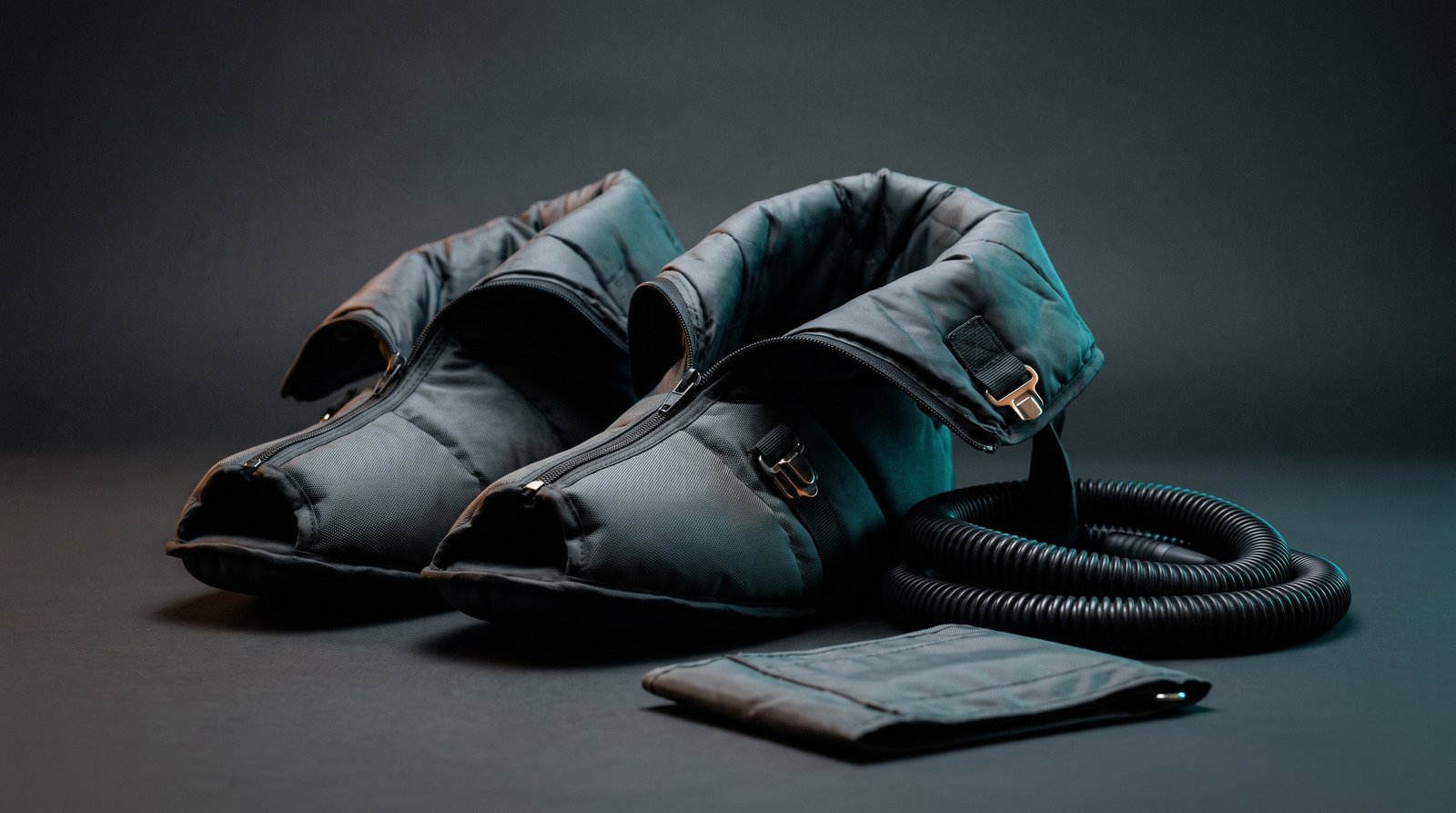
Two devices, both strapped to the legs, both sold as recovery technology, and the evidence runs backwards from the marketing budget. The pneumatic boots - the ones in every photograph of an athlete reclining with a laptop - have a research base that keeps arriving at the same uncomfortable place: you feel better, and that is most of what happens. The nylon cuffs that look like a blood pressure sleeve and cost a fraction as much have a trial literature deep enough that reasonable people argue about subgroups.
Neither of those sentences is a takedown. Feeling less sore is worth something, and a training method that builds muscle at loads a deconditioned or post-operative limb can tolerate is worth a great deal. But the two devices ask you to believe different kinds of claims, and only one of them has the trials to support the strong version.
The boots move blood, then stop
Intermittent pneumatic compression does something measurable while it is running. In a double-blinded randomised crossover study of 22 athletes published in Int J Sports Physiol Perform in 2024, compression raised systolic and end-diastolic peak blood-flow velocities during the protocol, with larger effects at 200 mmHg than at 80 mmHg. Heart rate did not change. And within two minutes of the pump switching off, the haemodynamic variables had returned close to baseline.
Read that last clause twice, because it defines the category. The mechanism is real and it is transient. Whatever the boots deliver has to survive the two-minute mark on its own.
Soreness is not recovery
A 2024 systematic review and meta-analysis in Biol Sport pooled 17 studies and 319 participants and found lower-limb intermittent pneumatic compression produced only trivial-to-small benefit for muscular function, trivial-to-moderate effects on pain and soreness, and highly variable effects on markers of muscle damage. The protocols people actually used clustered at 20 to 30 minutes around 80 mmHg, which is worth knowing: the settings with trial data behind them are the modest ones, not the top of the dial.
A randomised within-subject trial in J Strength Cond Res in 2022 fitted a sequential compression sleeve to 50 resistance-trained athletes after upper-body work and found perceived soreness significantly lower immediately afterwards and at 24 hours, across every muscle group tested. Effects on physical performance were trivial or not significant. Clean result, narrow result: the device changed how the arm felt, not what it could do.
Blood flow restriction, the unexpected heavyweight
Now the cuffs. A 2018 systematic review and meta-analysis in Sports Med compared heavy resistance training against low-load training with blood-flow restriction and found the split that has held up since: high loads produced greater maximal strength gains, while muscle growth was similar between the two - and similar regardless of absolute occlusion pressure, cuff width, or the method used to prescribe pressure.
In older adults the numbers get more interesting. A 2019 meta-analysis in Sports Med covering 11 studies and 238 older adults found that adding restriction to low-load training produced far greater strength gains than the same light training alone, with a pooled effect size of 2.16. Measured against heavy training, restricted light work gave similar hypertrophy and smaller strength gains. A 2022 meta-analysis in J Clin Med, 14 studies in adults older than 60, reproduced the pattern almost exactly: better than light training alone on both strength and size, statistically indistinguishable from heavy training on hypertrophy, modestly behind heavy training on strength.
That is a replicated finding across independent reviews, and it is the most defensible claim in the leg-strapping aisle. Light loads plus a cuff behave more like heavy loads than light loads have any business behaving.
What the evidence does not show
Start with the boots. A 2025 systematic review with meta-analysis in J Bodyw Mov Ther, 19 randomised trials and 672 participants, reported moderate-certainty evidence that intermittent pneumatic compression does not reduce muscle soreness at 24 hours after the intervention. The mean difference was -2.20 points, with a confidence interval running from -10.08 to 5.68 - wide enough to contain zero and both directions of effect. Moderate certainty on a null result is about as close as this field comes to a shrug on the record, and it sits directly against the positive soreness signal from the arm-sleeve trial. Same intervention, same outcome, same time point, opposite answers.
Then the cuffs, in the exact setting where they are marketed hardest. A double-blind randomised trial with a placebo and sham condition, published in Med Sci Sports Exerc in 2025, followed 48 athletes from one month before anterior cruciate ligament reconstruction through four to five months after surgery. Adding blood-flow-restriction training to standard rehabilitation produced no significant between-group difference in anything measured: not quadriceps strength, not muscle morphology on MRI, not muscle physiology on biopsy, not knee biomechanics. Blinded, sham-controlled, multicentre, negative.
Hold both findings at once, because they are not actually contradictory. Restriction training has good evidence for building strength and size in healthy and older adults, and a clean null in post-surgical ACL rehabilitation. Those are different questions. The marketing collapses them.
How to read a pressure number
The most useful paper in this whole file is a 2023 study in J Sport Rehabil that measured limb occlusion pressure by Doppler ultrasound in 75 participants using 9 to 13 cm cuffs. Fixed pressures taken off a chart landed at roughly 120 to 190 percent of the pressure needed to occlude the limb completely. The familiar settings of 200 and 300 mmHg far exceeded full occlusion. By contrast, 100 mmHg, or a pressure equal to resting brachial systolic pressure, fell into a 60 to 80 percent band, and 130 percent of resting brachial systolic pressure approximated full occlusion.
So a cuff advertising a number in mmHg is advertising almost nothing. The same setting is a moderate stimulus on one limb and a tourniquet on another, and in that study the errors ran consistently high. Any protocol that never references your own occlusion pressure is guessing.
Which brings up the part of the file the boot companies never have to write. A 2022 literature review in Mil Med pooled case reports, case series, national surveys, questionnaires and randomised studies and found 1,672 of 25,813 individuals reporting an adverse event after blood-flow-restriction therapy, most often numbness, dizziness, subcutaneous haemorrhage and rhabdomyolysis. Isolated serious events included central retinal vein occlusion and Paget-Schroetter syndrome, in people with comorbidities such as hypertension and thoracic outlet syndrome. That is not a reason for a healthy adult to panic. It is a reason the cuff belongs in a conversation with someone who knows your medical history, which is a sentence nobody has ever needed to say about inflatable boots.
So here is the honest hierarchy. The boots are a comfort device with a two-minute mechanical afterlife and a soreness signal that survives one meta-analysis and not the next. The cuffs are a real training tool, and the reason they deserve respect is the same reason they work: they are doing something to your circulation. If you like how the boots feel, that is a legitimate reason to own a pair, and you do not have to invoke lymphatic drainage to justify it. If you want the cuffs, the first thing to acquire is not the cuffs - it is a way of knowing what pressure you are actually applying.
The gear in this story
Inclusion means the story discusses it — read the verdict and the checklist above before buying. Product pages carry the full citation list and the evidence grade, and grades are set before any affiliate relationship is considered.
Questions this story answers
Are compression boots or BFR cuffs worth it?
Buy the cuffs if you will measure limb occlusion pressure rather than trust a preset, and buy the boots only if you are knowingly buying comfort.
Who should skip it?
Skip the boots if you expect them to change performance, and skip the cuffs if your plan is to set them to 200 mmHg and hope.
How strong is the evidence?
Mixed evidence. Two devices in one category with opposite profiles: compression has multiple meta-analyses landing on trivial-to-small or frankly null effects, while blood flow restriction has replicated meta-analytic support for strength and hypertrophy alongside a blinded, sham-controlled null in post-surgical rehabilitation.
What is the bottom line?
Pneumatic compression reliably changes how sore you feel and reliably fails to change what you can do, with one moderate-certainty meta-analysis finding no soreness benefit at 24 hours at all. Blood flow restriction has the deeper evidence base - similar hypertrophy to heavy lifting, less strength - but produced a clean null after ACL reconstruction, and its cuff pressures are meaningless unless referenced to your own limb occlusion pressure.
Sources
10 peer-reviewed papers. Every claim above traces to this list.
- Effects of lower-limb intermittent pneumatic compression on sports recovery: A systematic review and meta-analysisBiol Sport 2024 · PubMed · PMID 39416507 ↗ · doi:10.5114/biolsport.2024.133665 ↗ · Plain-English write-up →
- Effects of photobiomodulation, intermittent pneumatic compression and neuromuscular electrical stimulation on muscle recovery: Systematic review with meta-analysisJ Bodyw Mov Ther 2025 · PubMed · PMID 40954632 ↗ · doi:10.1016/j.jbmt.2025.06.021 ↗
- Investigating the Use of an Intermittent Sequential Pneumatic Compression Arm Sleeve for Recovery After Upper-Body ExerciseJ Strength Cond Res 2022 · PubMed · PMID 35622105 ↗ · doi:10.1519/JSC.0000000000003680 ↗
- Hemodynamic Effects of Intermittent Pneumatic Compression on Athletes: A Double-Blinded Randomized Crossover StudyInt J Sports Physiol Perform 2024 · PubMed · PMID 39043362 ↗ · doi:10.1123/ijspp.2024-0017 ↗
- Magnitude of Muscle Strength and Mass Adaptations Between High-Load Resistance Training Versus Low-Load Resistance Training Associated with Blood-Flow Restriction: A Systematic Review and Meta-AnalysisSports Med 2018 · PubMed · PMID 29043659 ↗ · doi:10.1007/s40279-017-0795-y ↗ · Plain-English write-up →
- Effects of Blood Flow Restriction Training on Muscular Strength and Hypertrophy in Older Individuals: A Systematic Review and Meta-AnalysisSports Med 2019 · PubMed · PMID 30306467 ↗ · doi:10.1007/s40279-018-0994-1 ↗ · Plain-English write-up →
- Effects of Low-Load Blood Flow Restriction Resistance Training on Muscle Strength and Hypertrophy Compared with Traditional Resistance Training in Healthy Adults Older Than 60 Years: Systematic Review and Meta-AnalysisJ Clin Med 2022 · PubMed · PMID 36556004 ↗ · doi:10.3390/jcm11247389 ↗
- The Efficacy of Blood Flow Restriction Training to Improve Quadriceps Muscle Function after Anterior Cruciate Ligament ReconstructionMed Sci Sports Exerc 2025 · PubMed · PMID 39350350 ↗ · doi:10.1249/MSS.0000000000003573 ↗
- Blood Flow Restriction Training in Clinical Rehabilitation: Occlusion Pressure Methods Relative to the Limb Occlusion PressureJ Sport Rehabil 2023 · PubMed · PMID 36640776 ↗ · doi:10.1123/jsr.2022-0240 ↗
- Overall Safety and Risks Associated with Blood Flow Restriction Therapy: A Literature ReviewMil Med 2022 · PubMed · PMID 35284924 ↗ · doi:10.1093/milmed/usac055 ↗
Related on Magellan
More from the Recovery, Light & Heat beat, and from the rest of the tech desk.
Photobiomodulation has decent randomised evidence for skin and pain, a biphasic dose curve, and a marketing layer far ahead of…
The Finnish cohort numbers are striking. They are also observational, and the people who sauna four times a week differ in other…
Cold water immersion reliably makes you feel recovered and can reliably interfere with the adaptation you were training for.
Consumer sleep trackers are good at telling sleep from wake and mediocre at staging it. The validation studies are unusually…
One particle, one measurement, and a cleaner line to risk than the LDL-C most labs report by default.
Molecule and marker monographs: Skeletal muscle · Type II muscle fibres · Grip strength · Myostatin
Long reads: Blood flow restriction cuffs
Evidence guides: The longevity supplement guide · Longevity research map