Quercetin: The Onion's Molecule, the Blood-Pressure Signal, and the Senolytic Detour
Quercetin shows a small blood-pressure effect at higher doses in meta-analyses of randomized trials — but almost everything else claimed for it, including its famous senolytic story, is weaker, narrower, or belongs to a drug combination rather than a capsule.
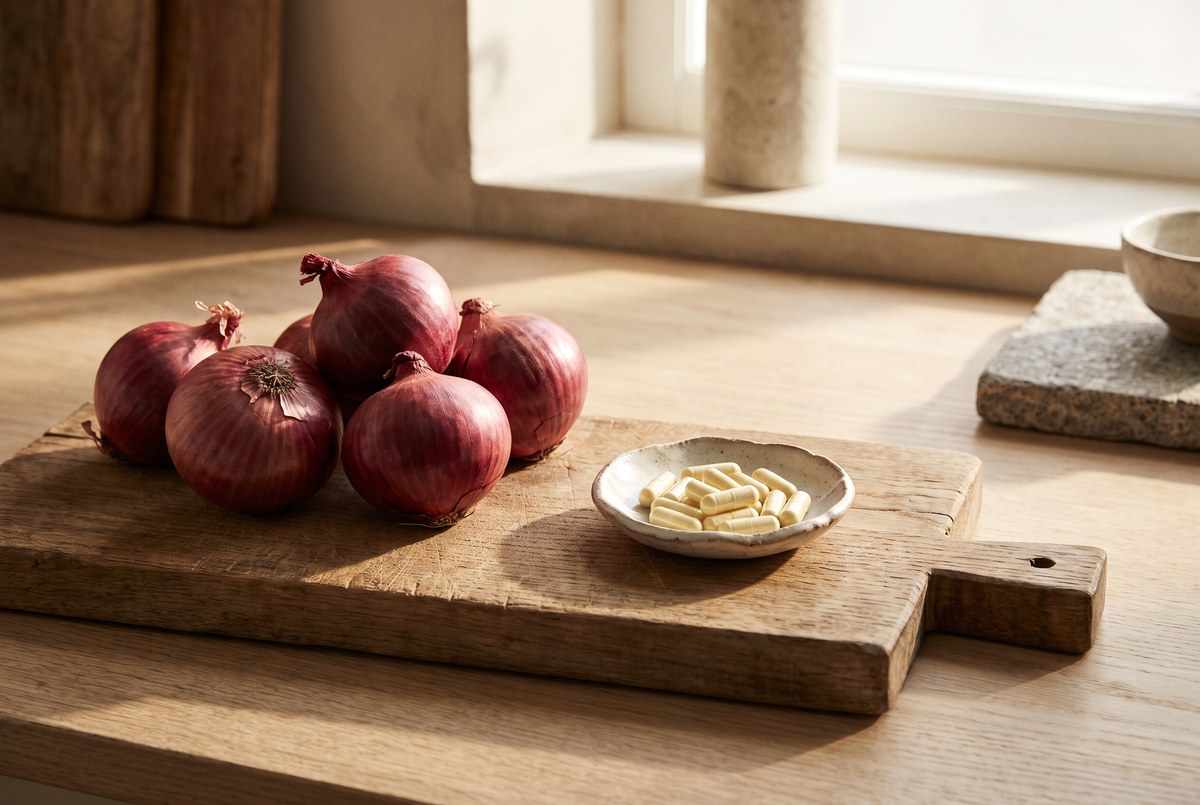
Here's the thing about quercetin, which you have almost certainly eaten today (it is in onions, apples, berries, capers, tea — basically anything a plant does to defend itself, politely, with polyphenols), which is that the molecule is simultaneously one of the most common flavonoids in the human diet and one of the most over-promised capsules in the supplement aisle, and untangling those two facts — the quiet dietary ubiquity on one side, the loud label on the other — is more or less the entire story.
So let's untangle. The claims cluster into three: blood pressure, general metabolic effects, and the senolytic aging story. Only the first survives contact with meta-analysis intact — and even it survives in reduced form. The proposed antihypertensive mechanisms are plausible (improved endothelial nitric-oxide-dependent vasodilation, inhibition of angiotensin-converting enzyme activity, reduced oxidative stress), but plausible mechanisms are the appetizer, not the meal.
The blood-pressure signal is real but small
A 2016 systematic review and meta-analysis of randomized controlled trials in the Journal of the American Heart Association found that quercetin lowers blood pressure; a 2022 review in Current Problems in Cardiology summarized the evidence similarly, as lowering both systolic and diastolic pressure. The size of the effect is the honest part: on the order of 2 to 3 mmHg, most apparent at doses of at least 500 mg per day, and mostly in people who actually have hypertension rather than normal readings. Individual trials are mixed, and a rigorous trial of purified quercetin found no effect on vascular function at all.
Everything metabolic is flat
A 2020 meta-analysis in Nutrition Reviews examined plasma lipids, blood pressure, and glucose together and found no meaningful quercetin effect on lipids, glucose, or insulin measures. Quercetin's poor and highly variable oral bioavailability — the molecule is absorbed badly and inconsistently — likely explains why the effects are small even where they exist. A capsule cannot deliver what the gut will not absorb.
The senolytic story is not about your capsule
Quercetin was one of the first compounds identified as senolytic — able, experimentally, to clear senescent cells — but always in combination with the cancer drug dasatinib. A first-in-human trial of the pair found it cleared senescent cells and lowered inflammatory factors; the largest 2024 randomized trial of the combination was negative overall; an Alzheimer's trial showed only safety and feasibility. Those results belong to a prescription-drug combination in early trials. They do not describe an over-the-counter quercetin capsule, and the leap from one to the other is marketing, not evidence.
The odd outliers in the literature — a preliminary 1999 double-blind trial in Urology in men with category III chronic prostatitis, a 2025 randomized study in Drug Design, Development and Therapy on adjunctive postoperative pain after cesarean section — are single findings in narrow settings: interesting, not generalizable.
So what is a capsule, honestly?
For a reader with normal blood pressure hoping for broad metabolic or anti-aging effects, the controlled evidence offers little. For someone with hypertension taking at least 500 mg daily, the literature supports a small, real, but modest average effect — a few millimeters of mercury, certainty at the meta-analysis-of-small-trials level, and never a substitute for prescribed treatment. And the evidence describes the compound quercetin and its mechanisms, not any specific commercial product.
Which brings us back to the onion. The molecule has always been there, in the diet, in milligram quantities, doing whatever it quietly does. The capsule is a bet that a much larger dose does proportionally larger good — and the trial record, read without hope, says the bet pays out, if at all, in millimeters of mercury. Educational, not medical advice.
The takeaway
The strongest human evidence is a modest ~2–3 mmHg blood-pressure reduction, mainly at ≥500 mg/day in people with hypertension; the senolytic fame comes from the dasatinib-plus-quercetin drug pairing, not over-the-counter quercetin.
References
5 peer-reviewed sources, published 1999–2025, across 5 journals. 3 of them have a full Magellan study write-up linked below.
- Curr Probl Cardiol · 2022 · PMID 35948195 · DOI 10.1016/j.cpcardiol.2022.101350Quercetin supplementation can lower both systolic and diastolic blood pressure depending on the individual's blood pressure status. Read our full write-up →
- J Am Heart Assoc · 2016 · PMID 27405810 · DOI 10.1161/JAHA.115.002713Quercetin supplementation, especially at doses of 500 mg/day or more, may help reduce both systolic and diastolic blood pressure. Read our full write-up →
- Nutr Rev · 2020 · PMID 31940027 · DOI 10.1093/nutrit/nuz071Quercetin supplementation can lower blood pressure and may improve some lipid markers with longer-term use. Read our full write-up →
- Urology · 1999 · PMID 10604689 · DOI 10.1016/s0090-4295(99)00358-1
- Drug Des Devel Ther · 2025 · PMID 40687903 · DOI 10.2147/DDDT.S526188
Mechanisms and molecules in this article
Each links to its Magellan monograph — what it is, what it does, and the studies behind it.
Related reading
A July 2026 Nature Reviews Genetics review from the lab that discovered fisetin's senolytic activity says…
Fisetin, a flavonol, shows promise as a senolytic agent, but human longevity benefits remain to be…
Grape seed extract pools to a systolic blood-pressure reduction of roughly 2–6 mmHg across meta-analyses —…
All Magellan articles → · More on Nutraceuticals & Cellular Energizers →
Prefer the interactive version? Open this article inside the Magellan app →